
Carer's Leave in the UK: One Week of Unpaid Leave a Year, Explained
UK employees can take up to one week of unpaid carer's leave in any 12 months to care for a dependant with a long-term care need. It is a day-one right, can be taken in half or full days, and needs notice of twice the leave or 3 days, whichever is longer.
Under the Carer's Leave Act 2023 and the Carer's Leave Regulations 2024, UK employees can take up to one week of carer's leave in any 12-month period to give or arrange care for a dependant with a long-term care need. Carer's leave is unpaid by law, it applies from the first day of the job, and it can be taken as half days, full days or one continuous week.
Below is how carer's leave works as of 2026: who qualifies, how many days you get, how much notice to give and what your employer can and cannot do.
What is carer's leave?
Carer's leave is a legal right to take time off to give or arrange care for a dependant who has a long-term care need. The Carer's Leave Act 2023 added it to the Employment Rights Act 1996 (Part 8B, section 80J). The detailed rules are in the Carer's Leave Regulations 2024, which came into force on 6 April 2024. They cover anyone who gives notice to take carer's leave on or after that date.
It is a day-one right. You can ask for it from your first day with your employer, and no minimum length of service applies.
How many days of carer's leave do you get?
You get one week in any 12 months. GOV.UK describes a "week" as the number of days you usually work in a week, so the allowance follows your working pattern:
| Working pattern | Carer's leave per 12 months |
|---|---|
| Full time, 5 days a week | 5 days |
| Part time, 3 days a week | 3 days |
| Part time, 2 days a week | 2 days |
The 12 months is not a calendar year or your holiday year. The Regulations count back from the last day of the carer's leave you are asking for, so the period rolls. Before approving a request, look at how much carer's leave the person has taken in the 12 months ending on the last requested day.
The week is a total allowance. If you care for two people, you still get one week in total, not one week for each.
The smallest amount you can take is half a working day, and the most you can take in one go is one continuous week. The days do not have to run together, so you can take a half day for a hospital appointment in March and two full days in September. If your hours vary, Acas says to add up the hours worked in the previous 12 months and divide by 52 to find your weekly allowance.
Is carer's leave paid?
No. The statutory right is to unpaid leave. Acas puts it this way: "An employer might choose to pay their employees for this type of leave but they do not have to." Check your contract or staff handbook, because some employers pay carer's leave on top of the legal minimum.
You keep your other terms and conditions while you are on carer's leave. The Regulations say you keep the benefit of everything that would have applied if you had not been away, except salary and wages. According to GOV.UK, your holiday and your right to return to your job are protected.
Who counts as a dependant for carer's leave?
There are two tests: who the person is, and what care they need. Section 80J(2) of the Employment Rights Act 1996 sets out both.
The person must be at least one of these:
- your spouse, civil partner, child or parent
- someone who lives in your household, but not as your lodger, boarder, tenant or employee
- someone who reasonably relies on you to provide or arrange care, such as an elderly neighbour (Acas's example)
They must also have a long-term care need, which means one of these:
- a physical or mental illness or injury that needs care, or is likely to need care, for more than three months
- a disability as defined in the Equality Act 2010
- care needs because of old age
GOV.UK points out that the dependant does not have to be a family member. Your employer cannot ask for evidence of the dependant's care needs before agreeing to the leave.
How much notice do you need to give for carer's leave?
The notice is twice the length of the leave or 3 days, whichever is longer. Notice is counted in full days, even when you ask for a half day.
| Leave requested | Minimum notice |
|---|---|
| Half a day or 1 day | 3 days |
| 2 days | 4 days |
| 3 days | 6 days |
| 4.5 to 5 days | 10 days |
The request does not have to be in writing. Telling your manager is enough, although an email or a request in your leave system leaves a record for both of you.
Can my employer refuse carer's leave?
No, but they can postpone it. An employer cannot refuse a carer's leave request. They can only move it to a later date if your absence would unduly disrupt the business (GOV.UK says "serious disruption"). If they postpone it, they must:
- agree a new date that falls within one month of the start date you first asked for
- give you the reason and the new dates in writing
- do this within 7 days of your request, and before the leave would have started
A manager cannot quietly turn down carer's leave, or keep pushing it back. Employers who want a consistent way to handle this can use our guide to approving leave requests fairly.
Are you protected if you take carer's leave?
Yes. You have the right not to suffer a detriment because you took carer's leave, asked for it, or because your employer thought you were likely to take it. A detriment could mean being passed over, disciplined or given worse shifts. If the main reason for a dismissal, including selection for redundancy, is connected to carer's leave, the dismissal is treated as automatically unfair.
Carer's leave vs time off for dependants
These are two separate rights, and they are easy to mix up:
| Carer's leave | Time off for dependants | |
|---|---|---|
| What it is for | Planned care for a long-term care need | An emergency involving a dependant |
| How much | One week in 12 months | A "reasonable" amount, with no set limit |
| Notice | Twice the leave or 3 days | None set, because it is an emergency |
| Pay | Unpaid unless the employer pays | Unpaid unless the employer pays |
If your father falls and goes into hospital, that is time off for dependants. If you take him to his regular chemotherapy appointments, that is carer's leave. For other leave types, see our guides to compassionate and bereavement leave and maternity, paternity and parental leave.
Tracking carer's leave as an employer
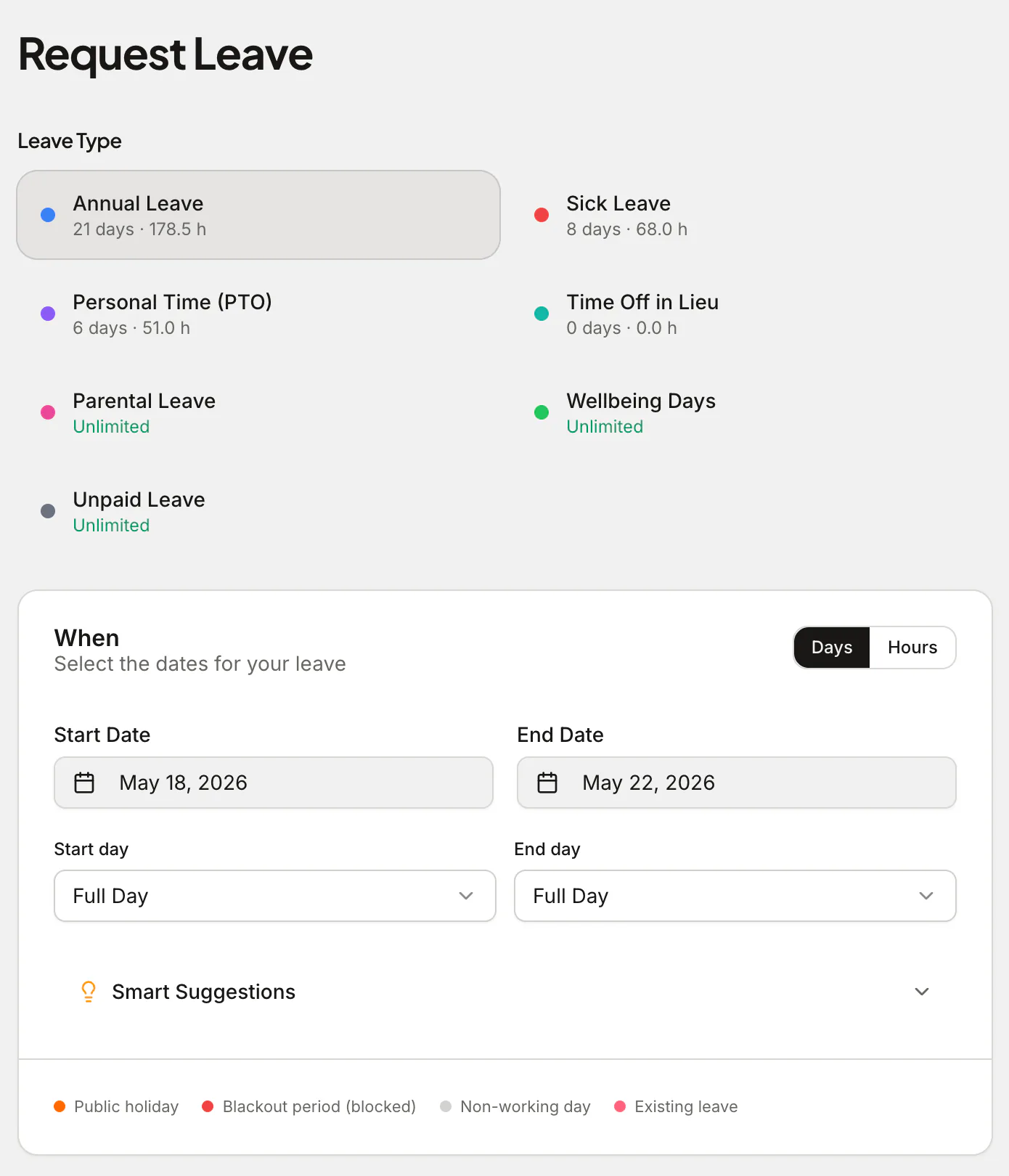
In practice, carer's leave goes wrong in two ways: nobody knows how much of the week a person has used in the last 12 months, and a postponement is agreed verbally and then forgotten. In Absenca, you can set carer's leave up as its own leave type with a five-day allowance. Employees request it in days or half-days and see their remaining balance on the request form, and the manager's approval is recorded against the request. Absenca balances follow your office's leave year, not a rolling 12 months, so check the past 12 months before approving. Absenca does not calculate pay, which is fine here because the statutory leave is unpaid.
FAQ
How many days is carer's leave in the UK?
One week in any 12 months, based on how many days you usually work. That is 5 days for a full-time, five-day worker and 3 days for someone who works 3 days a week.
Is carer's leave paid in the UK?
No. The legal right is to unpaid leave. Your employer can choose to pay it, so check your contract or policy.
Do I need to prove I'm a carer to get carer's leave?
No. Your employer cannot ask for evidence of your dependant's care needs before granting the leave.
Can I take carer's leave in my first week of a new job?
Yes. Carer's leave is a day-one right with no qualifying period. You still need to give the required notice.
Can I take carer's leave as half days?
Yes. Half a working day is the minimum. You can spread the week across the year in half or full days.
Rules can change and your employer's policy may be more generous. Check GOV.UK or Acas for the current position.