
Holiday Carry-Over & Leave Accrual Explained
What holiday carry-over and leave accrual mean, how caps and expiry work, and how to set fair rules — with clear examples for monthly and annual accrual.
Two of the most-misunderstood words in leave management are accrual and carry-over. They sound technical, but they answer two simple questions: when do employees earn their leave, and what happens to the days they don't use? Get the rules clear and you avoid both year-end scrambles and unexpected payouts.
Accrual: when leave is earned
Accrual is how leave builds up over time. There are two broad models:
- Up-front (lump sum): the full year's allowance is available on day one of the leave year. Simple, generous, common in salaried teams.
- Accrued: leave builds up gradually — often monthly — so people can only book what they've earned so far. Common for hourly staff and new starters, and it protects you if someone takes all their leave then leaves the company.
Monthly accrual example. A 24-day allowance accruing monthly earns 24 ÷ 12 = 2 days per month. By the end of April, an employee has accrued 2 × 4 = 8 days.
Other accrual frequencies exist too — quarterly, bi-weekly, or semi-annually — but the principle is the same: divide the annual allowance across the periods.
Accrual caps
Some policies cap how much leave can build up (e.g. "no more than 1.5× your annual allowance"). A cap stops balances ballooning when people don't take time off — which is good for the business and for preventing burnout.
Carry-over: what happens to unused days
Carry-over (or "rollover") is how many unused days move into the next leave year. Three common approaches:
- Use it or lose it — nothing carries over. Encourages people to actually take their leave, but can feel harsh.
- Capped carry-over — a set number of days (e.g. 5) rolls over. The popular middle ground.
- Carry-over with expiry — carried days must be used by a deadline (e.g. 31 March) or they're lost.
Example. Allowance 25 days, carry-over cap 5, expiry 31 March. An employee ends the year with 7 unused days: 5 carry over (and must be used by 31 March), 2 are lost.
Tip: a small carry-over cap with an expiry date is usually the fairest, simplest rule — generous enough to feel reasonable, bounded enough to avoid year-end chaos.
Putting it in your policy
Whatever you choose, write it down — vague rules cause disputes. Spell out:
- The accrual model (up-front or monthly) and any cap.
- The carry-over cap and expiry date.
- Whether unused leave is paid out when someone leaves.
Our annual leave policy template has ready-made wording for all three.
Let the system enforce it
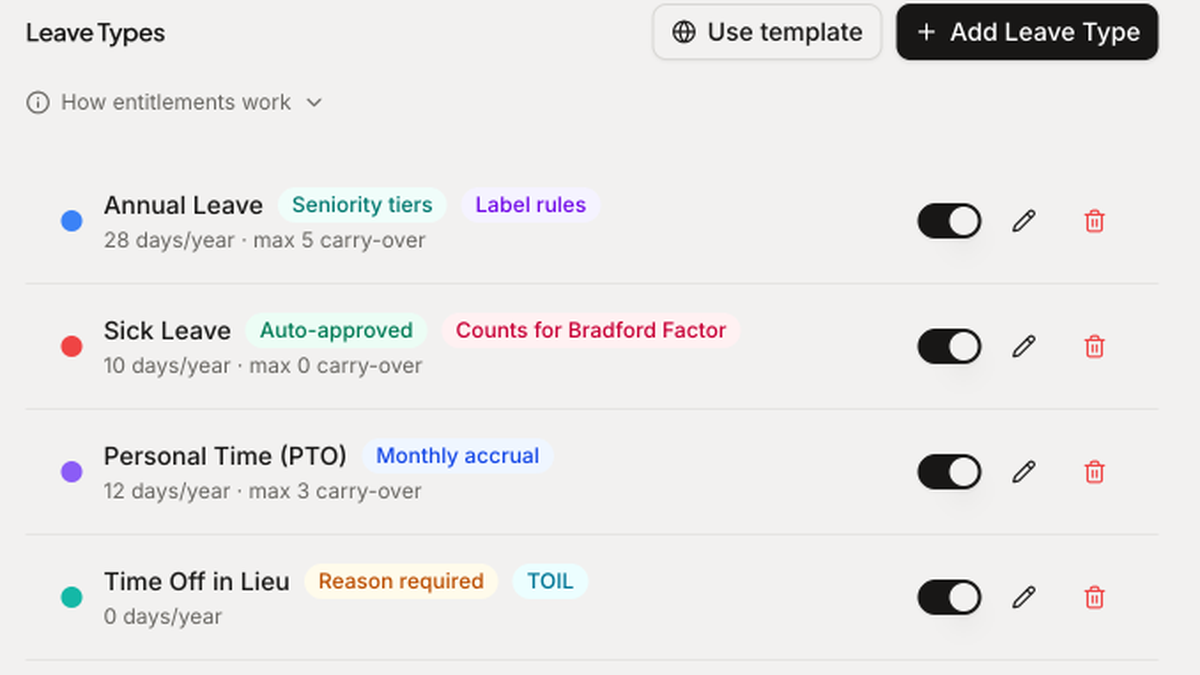
Accrual and carry-over are rules that have to be applied to every employee, every period — exactly what software is for. Absenca accrues leave on the schedule you choose, enforces accrual caps, rolls over unused days up to your cap, and expires carried-over days on the deadline you set. No spreadsheet formulas, no manual reset every January. It's free for up to 10 people.
Frequently asked questions
What's the difference between accrual and pro-rata? Pro-rata sets the total leave a person earns for the year (e.g. for part-timers), and the annual leave calculator works it out. Accrual controls when that total becomes available across the year.
Should new starters accrue or get the full allowance? Many companies accrue leave monthly for new starters (so they can't take a full year's leave in month one) and switch to up-front once they're established. Both are fine — just be consistent.
Do we have to allow carry-over? Often not beyond any statutory minimum, but a small cap is a common goodwill gesture. Always check your local employment rules.
Stop resetting balances by hand every January — Absenca handles accrual and carry-over automatically, free for up to 10 people.