
Study Leave Policy Template: Exam Leave, Paid vs Unpaid, and the UK Right to Request Time Off for Training (2026)
A study leave policy sets out time off for courses and exams, pay and fee repayment. UK law gives no right to paid study leave, only a right to request time off for training for employees with 26 weeks' service at organisations of 250+ people.
A study leave policy sets out when employees get time off for courses and exams, whether that time is paid, and what happens to any funding if they leave. In the UK there is no general right to paid study leave: employees with 26 weeks' service at an organisation of 250 or more people have a statutory right to request time off for study or training, which the employer must consider properly but can refuse for set business reasons (as of 2026).
Below: what the law requires, a template, and worked examples for exam days and repaying fees.
Is there a legal right to study leave in the UK?
Not to leave itself, only to a fair hearing. Under section 63D of the Employment Rights Act 1996, a qualifying employee can make a written request for time off to study or train, and the employer has to follow a fixed procedure before saying yes or no. According to GOV.UK, the leave is "usually unpaid unless the employer agrees to pay it", and the employer does not have to pay for the training.
The right applies in England, Wales and Scotland. It is still in force as of October 2026; the Employment Rights Act 2025 changed only the deadline for tribunal claims (see below).
Who qualifies for the right to request?
| Condition | Rule (GOV.UK, as of 2026) |
|---|---|
| Employment status | Must be an employee, not a worker or contractor |
| Service | At least 26 weeks with the employer |
| Employer size | At least 250 people in the organisation |
| Purpose | The training must improve the employee's effectiveness and the business's performance |
| How often | One request every 12 months |
| Excluded | Agency workers, armed forces, people of compulsory school age, and young people who already have a right to paid time off for study |
The training does not have to lead to a qualification. It can be on site or off site, in work hours or outside them, in the UK or abroad (s.63E).
Separately, section 63A gives some 16 and 17 year olds in Wales and Scotland, who are not in full-time education and have not yet reached a prescribed standard, a right to reasonable paid time off to study for certain qualifications.
What must an employer do with a request?
The request must be in writing, say it is made under section 63D, and give the subject, where and when the training happens, who provides it, any qualification it leads to, how it helps the business, and whether the employee made an earlier request. If details are missing the employer can decline to consider it.
| Step | Deadline |
|---|---|
| Accept, or meet to discuss | Within 28 days of receiving the request |
| Decision after a meeting | Within 14 days of the meeting (longer only if the employee agrees in writing) |
| Employee appeals a refusal | Within 14 days of the decision, in writing, with grounds |
| Appeal meeting | Within 14 days of receiving the appeal |
| Appeal decision | Within 14 days of the appeal meeting, in writing |
The employee can bring a colleague or trade union representative to the meetings.
On what grounds can an employer refuse?
Only the reasons listed in section 63F(7): the training would not improve the employee's effectiveness or the business's performance, the burden of additional costs, a detrimental effect on meeting customer demand, inability to reorganise work among existing staff, inability to recruit additional staff, a detrimental impact on quality or performance, insufficient work during the periods the employee proposes to work, or planned structural changes.
Cost alone is a valid ground. What goes wrong is process: a missed deadline or a refusal based on wrong facts, the two things a tribunal can rule on. It can order the employer to reconsider and award up to 8 weeks' pay (regulation 6, SI 2010/156). For appeal decisions from 1 October 2026 the claim deadline is six months; earlier decisions may have three.
Should study leave be paid or unpaid?
That is a policy choice, not a legal one. Most employers split it by who benefits:
| Type of learning | Typical approach |
|---|---|
| Training the employer requires for the role | Paid time, fees paid, no repayment |
| Professional qualification the employer supports (accountancy, HR, project management) | Paid exam days and some study days, fees paid, tapering repayment if the employee leaves |
| Course the employee chooses that helps the role | Unpaid leave or flexible hours, partial fee support at the manager's discretion |
| Personal interest with no link to the role | Annual leave or unpaid leave |
Whatever you pick, write it down and apply it consistently.
Study and exam leave policy template
Copy this and fill in the bracketed parts.
1. Purpose. This policy covers time off and funding for study, training and exams. It does not reduce any statutory right, including the right to request time off under section 63D of the Employment Rights Act 1996.
2. Who can apply. Employees who have completed [probation / 26 weeks' service]. Requests under section 63D follow the statutory procedure in section 6.
3. What counts. Courses, professional qualifications and exams that relate to the employee's current or next role. Learning unrelated to the role can be taken as annual or unpaid leave.
4. Time off.
- Exam days: [1] paid day for each exam sat, including resits [up to 2 resits per paper].
- Study days: up to [5] paid days a year for approved qualifications, booked at least [2] weeks ahead.
- Course attendance: paid if the course is required by [Company]; otherwise unpaid or swapped for flexible hours.
- Study leave is recorded as its own leave type and does not reduce annual leave.
5. Funding. [Company] pays [100% / X%] of course and first-attempt exam fees for approved study. Resit fees are paid by the employee unless the manager agrees otherwise.
6. How to apply. Submit the request form at least [4] weeks before the course starts, with the course details, dates, provider, cost and how it helps your role. Your manager replies within 28 days, or arranges a meeting and decides within 14 days of it. You can appeal a refusal within 14 days.
7. Repayment. If you resign or are dismissed for misconduct within [24] months of finishing a funded course, you repay fees on this scale: within 12 months, [100%]; 12–24 months, [50%]. You will sign a separate repayment agreement before any fees are paid. Time off is never repaid.
8. Your responsibilities. Tell your manager if you do not start or finish the course, or change to a different one.
How does a training cost clawback work?
A clawback (or repayment) clause makes an employee repay funded fees if they leave soon after. Two practical points matter:
- Get it in writing first. Under section 13 of the Employment Rights Act 1996, an employer can only deduct money from wages if the deduction is authorised by law, by a written contract term the employee was given beforehand, or by the employee's prior written agreement. Sign the repayment agreement before paying the fees, not when the employee resigns.
- Taper it. A repayment that reduces over time is easier to justify than a flat 100% years later.
Worked examples
- Exam days. Greta, an HR advisor at NovaTech, sits three professional exams this year and resits one. Under the template she gets 4 paid exam days (3 papers plus 1 resit) and pays the resit fee herself.
- Clawback. NovaTech pays £3,000 in fees. Greta finishes the qualification in March and resigns 15 months later. She is in the 12–24 month band, so she repays 50%: £1,500. Had she left after 25 months she would repay nothing.
- Statutory request. At a 300-person firm, an employee asks under s.63D for every Friday off for a course. The manager can refuse because work cannot be reorganised, but must still meet within 28 days and decide within 14 days of the meeting.
How do you track study and exam leave?
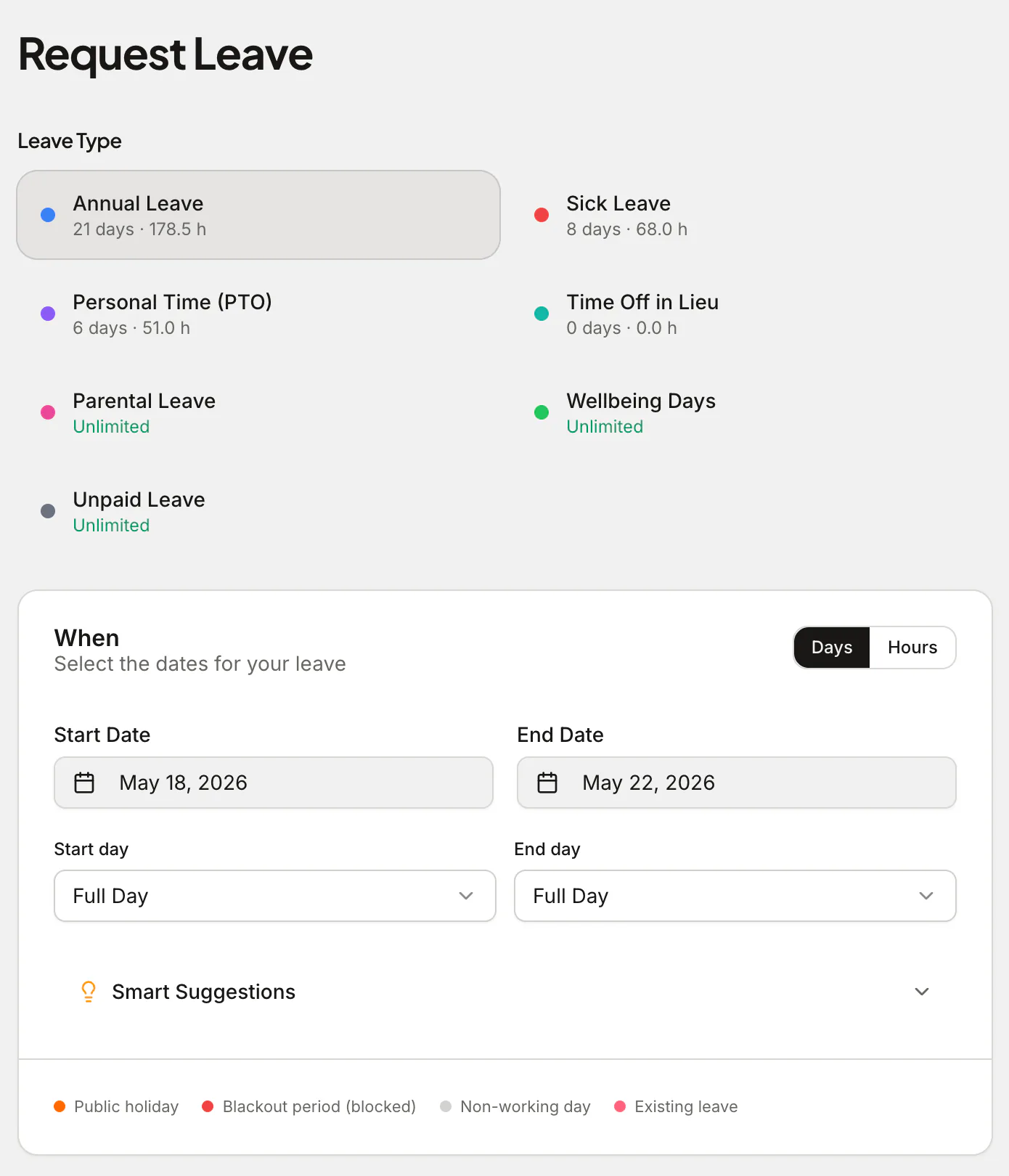
Give it its own leave type with a study-day allowance, so it never comes out of annual leave. In Absenca, employees pick the leave type and see the remaining balance before they submit. The Free plan covers up to 10 people with 2 leave types, so a separate study leave type usually means Pro (20 leave types). See our annual leave policy template for the rules study leave sits alongside.
FAQ
Do employers have to give paid study leave in the UK?
No. The statutory right is only a right to request time off, and GOV.UK says it is usually unpaid unless the employer agrees to pay. Paid study or exam leave comes from your contract or company policy.
Can my employer refuse my request for time off to study?
Yes, but only for the business reasons listed in section 63F(7), such as extra cost or being unable to cover your work, and only after following the 28-day and 14-day procedure. You can appeal within 14 days.
Can an employer make me repay training fees if I leave?
It can only be taken from your wages if you agreed to it in writing in advance, or a written contract term you were given beforehand covers it. A tapering scale is the usual approach. Check the agreement you signed before the course started.
Is study leave the same as time off in lieu?
No. TOIL repays extra hours already worked; study leave is time off for learning. See TOIL explained and our sick leave policy template for other policies you may be writing.
This is general guidance as of October 2026. Rules change and vary by situation, so check the official source on GOV.UK before relying on it.