
Annual leave in Denmark: 25 days, concurrent holiday (samtidighedsferie) and feriefridage
Under the Danish Holiday Act, employees earn 2.08 days of paid holiday a month (25 days a year) and can take it the month after earning it, paid as salary plus a 1% supplement or as 12.5% holiday pay. Feriefridage, the 6th week, come only from a collective agreement or contract.
Under the Danish Holiday Act (Ferieloven), every employee in Denmark earns 2.08 days of paid holiday for each month of employment, which comes to 25 days (5 weeks) a year, and since 1 September 2020 they can take it almost as soon as it is earned ("samtidighedsferie", concurrent holiday). Holiday is paid either as normal salary plus a 1% holiday supplement (ferietillæg) or as 12.5% holiday pay (feriegodtgørelse). Feriefridage, the "6th holiday week", are not part of the Act: you only have them if a collective agreement or your contract grants them.
Rules below are as of 2026, from the consolidated Act (LBK nr 152 of 20 February 2024), borger.dk and virk.dk.
How many days of annual leave do you get in Denmark?
Section 4 of the Act says an employee earns the right to 5 weeks of paid holiday in each holiday year. Section 5 sets the rate at 2.08 days for every month of employment. For a stint shorter than a month you earn 0.07 days per day of employment, up to 2.08 days.
borger.dk puts it simply: you earn 2.08 days a month "whether you work full time, part time, or a few days a week", which "corresponds to earning 25 holiday days if you are employed for a whole year".
| Term | What it means | Dates |
|---|---|---|
| Ferieår (holiday year) | The year you earn holiday in | 1 September – 31 August |
| Ferieafholdelsesperiode (holiday-taking period) | The window for taking that holiday | 1 September – 31 December of the following year (16 months) |
| Hovedferieperiode (main holiday period) | When you can insist on 3 weeks in a row | 1 May – 30 September |
What is concurrent holiday (samtidighedsferie)?
The current Act took effect on 1 September 2020. Under the old law, holiday earned in one year couldn't be taken until the next. Now holiday is taken "concurrently". Section 6 says earned holiday is taken during the holiday-taking period, which covers the holiday year in which it is earned plus the following 4 months up to the end of the calendar year.
In practice, as Life in Denmark explains, you can take your holiday "as soon as the month after you have earned it". Holiday earned from September 2025 to August 2026 can therefore be used until 31 December 2026, and the periods overlap by four months.
Employer and employee can also agree that holiday is taken in advance, before it has been earned (section 7). Days taken this way are deducted from the holiday earned later in that year.
How does the 3-week main holiday (hovedferie) work?
Section 8 gives employees two rights:
- at least 4 weeks of earned holiday must be scheduled within the holiday year, and
- at least 3 weeks in a row (the hovedferie) can be taken between 1 May and 30 September.
borger.dk adds that the main holiday can be placed after 30 September if you agree it with your employer. On notice, borger.dk says you should hear about your main holiday at least 3 months before it starts, and about other holiday at least 1 month before it begins. Shorter notice is allowed only in special cases, such as unforeseen operational circumstances.
Is holiday pay in Denmark 1% or 12.5%?
That depends on how you are paid (section 16):
| Who | What they get during holiday | Rate |
|---|---|---|
| Monthly-paid staff with full pay on public holidays and sick days | Normal salary during holiday plus ferietillæg | 1% of pay |
| Everyone else (typically hourly-paid) | Feriegodtgørelse instead of salary | 12.5% of pay |
| Salaried staff who choose holiday pay before the holiday year starts | Feriegodtgørelse instead of salary and supplement | 12% of pay |
Example: a salaried employee earning DKK 40,000 a month (DKK 480,000 over the holiday year) is owed a ferietillæg of about DKK 4,800. An hourly worker who earns DKK 300,000 in the holiday year builds up about DKK 37,500 in feriegodtgørelse.
Under section 18, the supplement is paid either when the corresponding holiday starts, or in two instalments: the share for September–May with May's pay, and the rest with August's pay. borger.dk notes that a collective agreement can set a different rate, higher or lower.
When a salaried employee leaves, virk.dk tells employers to calculate holiday pay at "12.5 percent of the employee's gross pay for the holiday that has not been taken". Our guide to being paid for unused holiday when leaving a job covers how this compares with other countries.
Can you carry over holiday in Denmark?
Only the fifth week. Section 21 lets an employee and employer agree to transfer earned holiday beyond 4 weeks to the next holiday-taking period:
- The agreement must be in writing and made by 31 December of the holiday-taking period.
- By the same date, the employer must tell FerieKonto, or whoever pays the holiday pay, that the holiday is being transferred.
- Transferred days are taken first in the new period.
borger.dk stresses that you are not entitled to a transfer, so it needs the employer's agreement. Section 22 is different: if illness or other "special circumstances" stopped someone from taking their holiday, up to 4 weeks are transferred to the next period. For how this fits with accrual systems elsewhere, see holiday carry-over and leave accrual explained.
Can the fifth week be paid out instead?
Yes, but only holiday beyond 4 weeks:
- After the holiday year ends, employer and employee can agree to pay it out before the holiday-taking period ends (section 23). Someone who wasn't employed full time for the whole year must sign a written declaration.
- After the holiday-taking period ends, the employer pays it out (section 24). virk.dk says this payout is automatic, "at the latest on 31 March" after the period ends, for employees who worked full time for the same employer throughout the holiday-taking period. Anyone else can request it via borger.dk, and from 1 January no written agreement with the employer is needed.
The first four weeks can't be paid out while you stay employed. Holiday pay that is neither taken, paid out nor transferred goes to Arbejdsmarkedets Feriefond (section 34). Employers must report and pay it by 15 November after the period ends.
What are feriefridage?
Feriefridage, often called the 6th holiday week, are extra paid days off on top of the 25 statutory days. They do not come from Ferieloven. Arbejdsmarkedets Feriefond's guidance on virk.dk says employers only report untaken days "out of the 25 annual holiday days covered by the Holiday Act", and that staff "may be entitled to feriefridage (6th holiday week) or other days off under a collective agreement".
So the rules on feriefridage come from the collective agreement (overenskomst) or the employment contract. That covers how many days you get, how they are earned, whether they lapse and whether they are paid out. borger.dk says the same about changing jobs: "the rules can vary" for feriefridage, so check your contract or collective agreement.
Tracking Danish holiday for a team
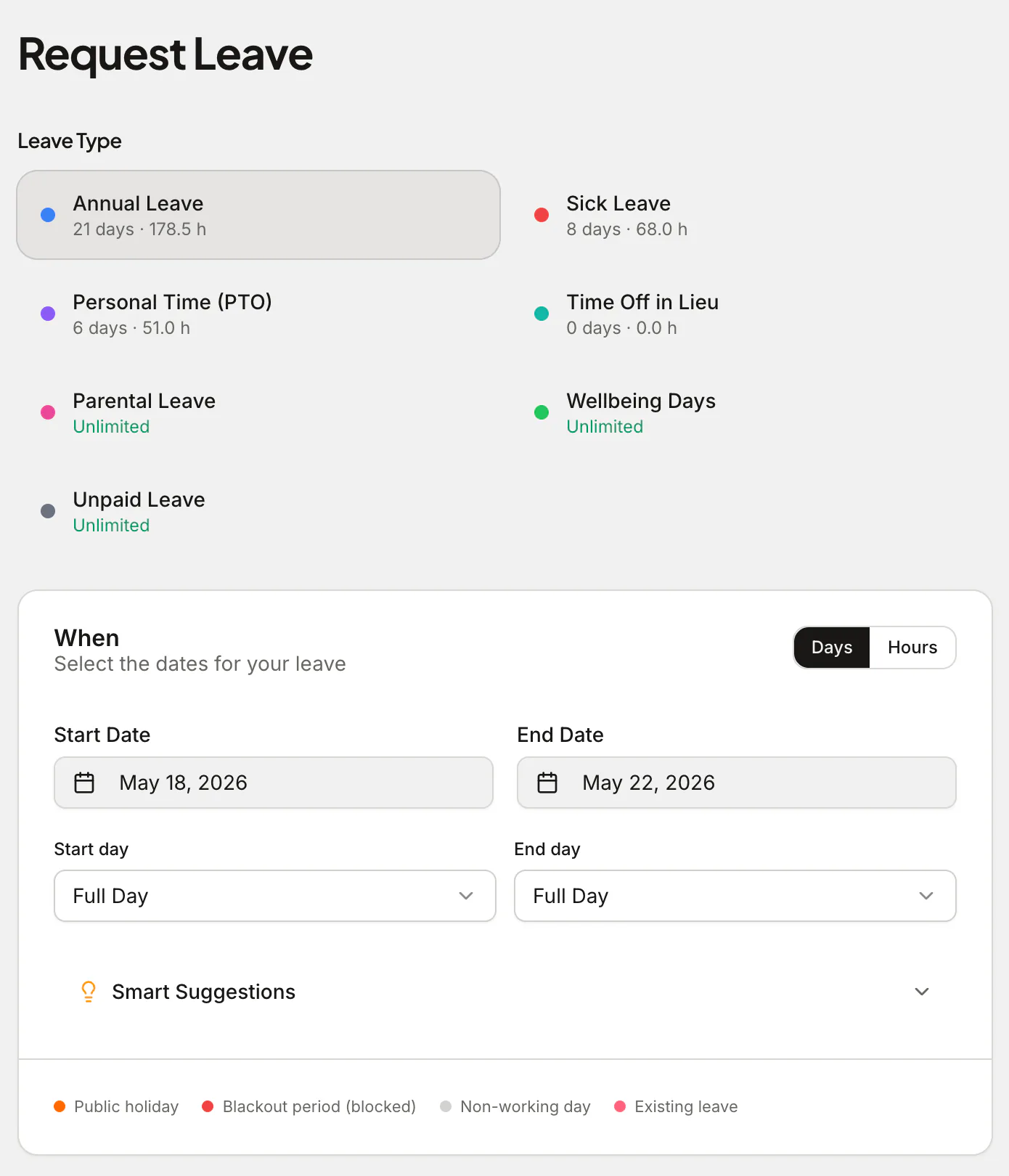
The September–August holiday year, monthly accrual and the 31 December transfer deadline are hard to manage in a spreadsheet. In Absenca, each office has its own leave year, work week, public holidays and leave types, so a Copenhagen office can run on a September leave year next to offices elsewhere. Accrual and carry-over are included on the Free plan (up to 10 people). You can also set up feriefridage as a separate leave type, keeping them apart from the 25 statutory days. Absenca tracks balances. It does not calculate holiday pay.
For other countries, see paid leave by country.
FAQ
Is it 25 or 30 days of holiday in Denmark?
The law gives 25 days (5 weeks). Some employees get extra feriefridage through a collective agreement or contract, but these are not statutory.
Do I have to wait a year before taking holiday in a new job in Denmark?
No. Under concurrent holiday you can take days the month after you earn them. You can also agree with your employer to take holiday in advance.
Can my employer refuse to let me carry over my fifth week?
Yes. Transferring holiday beyond 4 weeks needs a written agreement with your employer by 31 December. Without one, untaken days beyond 4 weeks are paid out after the holiday-taking period ends.
Does the 12.5% holiday pay apply to salaried employees?
Normally not. Salaried staff who get full pay on public holidays and sick days receive their salary during holiday plus a 1% supplement. The 12.5% applies to others, such as hourly-paid workers, and to untaken holiday when a salaried employee leaves.
Are feriefridage paid out if I don't use them?
That depends entirely on your collective agreement or contract, because the Holiday Act doesn't cover them.
Rules can change and collective agreements can vary them, so check the current Ferieloven on retsinformation.dk and the guidance on borger.dk and virk.dk.