
Annual Leave in the Netherlands: Vakantiedagen, the 4× Weekly Hours Minimum and 6-Month Expiry
Dutch employees get at least four times their weekly working hours as paid annual leave (20 days on a 40-hour week). Statutory days expire six months after the year they were earned, extra days after five years, and holiday allowance is at least 8% of gross annual pay.
In the Netherlands, every employee earns at least four times their contracted weekly working hours as paid annual leave each year: 160 hours (20 eight-hour days) on a 40-hour week, less pro rata for part-time. These statutory days (wettelijke vakantiedagen) expire six months after the end of the year they were earned in, any extra days your employer gives you (bovenwettelijke dagen) usually stay valid for five years, and on top of your salary you get holiday allowance (vakantiegeld) of at least 8% of your gross annual pay.
That's the short answer as of 2026. The rules sit in the Dutch Civil Code (Burgerlijk Wetboek, Book 7, articles 7:634 to 7:645), and the details below are what expats and HR teams most often get wrong.
How many vacation days do you get in the Netherlands?
Article 7:634 BW says an employee who has been paid for their full contracted hours for a whole year earns leave of "at least four times the agreed working hours per week". The law counts hours, not days, so the minimum always matches your own contract:
| Contracted hours per week | Statutory leave per year | In 8-hour days |
|---|---|---|
| 40 | 160 hours | 20 days |
| 36 | 144 hours | 18 days |
| 32 | 128 hours | 16 days |
| 24 | 96 hours | 12 days |
However your hours are spread, that works out to four of your normal working weeks off each year. If you join or leave partway through a year, you earn a proportional share (art. 7:634 lid 2). The government's employer portal gives the same example: someone working 40 hours a week is entitled to 4 × 40 = 160 leave hours a year.
Most collective labour agreements (cao's) and many contracts add more. Those extras are the bovenwettelijke days, and they follow different rules. If you want to work out your own number, the annual leave calculator does the arithmetic.
What is the difference between wettelijke and bovenwettelijke vakantiedagen?
- Wettelijke vakantiedagen (statutory days): the four-times-weekly-hours minimum. The law protects them. Your employer must give you the chance to take them every year (art. 7:638 lid 1), and they cannot be swapped for money while you are still employed (art. 7:640).
- Bovenwettelijke vakantiedagen (extra days): anything above the minimum. They are not compulsory, and the official employer guidance confirms they can be bought out. Neither side can force a buy-out, though.
| Wettelijke days | Bovenwettelijke days | |
|---|---|---|
| Required by law | Yes, 4× weekly hours | No, set by contract or cao |
| Expiry | 6 months after the year they were earned | 5 years after the year they were earned |
| Paid out during employment | No | Yes, if both sides agree in writing |
| Paid out when you leave | Yes | Yes |
Payslips and HR systems often show the two balances separately. It's worth checking which bucket you are drawing from, because that decides which days expire first.
Do vakantiedagen expire after 6 months?
Statutory days do. Article 7:640a BW says the claim to the statutory minimum "lapses six months after the last day of the calendar year in which it was acquired". The government's own example: days built up in 2026 expire on 1 July 2027.
There are two exceptions:
- You could not reasonably take them. If illness kept you from taking leave, or your employer made it impossible, the days do not lapse after six months. They fall under the five-year limitation period instead.
- A longer period was agreed in writing. The law lets a written agreement or a cao extend the six months in the employee's favour. The government's employer portal puts the ceiling at five years.
Extra (bovenwettelijke) days are not caught by the six-month rule. Under article 7:642 BW, a claim for leave becomes time-barred five years after the last day of the calendar year in which it arose. Extra days earned in 2026 therefore stay valid until the end of 2031, unless your contract or cao says otherwise.
For HR, this means the leave year has two deadlines: statutory balances by 1 July, extra balances on a five-year rolling clock. Our guide to carry-over and leave accrual explains how to keep the two apart.
How much holiday allowance (vakantiegeld) do you get?
The government's answer: at least 8% of your gross annual salary from the past year. The legal term is vakantiebijslag. Key points:
- It is calculated on the salary earned over the past year, often counted May to May. Most employers pay it once a year, in May or June. Paying at another time or in instalments needs the employee's written consent.
- Overtime counts, including any overtime premium. Profit-sharing and year-end bonuses do not.
- It keeps building up while you are sick.
- A cao can replace the allowance with nothing, but then you must earn at least 108% of the minimum wage. For people earning more than three times the statutory minimum wage, employer and employee can agree in writing to a lower allowance or none.
Example: on a gross salary of €36,000 a year, the minimum vakantiegeld is €2,880 gross.
Are public holidays extra paid days off in the Netherlands?
Not by law. The government states plainly that no law makes particular public holidays days off for employees, so there is no statutory right to a day off on a feestdag. Your cao or employment contract decides whether you are off, whether you are paid, and whether working that day earns a premium.
The official holidays in 2027 are New Year's Day (1 January), Good Friday (26 March), Easter Sunday and Monday (28–29 March), King's Day (27 April), Liberation Day (5 May), Ascension Day (6 May), Whit Sunday and Monday (16–17 May), and Christmas Day and Boxing Day (25–26 December). Many cao's give Liberation Day as a paid day off only once every five years, in a lustrum year (2025, 2030). See our public holidays calendar for other countries.
Can my employer refuse my leave dates?
Unless a contract, cao or the law covers how leave is scheduled, article 7:638 BW says the employer must set your leave according to your wishes unless there are "weighty reasons" (gewichtige redenen) not to. If the employer hasn't given you those reasons in writing within two weeks of your written request, the leave is fixed as you asked. Days you are sick during a booked holiday don't count as leave unless you agree that they should.
What happens to unused days when you leave?
Under article 7:641 BW, any leave you still have when the contract ends is paid out in cash, statutory and extra days alike. Your employer must also give you a written statement (verklaring) of the remaining balance. If you choose not to cash out statutory days and take them as unpaid leave at your next job, they keep their original expiry date. For the general picture, see getting paid for unused holiday when you leave.
Tracking Dutch leave in hours
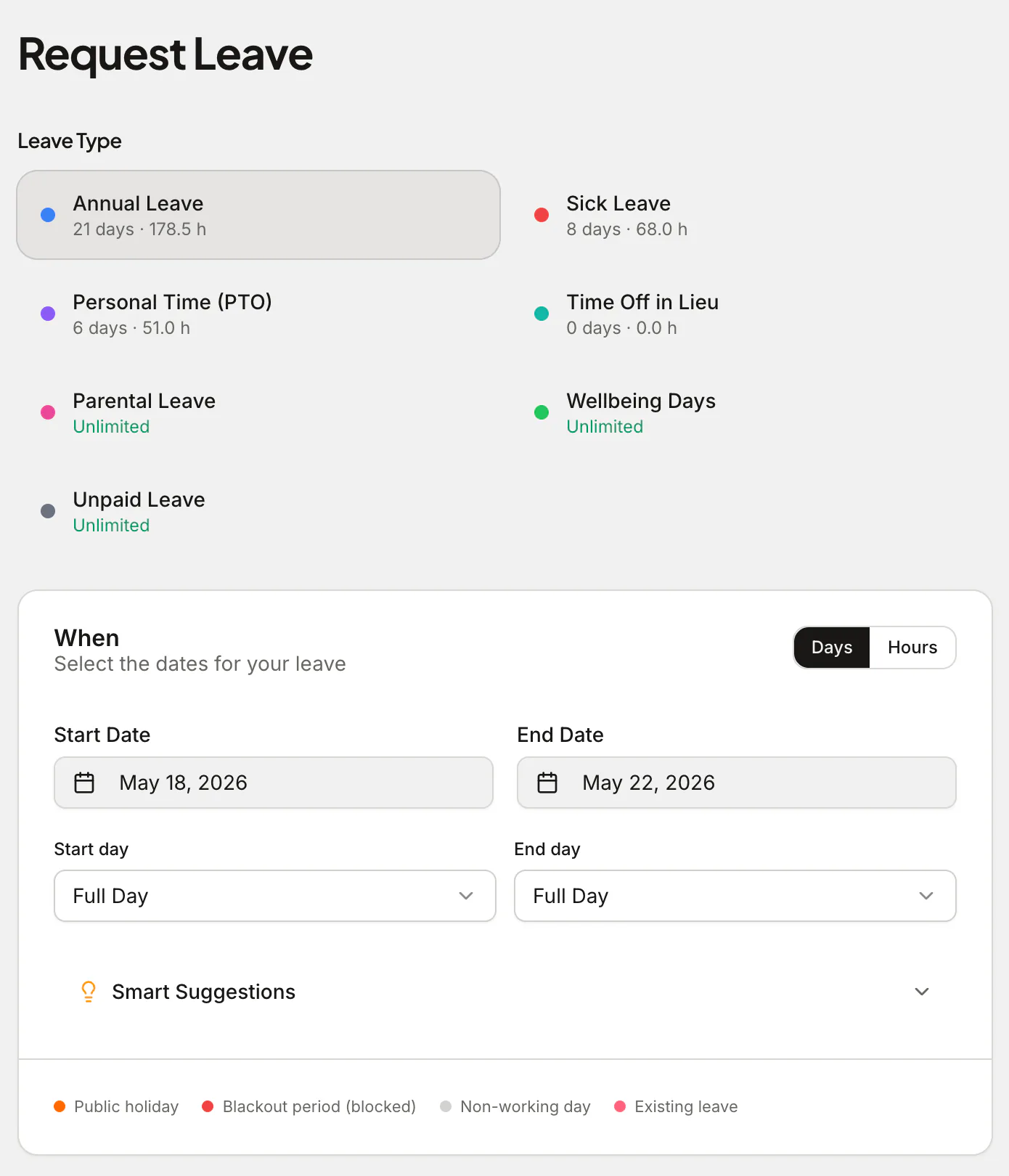
Because Dutch entitlement is counted in hours and the two kinds of balance expire on different clocks, a day count in a spreadsheet drifts quickly. Absenca tracks leave in days, half-days or hours (15, 30 or 60-minute steps), and each office gets its own work week, public holidays, leave year and leave types, so a Dutch office can keep statutory and extra leave as separate types with their own carry-over. The free plan covers up to 10 people. Absenca does not calculate pay, so vakantiegeld stays with payroll.
FAQ
How many vacation days do I get on a 40-hour contract in the Netherlands? At least 160 hours a year, which is 20 eight-hour days. Your cao or contract may give more as bovenwettelijke days.
When do my 2026 vakantiedagen expire? Statutory days earned in 2026 expire on 1 July 2027, unless you couldn't reasonably take them or a longer period was agreed in writing. Extra days stay valid for five years after the end of 2026.
Is vakantiegeld 8% of gross or net salary? Gross. It's at least 8% of the gross salary you earned over the past year, usually paid in May or June.
Can my employer pay out my statutory leave instead of letting me take it? Not while you are employed. Only bovenwettelijke days can be bought out, and both sides have to agree. Statutory days are paid out only when the contract ends.
Do I automatically get King's Day or Christmas off? No. Dutch law doesn't make any public holiday a paid day off. Check your cao or contract.
Rules can change and cao's often add to them. Check the current text on wetten.overheid.nl and rijksoverheid.nl before you rely on it.