
Can My Employer Refuse My Holiday Request? UK and Ireland Rules (2026)
Yes, but within limits. In the UK your employer must refuse with at least as many days' notice as the leave you asked for and can't stop you taking your statutory holiday; in Ireland the employer sets dates but must consult you a month ahead.
Yes, your employer can refuse a holiday request in the UK and Ireland, but not however and whenever it likes. In Great Britain and Northern Ireland it must tell you before a notice deadline (at least as many days ahead as the leave you asked for) and it can never stop you taking your statutory holiday altogether; in Ireland the employer sets the timing, but must consult you at least a month beforehand and let you take the leave within the leave year.
So if your manager has just said "no" to the week you wanted, or cancelled a trip you already booked, the questions that matter are: did they give enough notice, do you still get to use your full entitlement this year, and what does your contract say? This guide covers the rules as of October 2026.
Can my employer refuse my holiday request in the UK?
Yes. Under regulation 15 of the Working Time Regulations 1998, you choose when to take your leave by giving notice, but your employer can serve a counter-notice telling you not to take it on those days. GOV.UK puts it plainly: "An employer can refuse a leave request or cancel leave", but "they cannot refuse to let workers take the leave at all."
Acas adds that an employer "should have a good business reason to refuse or cancel a holiday request", such as being too short-staffed that week. That's guidance on good practice rather than a word in the regulation, but a pattern of refusals with no reason given is a warning sign.
Citizens Advice also notes your employer can refuse if you've already used all your holiday entitlement for the leave year.
How much notice do I have to give for annual leave in the UK?
At least twice as many days as the leave you want. The same rule, mirrored, sets how much notice your employer needs to refuse, cancel or tell you when to take leave.
| Who gives notice | For what | Minimum notice (statutory default) | Example |
|---|---|---|---|
| You | Booking holiday | Twice the length of the leave | 20 days ahead for 10 days off |
| Employer | Refusing or cancelling your holiday | The same length as the leave | 7 days ahead for 7 days off |
| Employer | Making you take holiday (e.g. a Christmas shutdown) | Twice the length of the leave | 10 days ahead for 5 days |
Two details catch people out:
- GOV.UK counts one extra day. Its guidance adds "plus 1 day" to each period (3 days' notice for 1 day's leave; 11 days' notice to refuse 10 days). Acas and the regulation itself state the period without that extra day. If you're cutting it close, assume the extra day.
- Your contract can change all of this. Regulation 15(5) lets a "relevant agreement" vary or exclude these notice rules. Many contracts and handbooks ask for more notice, or let the employer refuse at shorter notice. Check yours first.
Northern Ireland has the same notice rules, according to nidirect: twice the holiday for you, at least as long as the holiday for your employer to refuse.
Can my employer cancel holiday I've already booked?
Yes, if the cancellation reaches you before the deadline above (at least as many days before the leave as the leave lasts) and your contract doesn't say otherwise. Acas points out that cancelling can be especially damaging if you've already paid for the trip, and that employers should weigh that, but the law doesn't require them to refund you.
If they cancel after the deadline, or refuse leave so often that you can't use your entitlement, that's where you have grounds to push back.
Can my employer tell me when to take holiday?
Yes. Your employer can require you to take leave on particular days, for example over bank holidays or during a Christmas shutdown, as long as it gives you notice of at least twice the number of days involved. It can also ban leave during busy periods. Citizens Advice gives examples like a teacher being required to take holiday in school holidays.
What it can't do, per Acas and GOV.UK, is use this to stop you resting: workers must still be able to take their 5.6 weeks (28 days for a five-day week) during the year. Our guide to blackout periods covers how these restrictions are normally set up.
What are the rules in Ireland?
Ireland works differently: your employer decides when you take annual leave, not you. Section 20 of the Organisation of Working Time Act 1997 says the times are "determined by his or her employer having regard to work requirements", subject to three conditions:
- The employer must take into account your need to balance work with family responsibilities, and your opportunities for rest and recreation.
- It must consult you (or your trade union) not later than 1 month before the leave is due to start.
- The leave must be granted within the leave year, or, with your consent, within the 6 months after it.
Section 19(3) adds that if you work 8 or more months in a leave year, your leave should include an unbroken period of 2 weeks, unless an agreement says otherwise. The statutory minimum itself is 4 working weeks for most full-time staff (section 19(1)).
So in Ireland a refusal of your preferred dates is generally lawful. What isn't lawful is never letting you take your leave within the year (or the 6 months after, with your agreement), or fixing dates without consulting you a month ahead.
What can I do if my holiday is refused unfairly?
Work through it in this order:
- Check the facts. How many days' notice did you give, and how much did your employer give? What does your contract or holiday policy say? How much entitlement do you have left this leave year?
- Ask for the reason and alternative dates in writing. Most refusals are about cover, and a counter-offer often solves it.
- Don't just take the leave anyway. Settle the dispute first, through the steps below.
- Raise a formal grievance if the refusal looks like it breaks the rules, or if you're being prevented from using your entitlement.
- Escalate. In Great Britain a worker can complain to an employment tribunal that their employer refused to let them take statutory leave. Since 1 October 2026 the time limit is six months (regulation 30, as amended by the Employment Rights Act 2025), and you must notify Acas for early conciliation first. In Ireland, complaints go to the Workplace Relations Commission within 6 months of the breach, extendable by up to another 6 months for reasonable cause (Workplace Relations Act 2015, section 41).
If you lose days because your employer kept refusing, you're in a stronger position to carry them over: Citizens Advice says that where an employer stopped you taking holiday, you can carry over up to 4 weeks (5.6 weeks for irregular-hours workers). Our carry-over and accrual guide explains the rest.
For managers: how do you refuse holiday fairly?
Refusing is sometimes unavoidable. Doing it badly is what turns a scheduling problem into a grievance.
- Respond quickly. The counter-notice clock runs from the start of the leave, so a late "no" may not count at all.
- Give the business reason, in writing, and offer alternative dates.
- Use a consistent rule for clashes: first come, first served, or rotating priority for school holidays and Christmas. Our post on how to approve leave requests fairly sets out options that hold up.
- Publish restrictions in advance rather than refusing case by case.
- Watch who keeps getting refused. By the last quarter of the leave year, make sure everyone can still use their entitlement.
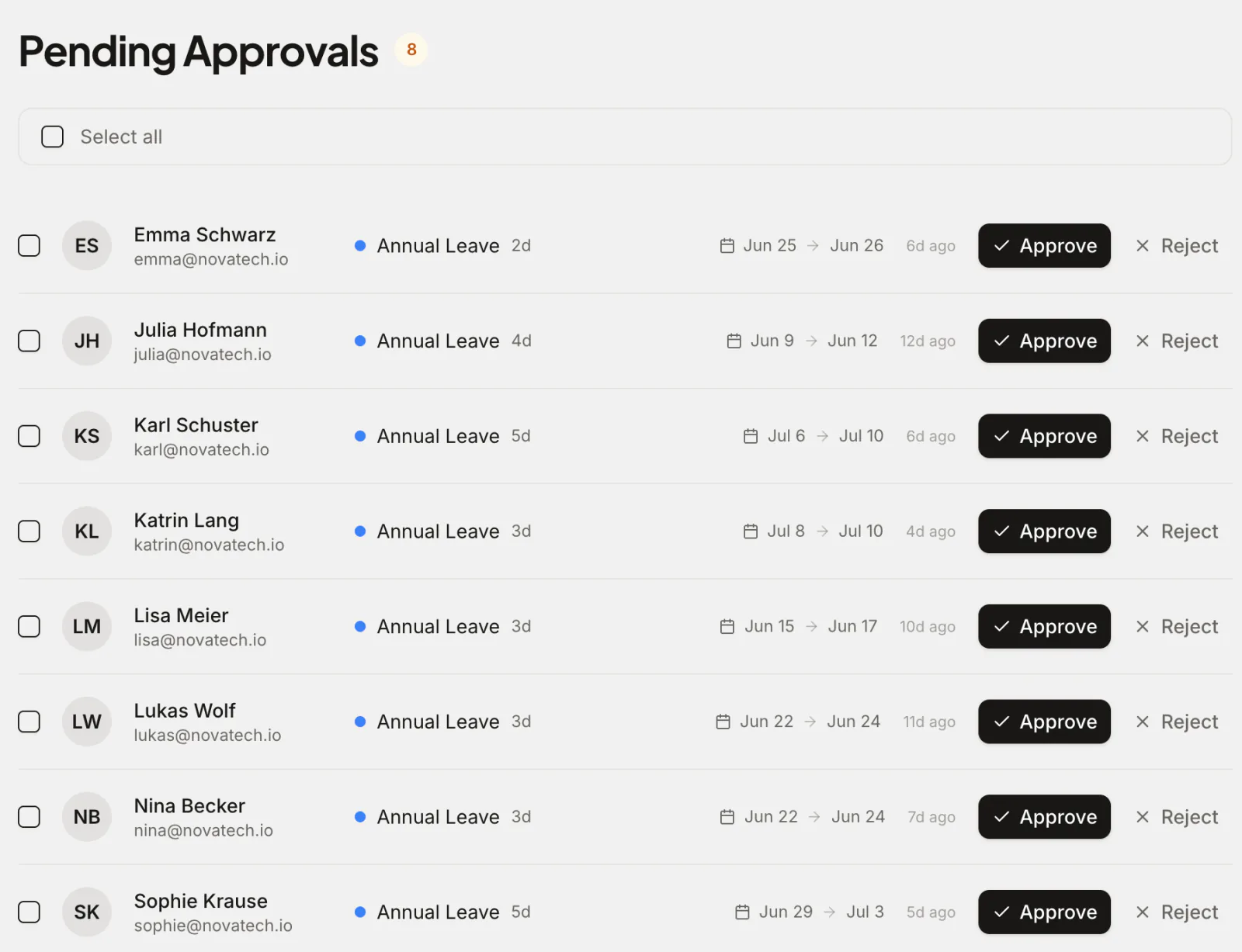
Most refusals happen because the manager can't see who else is off. If you track leave in Absenca, each request shows up in an approvals queue, and the wallchart shows overlaps across the team before you decide. The Free plan covers teams of up to 10 people.
Frequently asked questions
Can my employer refuse holiday I booked months ago? In the UK they can still cancel it, provided they tell you at least as many days before the holiday as it lasts (unless your contract says otherwise). Booking early doesn't lock the dates in, but it makes a good business reason harder to show.
Can my employer refuse my holiday if I give enough notice? Yes. Giving the right notice makes your request valid; it doesn't oblige your employer to say yes. What they can't do is block you from taking your full statutory leave during the year.
Can my employer make me use holiday for Christmas or bank holidays? Yes, in the UK if they give at least twice as many days' notice as the leave involved, or under your contract. In Ireland the employer sets the timing anyway, after consulting you at least a month ahead.
How many days off am I entitled to? 5.6 weeks in Great Britain (28 days for a five-day week) and 4 working weeks for most full-time employees in Ireland. See paid leave by country for other countries.
This is general guidance as of October 2026. Rules vary by contract and jurisdiction, so check GOV.UK, nidirect or the Workplace Relations Commission for your situation.