
Ferragosto 2027 and the European August: Running a Team When Italy, France and Spain Go on Holiday
Ferragosto is Italy's 15 August public holiday, which falls on Sunday 15 August in 2027. Much of Italy, France and Spain takes its main summer leave around it, so agree cover by June and brief clients on your August plans in early July.
Ferragosto is Italy's public holiday on 15 August, and in 2027 it falls on Sunday 15 August. It sits in the middle of the month when much of Italy, France and Spain takes its main summer holiday, so if your team or your clients are in southern Europe, plan for a quiet first three weeks of August, agree cover by June, and tell clients your August arrangements before July ends.
This guide is for managers who run a team or serve clients across Italy, France and Spain. It covers what the holiday is, why August empties out, the legal background that makes summer leave so concentrated, and a plan for cover and client communication.
When is Ferragosto in 2027?
Ferragosto is always on 15 August, whatever the weekday. In 2027 that is a Sunday. The same day is a public holiday in France (Assomption) and in Spain (Asunción de la Virgen), because it is the Catholic feast of the Assumption.
| Country | Holiday on 15 August | Day in 2027 | What happens to the Monday (16 August 2027) |
|---|---|---|---|
| Italy | Ferragosto / Assunzione | Sunday | No Monday holiday in the national list |
| France | Assomption | Sunday | Normal working day |
| Spain | Asunción de la Virgen | Sunday | Public holiday in Andalucía, Aragón, Asturias, Canarias, Castilla y León and Madrid; a working day elsewhere |
The Italian list of public holidays is set by Law 260 of 27 May 1949, article 2, which includes the Assumption. France's dates come from the official service-public.gouv.fr list of jours fériés, which shows Assomption on Sunday 15 August 2027. Spain's 2027 calendar was published in the BOE on 13 October 2026 (Resolución de 8 de octubre de 2026): regions can choose whether a national holiday that lands on a Sunday moves to the Monday, and six kept the Monday off. Spanish towns also add up to two local holidays of their own, so check the office's municipality too.
Why is Europe closed in August?
It isn't closed, but large parts of it slow down at the same time. Three things push in the same direction:
- Tradition. The name comes from the Latin Feriae Augusti, a rest period after the summer's farm work that the Church later moved to 15 August, the feast of the Assumption. Taking the long summer break around mid-August is a habit that predates any employment law.
- School holidays and heat. Families leave cities in July and August, and inland cities get very hot. Many people go to the coast or the mountains and stay for two or three weeks.
- Collective closures. Many companies, especially manufacturers, family businesses and small professional firms, close for one to three weeks around 15 August and ask everyone to take leave then. That means suppliers, accountants, printers and clients' decision-makers can all be away at once.
The result: tourist businesses are busy, but B2B life slows sharply. Emails go unanswered, approvals wait, and deliveries pause until late August.
What does the law say about summer leave?
Labour law in all three countries pushes leave towards summer or towards long, unbroken blocks. As of 2026:
| France | Italy | Spain | |
|---|---|---|---|
| Minimum annual leave | 5 weeks (30 working days, jours ouvrables) | 4 weeks | 30 calendar days |
| Main summer rule | Leave is taken within 1 May – 31 October; at least 12 working days in one continuous block | At least 2 weeks in the year they're earned, consecutive if the employee asks | Dates agreed between employer and employee |
| Notice | Leave period announced at least 2 months before it opens | No fixed notice period in D.Lgs. 66/2003 | Employee knows dates at least 2 months before |
| Source | Service-public F2258 (Code du travail L3141-12 to L3141-23) | D.Lgs. 66/2003, art. 10 | Estatuto de los Trabajadores, art. 38 |
France is the strictest about summer. The congé principal is up to 24 working days (four weeks) in a row, and at least 12 of them must be taken continuously between 1 May and 31 October. If part of the main leave is pushed outside that window, the employee may earn extra jours de fractionnement: one day for 3 to 5 days taken outside it, two days for 6 or more, unless a collective agreement says otherwise. A French employer can also require staff to take leave during a temporary company closure. For how French leave is counted, see our guide to calculating congés payés.
In Italy, the two-week block in the year of accrual is what makes a fortnight around Ferragosto so common. The remaining two weeks can be taken within 18 months after the end of that year. Collective agreements can change these rules. In Spain, the minimum is 30 calendar days, and the worker must know their dates at least two months before the holiday starts, so August plans are usually settled by June.
These are general guidelines. Collective agreements often add to them, and rules vary by sector and region, so check the official source for your case.
How do you plan cover when half your team is away?
Start in spring, not in July. A workable sequence:
- Collect August requests by the end of April. French and Spanish rules both expect dates to be known around two months ahead, so this is what local staff expect anyway.
- Map peaks by week, not by month. The days either side of 15 August are usually the emptiest. In 2027, with 15 August on a Sunday, that means 9–13 August and 16–20 August (and Monday 16 August is a holiday in six Spanish regions).
- Set a minimum staffing level per team, for example "at least one person who can approve payments and one who can answer support". Agree it openly, then book leave around it. Our guide to approving leave requests fairly covers who gets priority when everyone wants the same weeks.
- Pair southern European staff with colleagues elsewhere. Someone in another country can cover the mid-August weeks and take their own break at another time.
- Write handover notes before people leave: open items, client contacts, who decides what. One page per person is enough.
- Freeze risky work. Avoid launches, migrations and contract renewals in the two weeks around 15 August. A short blackout period for critical roles is a fair tool if you publish it early.
The same thinking applies to December. Our holiday season cover planning guide walks through it.
How do you tell clients about August?
Clients in Italy, France and Spain usually expect a slower August, but they still want to know what to expect. A simple plan:
- Tell them in early July which weeks you'll run reduced service, who their contact is, and the expected response time.
- Ask them in return when their own office closes and who signs off while they're away. Many invoices and approvals stall simply because the decision-maker is at the coast.
- Move deadlines forward. Anything that needs a client's approval should go to them by mid-July, not on 10 August.
- Use a clear out-of-office, in the client's language if you can, naming a backup contact and the return date.
- Plan for late August. The last week of August and the first week of September are when everyone returns at once; leave room for the backlog.
How Absenca helps
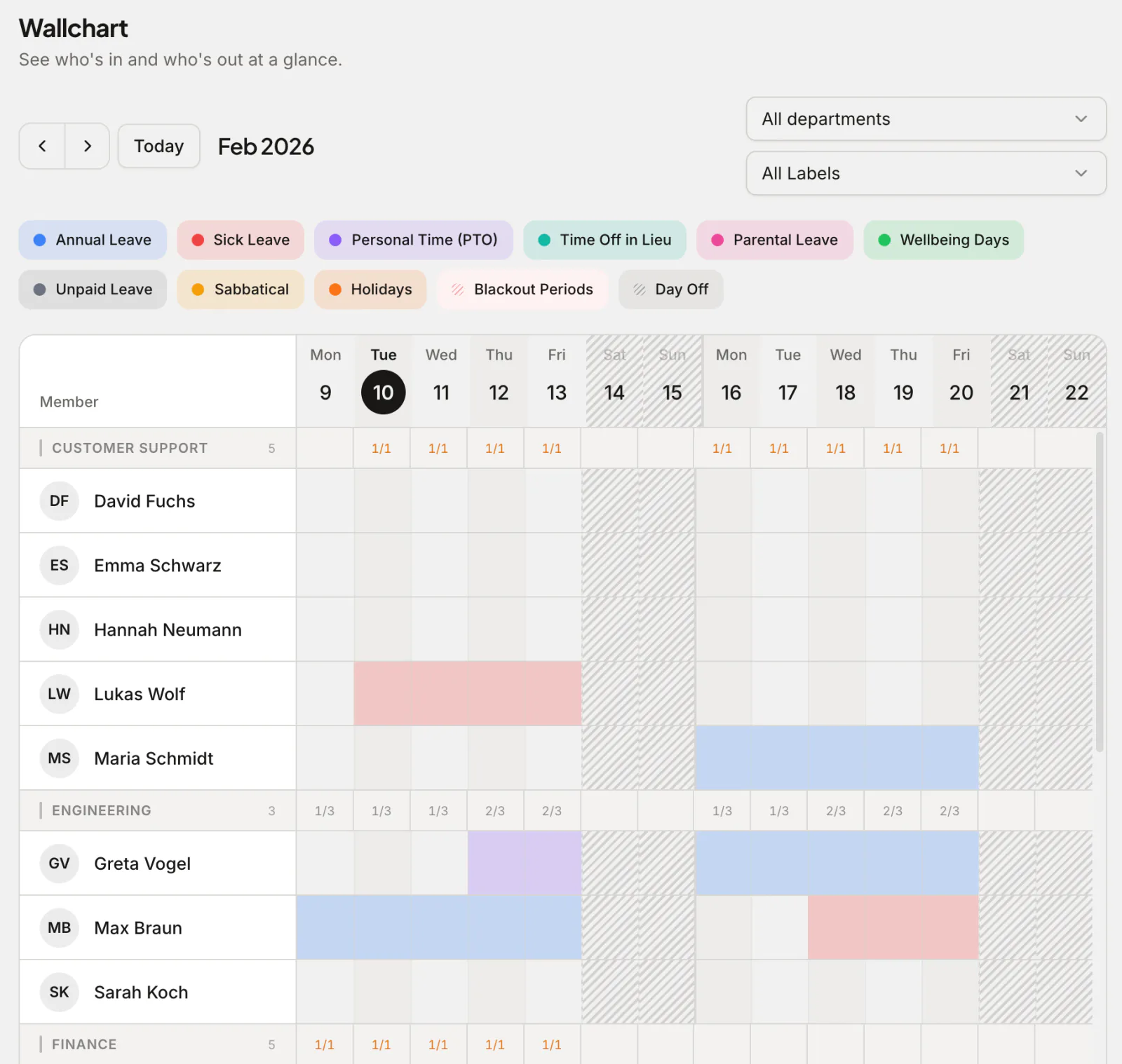
Absenca puts every person's approved leave and each office's own public holidays on one wallchart, so you can see the week of 15 August thin out long before it arrives. You can cap how many people in a department are off at once, and blackout periods block requests on critical dates. The Free plan covers teams of up to 10 people.
FAQ
Is Ferragosto a public holiday in Italy?
Yes. 15 August (the Assumption) is on Italy's list of public holidays in Law 260 of 1949, and many companies close for a week or two around it.
Does Ferragosto move when it falls on a Sunday?
In Italy and France, 15 August stays on 15 August; in 2027 it is a Sunday. In Spain, six regions (Andalucía, Aragón, Asturias, Canarias, Castilla y León and Madrid) make Monday 16 August 2027 a holiday instead.
Can a French employer make everyone take leave in August?
A French employer can require staff to take leave during a temporary company closure, and the main leave is generally taken between 1 May and 31 October. The leave period is set by the collective agreement or, failing one, by the employer after consulting staff representatives, and the employer sets the order of departures, sharing it with each employee at least one month ahead.
How much annual leave do workers get in France, Italy and Spain?
As of 2026, the statutory minimum is five weeks in France, four weeks in Italy and 30 calendar days in Spain. Collective agreements often give more. Our paid leave by country table compares more countries.
What's the best week to schedule work with southern European clients in August?
The first days of August and the last week of the month are usually workable. The week containing 15 August is the quietest, so avoid deadlines that need a client's decision then.