
Floating Holiday Policy for Religious Holidays: Template, 2027 Dates and Pitfalls
A floating holiday policy gives every employee one to three paid days a year to place on the religious or cultural dates that matter to them, such as Diwali, Eid, Lunar New Year or Orthodox Easter. Here's a template, the 2027 dates and how to run it fairly.
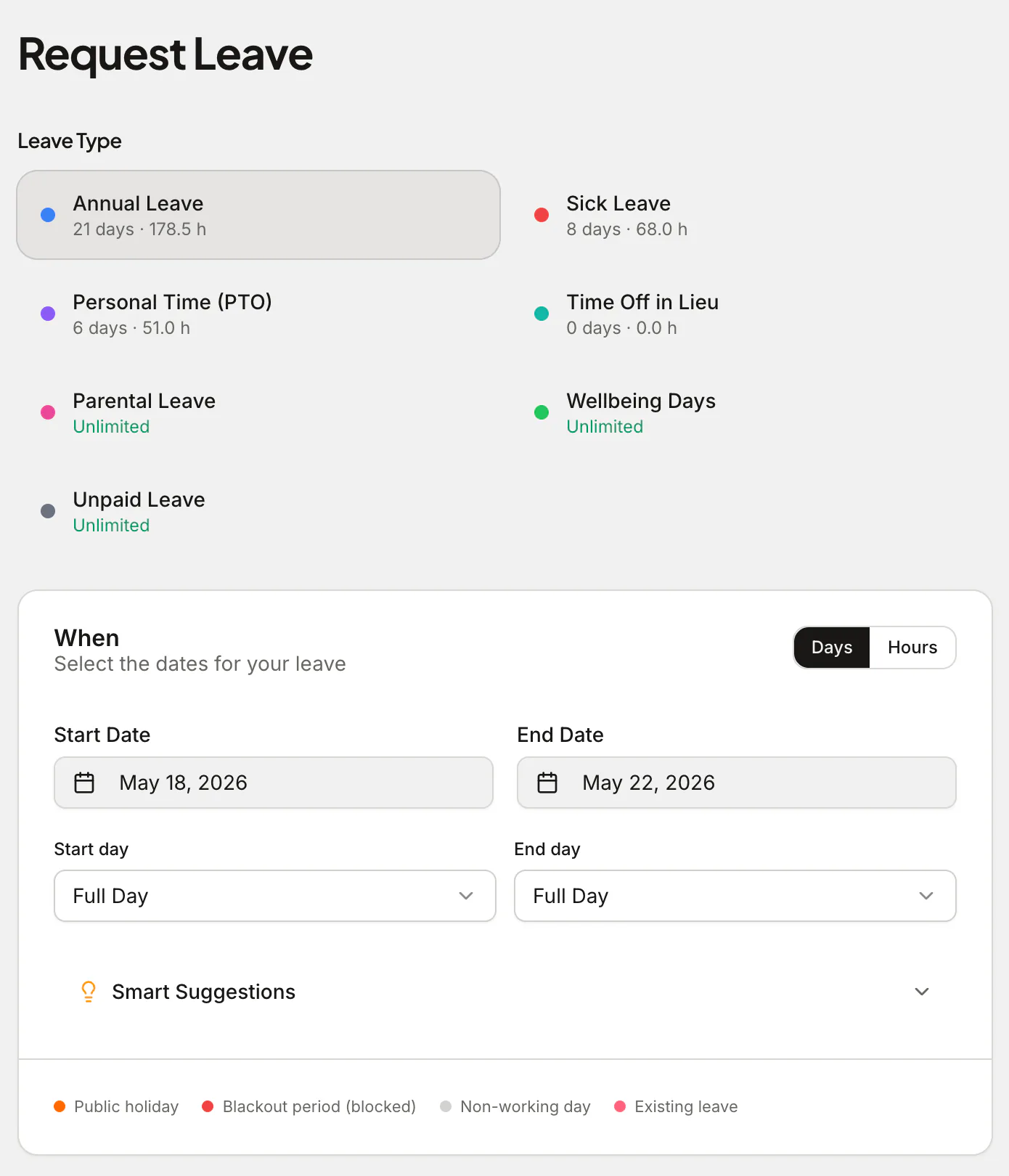
A floating holiday policy gives every employee a fixed number of paid days off (usually one or two a year) that they place on the religious or cultural dates that matter to them, instead of everyone getting the same calendar. Most policies add them on top of the standard holiday calendar, ask for advance notice, let the days expire at year end, and track them as their own leave type so they never get mixed up with annual leave.
Below: a template, the 2027 dates, and the mistakes that make a well-meant policy feel unfair.
Why offer floating holidays at all?
Because a standard holiday calendar is built around one tradition. In the US, the Bureau of Labor Statistics found that 81% of private industry workers had paid holidays in 2025, and the average was 8 days. They rarely include Eid, Diwali, Lunar New Year or Yom Kippur, so colleagues who celebrate those spend annual leave on them.
Floating holidays fix that without new office closures: everyone gets the same number of days, and each person decides where they go.
There is also a compliance angle. The US Equal Employment Opportunity Commission lists "floating or optional holidays" among the ways employers can accommodate religious practice, and its best practices point to policies that give each employee a set number of floating holidays. In the UK, Acas advises employers to try to allow time off for festivals that matter to people, without letting those requests take priority over other reasons for wanting time off.
How many floating holidays should you give?
Two is a sensible starting point, and it's the number in SHRM's example policy. One day covers a single festival but not a two-day one like Rosh Hashanah, or two festivals in one year. Three gives room for people whose calendar has several major dates.
There's no legal minimum in the US: the federal wage law does not require payment for holidays at all, so the number is a policy choice. A fair policy gives the same days to people with no religion too.
Floating holiday policy template
Copy this, then fill in the choices in brackets.
Floating holidays
- Allowance. Every [full-time / all] employee receives [2] paid floating holidays per [calendar / leave] year, in addition to the company holidays listed in [holiday calendar].
- What they're for. Floating holidays may be used for religious, cultural or personal days of significance. You don't need to tell us what the day is for, and we will not ask for proof.
- Booking. Request a floating holiday through [leave system] at least [10 working days] in advance. For observances whose date depends on a moon sighting, book the expected date and you may move it by one day at short notice.
- Half days. Floating holidays may be taken as [whole days / half days], so you can leave early for an observance that begins at sundown.
- Clashes. If more people request the same day than the team can cover, we will [approve in the order requests were made / agree a rota with the people involved] and look at alternatives such as a shift swap or a different working pattern for that day.
- New starters and part-time staff. New starters receive [all / a pro-rata share] of the allowance. Part-time employees receive [a pro-rata share / the full number of days].
- Unused days. Floating holidays [do not carry over / carry over up to 1 day] and [are not / are] paid out when you leave, subject to local law.
- Other time off. Floating holidays don't replace annual leave or any other request for time off for religious reasons. You can still ask for annual leave, unpaid leave or a schedule change for further observances.
For the rest of your leave rules, see our annual leave policy template.
When are the major religious holidays in 2027?
These are the dates for the observances employees most often ask to float, as of 2026. Several depend on the moon or on local custom, so read the notes before you circulate them.
| Observance | 2027 date | Note |
|---|---|---|
| Lunar New Year | Sat 6 Feb | Celebrations span several days. Singapore gives Mon 8 Feb as an extra holiday when the second day falls on someone's rest day (MOM). |
| Eid al-Fitr | Wed 10 Mar | Depends on the moon sighting and can move by a day. Starts at sundown the evening before. |
| Holi | Tue 23 Mar | Date from India's central government list (DoPT, O.M. of 16 July 2026). |
| Good Friday (Western) | Fri 26 Mar | Western Easter Sunday is 28 March. |
| Orthodox Good Friday and Easter | Fri 30 Apr to Mon 3 May | Five weeks after Western Easter in 2027 (Greek holiday calendar). |
| Eid al-Adha | Mon 17 May | Moon-dependent; may shift by a day. |
| Vesak | Thu 20 May | Singapore date; other countries may mark it on a different day. |
| Rosh Hashanah | Sundown Fri 1 Oct to nightfall Sun 3 Oct | Falls over a weekend in 2027 (Hebcal). |
| Yom Kippur | Sundown Sun 10 Oct to nightfall Mon 11 Oct | Many people need the Monday and an early finish on the Sunday (Hebcal). |
| Diwali | Thu 28 Oct (Singapore) / Fri 29 Oct (India) | Same festival, different official dates. Some Indian states observe it a day earlier. |
India's list itself warns that the Eid dates can change at short notice after the moon is sighted (full O.M.).
The lesson: the "right" date depends on where your employee's family is, not where your office is, and a fixed list of approved festivals always misses someone. Let the employee choose.
If you have staff in several countries, also check each office's own public holidays in our public holiday calendars, and see managing leave across two offices.
How do you run floating holidays in a leave tool?
Set them up as a separate leave type, not as extra annual leave days. That way:
- The balance is visible on its own: "2 floating holidays left" next to annual leave.
- The rules can differ: floating holidays usually expire at year end while annual leave carries over.
- Reports stay honest. You can see who hasn't used them, a sign people may not know the days exist.
In Absenca, you'd add a "Floating holiday" leave type with a yearly allowance of 2, no carry-over and a minimum notice period, and turn on half days if you allow them. You can also mark the leave type as private, so colleagues see the person as "Away" rather than learning their religion from the team calendar. The Free plan covers up to 10 people with 2 leave types, so a third type such as floating holidays needs Pro, which is billed as 50 seats at $0.75 each ($37.50 a month).
What are the common pitfalls?
- Asking people to justify their faith. Requiring someone to name the festival, or prove they observe it, turns a benefit into a test. Let the days be used for any day of personal significance.
- Putting festival requests ahead of everyone else. Acas is explicit that religious requests should not take priority over other reasons for time off, as that can discriminate against people with no religion. Handle clashes with the same rule you use for any leave; our guide to approving leave requests fairly has options.
- Forgetting that dates move. Eid can shift by a day after the moon is sighted. Allow a short-notice change for those observances without treating it as a late request.
- Treating the floating days as the end of the conversation. The EEOC's guidance is that a partial fix isn't enough if more can be done without undue hardship. Someone who needs a third day, or a regular schedule change for prayer, still deserves a hearing.
- Clashing with blackout periods. If you block leave during a year-end close or peak season, say whether floating holidays are exempt. See blackout periods explained.
FAQ
Is a floating holiday the same as PTO?
No. PTO is a general pot for any time off. A floating holiday is a separate, usually smaller allowance meant for a holiday the company calendar doesn't cover, often with its own expiry and notice rules.
Do floating holidays roll over to next year?
Usually not: the sample policies from SHRM and others let them expire at year end. You can allow one to carry over if you prefer. In the US, check your state's rules on paying out unused paid time off when someone leaves.
Can an employer deny a floating holiday request?
An employer can usually refuse a specific date for a real business reason, such as too many people already off. Refusing religious time off without a good reason can be discrimination in both the US and the UK, so offer an alternative date or arrangement rather than a flat no.
Should part-time employees get floating holidays?
Usually a pro-rata share. Some employers give the full number of days instead, since a festival is a whole day for everyone.
This is general guidance as of 2026, not legal advice. Rules vary by country and state, so check the official source for where your employees work.