
Holiday Entitlement on a 4-Day Week or Compressed Hours (UK)
On a 4-day week UK statutory holiday is 5.6 weeks: 22.4 days. On compressed hours, calculate it in hours (e.g. 4 × 9.5h = 38h × 5.6 = 212.8 hours) so long days and bank holidays come out fair.
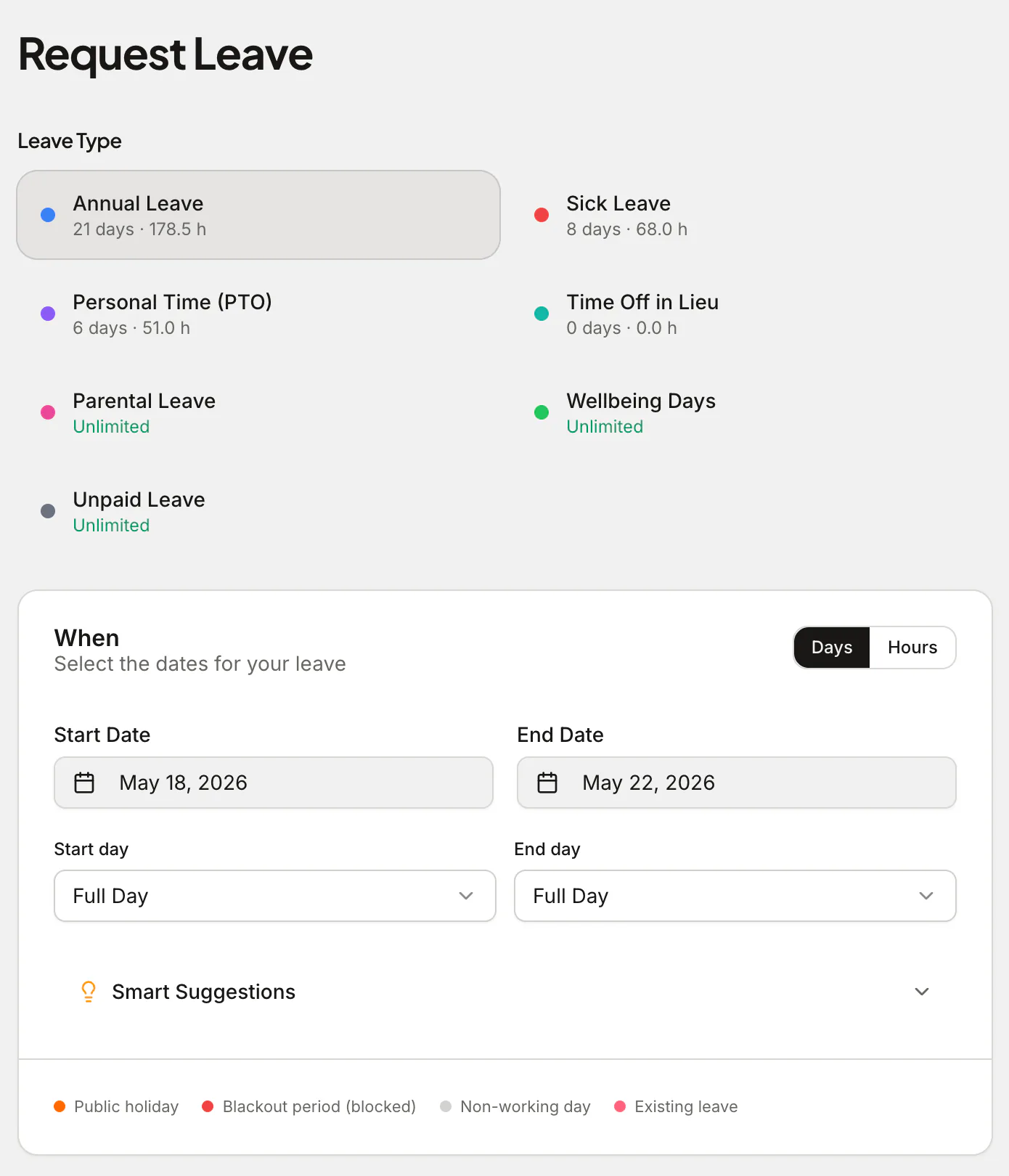
On a 4-day week in the UK, your statutory holiday is still 5.6 weeks a year: 4 × 5.6 = 22.4 days. If you work compressed hours (full-time hours over four longer days), count it in hours instead: 4 days of 9.5 hours is 38 hours a week, so 5.6 × 38 = 212.8 hours, the same time off as a five-day colleague on 7.6-hour days.
The days figure looks smaller, but each of your days is longer. The trouble starts when leave is booked as "one day" no matter how long the day is, and when bank holidays land on days you don't work. Worked 2027 numbers below (as of 2026).
How much holiday do you get on a 4-day week?
GOV.UK puts the floor plainly: "Almost all people classed as workers are legally entitled to 5.6 weeks' paid holiday a year". In days, it is the lower of 28 days or 5.6 × the days you work each week. Official guidance gives the 4-day case as an example: someone working "4 days per week, with each day being 8 hours long" has a "statutory leave entitlement" of 22.4 days.
| Working pattern | Weekly hours | Statutory days (5.6 × days) | Statutory hours (5.6 × weekly hours) |
|---|---|---|---|
| 5 days × 7.6h | 38 | 28 | 212.8 |
| 4 days × 9.5h (compressed) | 38 | 22.4 | 212.8 |
| 4 days × 8h (reduced hours) | 32 | 22.4 | 179.2 |
| 3 days × 7.5h | 22.5 | 16.8 | 126 |
These are legal minimums. If your contract gives full-timers more, say 25 days plus bank holidays, scale that number the same way.
How is holiday calculated for compressed hours?
Official GOV.UK guidance on calculating holiday says that for people who work compressed hours ("full-time hours over fewer days"), "it may be more appropriate to calculate their holiday entitlement in hours." Its method has two steps:
- Work out the entitlement in days: the lower of 28 or 5.6 × days a week.
- Multiply by your average working day (weekly hours ÷ days a week).
Worked example: 4 × 9.5 hours. 22.4 days × 9.5 hours = 212.8 hours a year. A full day off takes 9.5 hours from your balance. A morning dentist appointment of 3 hours takes 3.
If your four days are uneven, the method still holds. The guidance's own example is Irene, who works 30 hours over 4 days (two 9-hour days and two 6-hour days). Her entitlement is 22.4 × 7.5 = 168 hours, and "depending on which days she takes off as leave, it will either be 6 hours or 9 hours" from her total.
Why is "one day = one day" unfair on a 4-day week?
Picture a 22.4-day allowance where every day off counts as one day. If the four days are uneven, a 9-hour day off costs the same "one day" as a 6-hour one, so which days you book changes how much time off you really get. Bank holidays add to it, as the next section shows. Counting in hours removes the problem:
- Book a 9.5-hour Monday off: 9.5 hours come off the balance.
- A five-day colleague books a 7.6-hour Monday off: 7.6 hours come off.
- Both have 212.8 hours, so both get the same 5.6 weeks of real time away.
What happens to bank holidays on a 4-day week?
Bank holidays are not an extra legal right. GOV.UK says they "do not have to be given as paid leave", and an employer "can choose to include bank holidays as part of a worker's statutory annual leave." Acas adds that if a bank holiday falls on a day someone doesn't normally work, "the employer cannot make them use that day as part of their holiday entitlement."
The unfairness comes from where the bank holidays fall. England and Wales have 8 in 2027. Five of them are Mondays (29 March, 3 May, 31 May, 30 August and 27 December), two are Fridays (1 January, 26 March) and one is a Tuesday (28 December). Acas gives a similar example: two people both on 3 days a week, where the one who works Mondays "has to use more of their holiday entitlement for bank holidays."
Worked example, 2027, England and Wales, 4 × 9.5 hours:
| Pattern | Bank holidays on working days | Hours they cover |
|---|---|---|
| Monday to Thursday | 6 (5 Mondays + 28 Dec) | 57 |
| Tuesday to Friday | 3 (2 Fridays + 28 Dec) | 28.5 |
| Five-day colleague, 7.6h days | 8 | 60.8 |
When the business shuts on bank holidays and those hours come out of one shared allowance, the Monday-to-Thursday worker has far fewer hours left for their own holidays than the Tuesday-to-Friday worker.
How do employers fix it?
A common approach (not one set out in law) is to keep bank holidays separate and in hours:
- Give everyone a bank-holiday allowance in proportion to their hours. Someone on full-time hours compressed into four days gets the same as a full-timer: 8 × 7.6 = 60.8 hours.
- Take off the real length of each bank holiday that falls on a working day.
- Add any hours left over to annual leave. If the allowance runs short, the person books leave to cover the gap.
So the Monday-to-Thursday worker uses 57 hours and gets 3.8 hours back. The Tuesday-to-Friday worker uses 28.5 and gets 32.3 back. Both end up with the same total time off. Scotland (9 in 2027) and Northern Ireland (10) have different counts and dates, so do the sum for each office. Acas says employers should explain their bank-holiday rules, especially to people "changing from full-time work to part-time or shift work". Moving to a 4-day week is a good time to do that.
For the full-time and part-time basics, see Do Bank Holidays Count as Annual Leave?
What if I switch to a 4-day week part-way through the year?
The official guidance deals with starters and leavers, not a mid-year change of pattern. Many employers split the year at the switch date and pro-rate each part:
Example: 1 July switch, January to December leave year, statutory minimum.
- January to June on 5 × 7.5h (37.5h): 210 hours × 6/12 = 105 hours
- July to December on 4 × 8h (32h): 179.2 hours × 6/12 = 89.6 hours
- Total for the year: 194.6 hours
Take away the hours of any leave already used. Hours bring the biggest gain in a compressed switch: 5 × 7.6h becoming 4 × 9.5h is still 212.8 hours, so nothing has to be converted. In days, the balance would wrongly drop from 28 to 22.4 halfway through, and the days already taken would sit awkwardly against the new total.
The same split-year approach applies to joining mid-year. The guidance's Kirsty example pro-rates 28 days for the months she works, rounds up to 12 days, then multiplies by her 7-hour day to get 84 hours. For more on that, see Pro-Rata Holiday Entitlement, or check your own numbers with the annual leave calculator.
Why track a 4-day week in hours?
- It's fair across patterns. 9.5-hour, 7.6-hour and uneven days all come off at their real length.
- Bank holidays balance out. Whichever weekday you take off, the allowance works the same way.
- Switching pattern is simple. Hours carry over a compressed switch with no conversion.
Absenca can track leave in hours (in 15, 30 or 60-minute steps) as well as days or half-days. Each office has its own work week and public holidays. Each person follows one weekly work schedule of their office, such as Monday to Thursday, so leave is counted only on the days they work. The free plan covers up to 10 people.
FAQ
How many days holiday do I get on a 4-day week? At least 22.4 days (4 × 5.6), which can include bank holidays. If your contract gives full-timers more, you should get a proportional share of that.
Do I get fewer holidays on compressed hours? Not in real time off. You have fewer days, but each is longer. In hours, 4 × 9.5h gives 212.8 hours, the same as 5 × 7.6h.
Do I lose out if bank holidays fall on my day off? Your employer can't make you use your holiday for a bank holiday on a day you don't normally work. Many employers also give a pro-rata bank-holiday allowance in hours, so a Friday worker and a Monday worker end up even.
How many hours is a day's holiday on a 4-day week? Whatever that day would have been. A 9.5-hour day costs 9.5 hours. On uneven patterns, the official guidance takes the hours of the actual day off.
Does my holiday change if I move to a 4-day week mid-year? On compressed hours with the same weekly total, your hours entitlement stays the same. If your weekly hours drop, each part of the year is usually pro-rated at its own hours.
Rules vary and can change. Check GOV.UK's holiday entitlement guidance and Acas for the current position.