
Do Bank Holidays Count as Annual Leave? UK Rules for Full-Time and Part-Time Workers (2026)
They can: UK workers get 5.6 weeks' paid holiday (28 days for a five-day week) and employers may include bank holidays in it. Part-timers get 5.6 weeks pro rata and can't be made to use leave for a bank holiday on a day they don't work.
Yes, bank holidays can count as annual leave in the UK: the legal minimum is 5.6 weeks of paid holiday a year (28 days for someone working five days a week), and an employer is allowed to include bank holidays inside those 5.6 weeks rather than on top. Whether yours do depends on your contract, and if you work part time you get the same 5.6 weeks pro rata, so a bank holiday that falls on your day off must not leave you with less than your share.
Is there a legal right to bank holidays off?
No. GOV.UK states plainly that "bank or public holidays do not have to be given as paid leave", and nidirect says the same for Northern Ireland: there is no statutory right to paid leave on bank and public holidays.
What the law guarantees is the total: 5.6 weeks of paid holiday a year for almost every worker, capped at 28 days for statutory purposes even if you work six days a week. The employer then decides, through the contract, how bank holidays fit into that total.
Does 5.6 weeks include bank holidays?
It can. Acas puts it simply: an employer "can include bank holidays in the statutory minimum 5.6 weeks' paid holiday", or it can give them on top. The same rule applies to full-time and part-time staff. For a five-day full-timer in England and Wales, the two most common set-ups look like this:
| Contract wording | Total paid days | Bank holidays (England and Wales) | Days you choose |
|---|---|---|---|
| "28 days including bank holidays" | 28 | 8 | 20 |
| "20 days plus bank holidays" | 28 | 8 | 20 |
| "25 days plus bank holidays" | 33 | 8 | 25 |
| "25 days including bank holidays" | 25 | 8 | Not lawful: below the 28-day minimum |
The first two are the same minimum written two ways. The last is a common mistake: if bank holidays sit inside the allowance, the allowance must be at least 28 days.
How do I check what my contract says?
Look in your written statement of terms or contract for the holiday clause. The phrases that matter are "inclusive of" or "including" bank holidays (they come out of your allowance) versus "in addition to" or "plus" bank holidays (they're on top). Check too whether the workplace closes on bank holidays. Acas says an employer can make you take a bank holiday as part of your leave when the workplace is shut, but it has to be in the contract or you have to be given notice: at least twice as many days' notice as the leave they want you to take.
If you work a bank holiday, you can ask for a day off in lieu, but the employer doesn't have to agree. What they can't do is pay you instead of your leave while you're still employed: you must still get your full 5.6 weeks as paid time off.
How many bank holidays are there in each part of the UK?
The count isn't the same everywhere, which matters for any "including bank holidays" contract.
| England and Wales | Scotland | Northern Ireland | |
|---|---|---|---|
| Bank holidays in 2026 | 8 | 10 | 10 |
| Bank holidays in 2027 | 8 | 9 | 10 |
| Holidays only this nation has | — | 2 January, St Andrew's Day (30 November) | St Patrick's Day (17 March), Battle of the Boyne (12 July) |
Scotland has a first Monday in August summer holiday and no Easter Monday; in 2026 it also had a one-off bank holiday on 15 June for the World Cup. Northern Ireland has 10 bank and public holidays. So a Scottish employee on "28 days including bank holidays" in 2026 has 18 days to choose, while a colleague in Manchester on the same wording has 20. If your leave year runs April to March, Acas notes the number of bank holidays in it can change with the date of Easter. For full lists by year, see our public holidays calendar.
The leave rules themselves match: nidirect describes the same 5.6-week minimum and pro-rata approach for Northern Ireland.
How do bank holidays work for part-time workers?
Part-time workers get 5.6 weeks pro rata: multiply the days you work each week by 5.6. Someone on three days a week is entitled to at least 16.8 days (3 x 5.6); on four days, 22.4; on two days, 11.2. The Part-time Workers Regulations 2000 say a part-timer must not be treated less favourably than a comparable full-timer, applying the pro-rata principle, unless the employer can justify it on objective grounds.
Two rules follow from that:
- A bank holiday on your day off can't be taken from your allowance. Acas: if a bank holiday falls on a day you don't normally work, the employer "cannot make them use that day as part of their holiday entitlement".
- Extra bank holiday time off is pro rata, whatever your days. nidirect says bank holiday time off "should be given pro rata to you as well, even if the bank holiday does not fall on your usual work day."
Why do bank holidays on non-working days feel unfair?
Because in England and Wales most bank holidays land on a Monday. Of the 8 in 2026, five are Mondays (Easter Monday, both May holidays, the August holiday and the Boxing Day substitute), two are Fridays and one, New Year's Day, is a Thursday. If an employer gives full-timers "20 days plus bank holidays" and part-timers only the bank holidays that land on their working days, someone who never works Mondays or Fridays gets almost nothing, and someone who works Mondays gets most of them. That's the unfairness the pro-rata rule is there to fix.
Worked examples: full-time and part-time
Take an office in England that closes on bank holidays and uses "28 days including bank holidays" (pro rata for part-timers), with the 2026 calendar.
| Person | Pattern | Total entitlement | Bank holidays on their working days | Days left to book |
|---|---|---|---|---|
| Greta | Mon–Fri | 28 | 8 | 20 |
| Ali | Mon, Tue, Wed | 16.8 | 5 (the Mondays) | 11.8 |
| Jo | Tue, Wed, Thu | 16.8 | 1 (New Year's Day) | 15.8 |
This is the Acas approach: Ali and Jo both get 16.8 days including bank holidays, and Ali simply uses more of theirs on days the office is shut. Neither is short-changed, and the 0.8 of a day can't be rounded down.
Now the wrong way. Same office, but the policy is "20 days plus the bank holidays you'd normally work", with the 20 days pro-rated to 12 for three-day staff. Jo ends up with 12 + 1 = 13 paid days, below the statutory 16.8, so it isn't allowed. Ali gets 12 + 5 = 17 for the same hours.
Many employers avoid the problem altogether by giving leave in hours. A full-timer on 37.5 hours a week has 5.6 x 37.5 = 210 hours; someone on 22.5 hours has 126 hours. Each closed bank holiday is deducted at the hours you'd have worked, so nobody gains or loses from which weekdays they work. Our guide to pro-rata holiday entitlement covers the hours method in more detail, and the annual leave calculator does the sums for you.
Keeping the bank holiday sums straight
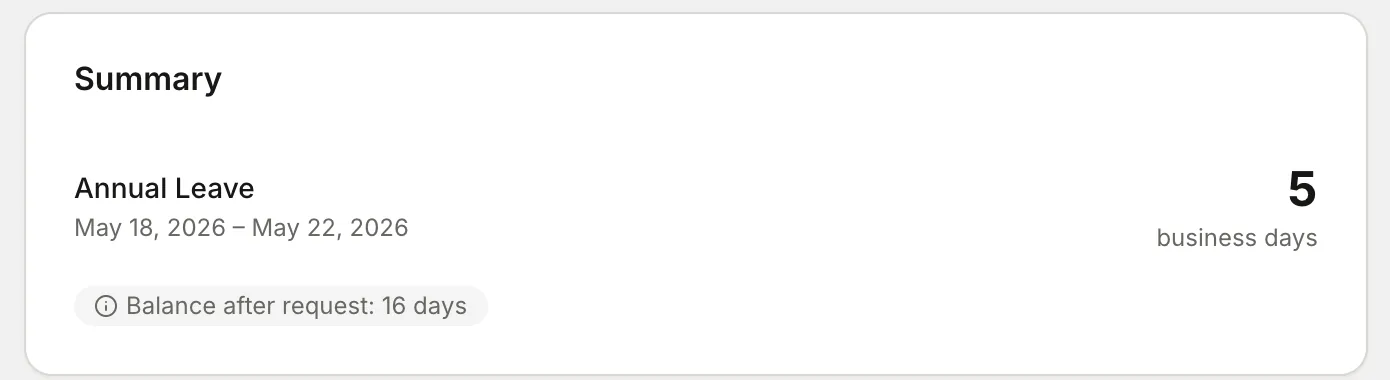
If you track this, the hard part is applying the right calendar and working pattern to each person. In Absenca, each office has its own work week and its own public holiday calendar, and a leave request is counted in that office's working days with its bank holidays skipped, so on a paid plan an Edinburgh office and a London office deduct different days without anyone checking by hand. The Free plan covers one office and up to 10 people.
Frequently asked questions
Do bank holidays count as annual leave? They can. UK law guarantees 5.6 weeks of paid holiday (28 days for a five-day week) and lets the employer include bank holidays in it. Your contract says whether they're "included" or "on top".
Is 28 days including bank holidays legal? Yes, for a full-time worker on five days a week that's exactly the statutory minimum. In England and Wales it leaves 20 days to choose; in Scotland and Northern Ireland, with more bank holidays, it leaves fewer.
What if a bank holiday falls on my day off? Your employer can't make you use your holiday for it. If full-timers get bank holidays as extra time off, you should get a pro-rata share even when they don't fall on your usual days.
How many bank holidays do part-time workers get? There's no fixed number. If bank holidays come out of the 5.6 weeks, your total is your days per week x 5.6 (16.8 for three days). If they're given on top, you get the full-time number pro rata: 8 x 3/5 = 4.8 days in England and Wales for a three-day week.
Can my employer make me take holiday on a bank holiday? Yes, if the workplace closes and it's in your contract or you get notice of at least twice as many days as the leave. For more on when employers can set your dates, see can my employer refuse my holiday request.
This is general guidance as of October 2026. Rules vary by contract and can change, so check GOV.UK, Acas or nidirect for your situation.