
Last-Minute Annual Leave Requests: A Fair Short-Notice Policy (With Sample Wording)
Sort last-minute annual leave requests by notice: same-day only for emergencies or when cover exists, under a week if the team can cover, and longer requests under the normal rule. In the UK the default notice is twice the length of the leave, so shorter requests are at the employer's discretion.
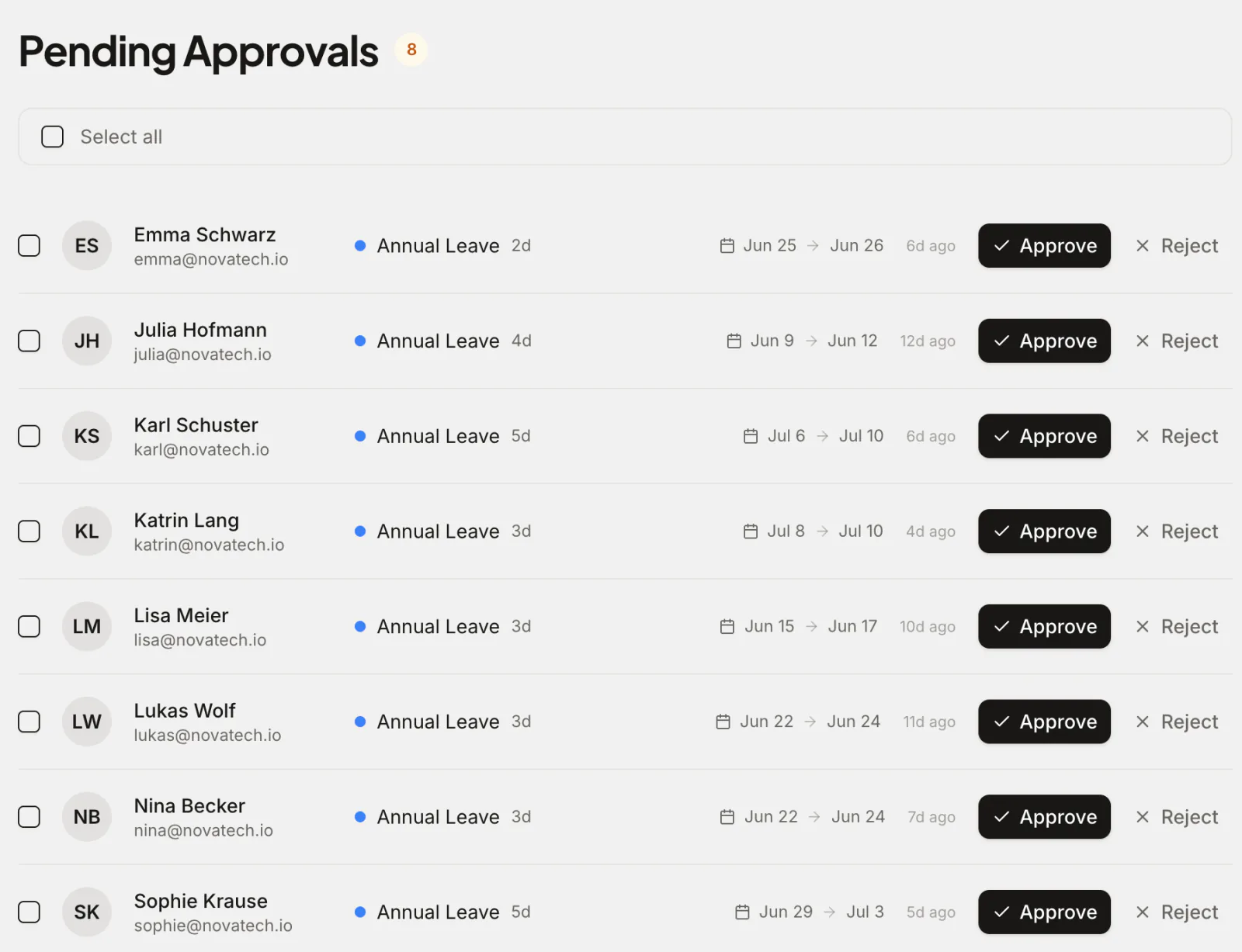
A fair policy for last-minute annual leave requests sorts them by how much notice they give: same-day and next-day requests are approved only for real emergencies or when cover is already in place, requests under a week are approved if the team can cover, and anything longer follows the normal notice rule. In the UK, the legal default is that a worker gives notice of at least twice the length of the leave, so anything shorter is at the employer's discretion unless your contract or policy says otherwise.
The harder part is refusing consistently. This guide gives the notice rules people expect, a three-tier policy, a way to tell emergencies from preferences, and wording you can paste into your handbook. Rules checked as of October 2026.
How much notice do employees have to give for a holiday request?
In Great Britain the default comes from regulation 15 of the Working Time Regulations 1998: the worker's notice must be at least twice as many days in advance as the leave they want. To refuse, the employer must give counter-notice at least as many days in advance as the leave requested.
| Situation | Statutory default (GB) | Example |
|---|---|---|
| Worker asks for leave | Twice the length of the leave | 10 days' notice for 5 days off |
| Employer refuses or cancels | Same length as the leave | 5 days' notice to refuse 5 days |
| Employer requires leave on set dates | Twice the length of the leave | 10 days' notice for a 5-day shutdown |
Two caveats:
- GOV.UK adds "plus 1 day". Its guidance says a worker gives "3 days' notice for 1 day's leave", and an employer refusing 10 days gives 11 days' notice. The regulation itself states the periods without the extra day. If you're writing a policy, build in the extra day and you're safe either way.
- Your contract or policy can replace the default. Regulation 15(5) lets a "relevant agreement" vary or exclude these notice rules, and GOV.UK confirms that what's in the contract applies. That's why a written short-notice policy is worth having.
If you're an employee wondering whether a refusal was allowed, our guide to whether your employer can refuse your holiday request covers the UK and Ireland from that side.
Can I refuse a short-notice holiday request?
Usually, yes. If someone asks for leave with less notice than the statutory default (or your contractual rule), there's no statutory right to that leave on those dates, so it's your call. But two limits apply even then:
- You still need a reason. Acas says an employer "should have a good business reason to refuse or cancel a holiday request" and should "follow their organisation's policy when considering requests". Short-staffing that week is a good reason. "I don't like short notice" on its own isn't one.
- You can't stop leave altogether. Acas is clear that "an employer cannot refuse to let workers take any holiday at all." Refusing short-notice requests is about controlling timing, not entitlement. Someone who keeps getting refused must still have a real chance to use their holiday within the leave year.
What does a fair tiered short-notice policy look like?
Group requests by notice, and give each tier a clear default answer. The point is that the manager applies the tier, rather than deciding from scratch each time.
| Tier | Notice given | Default answer | Approve when |
|---|---|---|---|
| 1. Same day / next day | Under 24 hours | Not as annual leave by default | It's an emergency (see below), or cover is already in place and no one else is off |
| 2. Short notice | 1 to 6 days | Case by case | The team stays above its minimum cover, there's no blackout, and the person has balance |
| 3. Standard | 7 days or more, and at least twice the length of the leave | Approve unless there's a stated business reason | Normal rules: cover cap, clashes, balance |
A few design choices make the tiers hold up:
- Use the longer of the two notice rules for tier 3. "Seven days, or twice the length of the leave, whichever is longer" means a two-week holiday still needs four weeks' notice, in line with the statutory default.
- Set a response time for each tier. A same-day request needs an answer within the hour, a short-notice request within one working day, a standard request within, say, three working days.
If you already restrict leave around busy periods, short-notice requests should respect those dates too; see blackout periods explained.
How do you tell an emergency from a last-minute preference?
Ask what happened, not how urgent it feels. An emergency is something the person couldn't have planned for; a preference is a plan that came up late (cheap flights, a friend visiting, good weather).
In the UK, many genuine emergencies aren't annual leave questions at all. Section 57A of the Employment Rights Act 1996 gives employees the right to "a reasonable amount of time off" to deal with emergencies involving a dependant: illness, injury, a death, an unexpected breakdown of care arrangements, or an incident at school. GOV.UK notes this time off can be unpaid ("Your employer may pay you … but they do not have to"), there's no set amount of time, and it doesn't cover situations the person knew about beforehand. The employee must tell you the reason "as soon as reasonably practicable".
So route emergencies to dependants, compassionate or sick leave (see our bereavement leave policy), and let the employee use annual leave instead if they'd rather be paid. Don't ask for evidence you wouldn't ask of anyone else.
How do you stay consistent when every request feels different?
Acas asks employers to "be open, fair and consistent". Three habits do most of the work:
- Decide on the same facts every time. Before answering, check the same four things: how much notice, who else is already off, whether the dates are restricted, and whether the person has the balance. If the answer to all four is fine, approve.
- Write the reason down. A one-line reason ("two of five on the support rota already off Friday") turns a refusal into the policy working.
- Review decisions twice a year. If the same people are always told no, adjust the rules or the cover plan.
For tie-breakers when two requests collide, see how to approve leave requests fairly.
Sample wording for a short-notice leave policy
Adapt the numbers to your team and drop it into your annual leave policy.
Short-notice leave requests
We ask for at least 7 days' notice, or twice the length of the leave you're requesting (whichever is longer), so that we can arrange cover.
Same-day or next-day requests are approved as annual leave only if cover is already in place and no one else in your team is off. If something unexpected has happened, such as a family emergency, illness or a breakdown in childcare, tell your manager as soon as you can. We'll treat it as emergency, compassionate or sick leave under the relevant policy, and you can choose to use annual leave instead if you prefer to be paid.
Requests with 1 to 6 days' notice are considered case by case. We'll approve them if your team stays above its minimum cover, the dates aren't restricted, and you have enough leave left. Your manager will reply within one working day.
Requests with standard notice are approved unless there's a business reason not to, which your manager will explain.
If your manager is away, [deputy role] decides. Every refusal comes with a reason. We apply these rules to everyone in the same way, and we'll never refuse leave so often that you can't use your full entitlement in the leave year.
Making short notice easier to answer
Most of the delay in a short-notice decision is checking who else is off. In Absenca, managers approve or reject from one queue and can check the team wallchart for cover first. The Free plan covers teams of up to 10 people.
FAQ
How much notice do you need to give for a holiday request in the UK?
By default, at least twice the length of the leave: 2 days' notice for 1 day off, 10 days for a week (GOV.UK adds one extra day). Your contract or handbook can set a different rule, and if it does, that rule applies.
Can my manager say no to a last-minute holiday?
Yes, if it doesn't meet the notice rule, they can generally refuse, though they should have a business reason and apply the policy consistently. They can't use refusals to stop you taking your holiday altogether.
Is a family emergency annual leave?
Not necessarily. In the UK, employees have a right to reasonable time off to deal with an emergency involving a dependant. It may be unpaid, so some people choose to use annual leave instead to keep their pay.
Can an employer cancel leave they've already approved at short notice?
Under the GB default, the employer must give at least as much notice as the length of the leave (5 days to cancel 5 days off), unless the contract says otherwise. Acas warns it can harm your relationship with the worker, especially if they've already booked and paid for a holiday.
This is general guidance based on the GB rules as of October 2026. Northern Ireland, Ireland and other countries have their own rules, and contracts can change the defaults, so check the official source for your jurisdiction.