
Menstrual and menopause leave policy: what the law says in Spain and the UK
Spain gives paid sick leave from day one, funded by Social Security, for painful periods caused by a diagnosed condition. The UK has no statutory menstrual or menopause leave, but the Equality Act 2010 and EHRC guidance expect reasonable adjustments, so many employers write a policy.
Spain has a legal menstrual leave: since 2023, women whose painful periods come from a diagnosed condition can be signed off sick, and Social Security pays from the first day. The UK has no statutory menstrual or menopause leave, but the Equality Act 2010 can protect people with menopause symptoms, and the EHRC expects employers to make reasonable adjustments, so a written policy is the practical way to handle it.
Below: what each country's law actually says (as of 2026), then the options for a policy you can adapt.
What is Spain's menstrual leave law?
Spain added it through Ley Orgánica 1/2023, of 28 February, which amended its sexual and reproductive health law and the General Social Security Law (LGSS). The law calls it menstruación incapacitante secundaria: incapacity caused by dysmenorrhoea "generated by a previously diagnosed pathology". The preamble gives examples such as endometriosis, fibroids, pelvic inflammatory disease, adenomyosis, endometrial polyps and polycystic ovaries.
It is not a separate pot of paid days. It is a special type of temporary incapacity (sick leave) for common contingencies, so it starts with a doctor's sick note (baja médica) like any other sickness absence.
| Question | Spain (LGSS as amended by LO 1/2023) |
|---|---|
| Who qualifies | Women with secondary incapacitating menstruation, linked to a previously diagnosed condition |
| How it starts | A medical sick note, as with other temporary incapacity |
| Minimum contribution period | None required (art. 172) |
| Who pays, and from when | Social Security, from the day the leave starts (art. 173.1) |
| Repeat episodes | Each episode counts as a new process (art. 169.2) |
| Social Security contributions | Continue during the leave (art. 144.4) |
| In force since | Three months after BOE publication on 1 March 2023, so from June 2023 |
The detail employers most often ask about is who pays. For menstrual incapacity, the law says the benefit "will be paid by Social Security from the day of leave from work". The employer's job is to accept the sick note and not treat the absence any differently from other protected leave.
Is there menstrual or menopause leave in the UK?
No. There is no statutory right to menstrual leave or menopause leave in the UK as of 2026. Acas says menopause "is not a specific protected characteristic under the Equality Act 2010" and that there is "no law" for time off for menopause appointments, although some people may have a contractual right to it.
That does not mean employers can ignore it. Unfavourable treatment linked to symptoms can still be discrimination if it is connected to a protected characteristic, mainly:
- Disability: in some cases menopause symptoms can amount to a disability. If they do, the employer must make reasonable adjustments.
- Age: less favourable treatment because someone is going through menopause can be age discrimination. Acas notes this can affect younger people with medical or early menopause too.
- Sex: unwanted behaviour about someone's symptoms can count as harassment or sexual harassment.
What does the EHRC menopause guidance say?
The Equality and Human Rights Commission published Menopause in the workplace: guidance for employers in February 2024. Its message is that symptoms with a long-term and substantial effect on day-to-day activities may be a disability, which brings the duty to make reasonable adjustments, and that women going through menopause may also be protected because of their age and sex. The guidance also covers the risks of disciplining someone for menopause-related absence or making comments about it.
Acas makes the practical point clearly: employers should record menopause-related absence separately from other absences, because "it could be unfair or discriminatory to measure this absence as part of the person's overall attendance record". If you use trigger points such as the Bradford Factor, this is where it matters.
What changed in 2026: menopause action plans
The Employment Rights Act 2025 introduced equality action plans. Employers with 250 or more employees can publish a voluntary plan for the 2026 to 2027 reporting year, and the government says that, subject to legislation, plans become mandatory from spring 2027. Each plan must include at least one action on the gender pay gap and at least one action supporting employees experiencing menopause, which "includes both perimenopause and postmenopause". Workplace adjustments are one of the listed actions.
Note what this is not: it is a duty to plan and publish, not a new right to leave.
How to write a menstrual and menopause policy
Most policies combine three building blocks. Pick the mix that suits your team.
Option 1: paid days off
Some employers offer a small number of paid days a year for menstrual or menopause symptoms, with no sick note needed. If you do this:
- Say how many days, whether they reset each leave year, and whether half-days count.
- Make them available to anyone with menstrual or menopause symptoms, including trans and non-binary staff, and people in early or medical menopause.
- Say clearly that these days do not count towards absence triggers.
In Spain, a policy like this sits on top of the statutory sick-leave route; it does not replace it.
Option 2: flexible working and adjustments
The government's adjustment guidance lists options such as:
- flexible working hours, or working from home when practical
- breaks when needed, or a private space to rest
- some control over the environment: a fan, a desk near a window, ergonomic furniture
- temperature and ventilation settings
- specialist health advice
Acas also suggests allowing time for menopause-related medical appointments as good practice.
Option 3: privacy and how to ask
This is where most policies succeed or fail. Write down:
- Who to tell. A named contact as well as the line manager, so nobody has to raise it with a manager they are uncomfortable with.
- What gets recorded. Use a neutral leave name ("wellbeing day" or "health leave") so a calendar or report doesn't reveal the reason. Health data is sensitive personal data, so limit who can see the reason.
- What you won't ask for. Decide whether you need any evidence for policy days. Many employers ask for none.
- Tone. Acas says menopause should be handled "sensitively, and with dignity and respect". Keep the language plain, not clinical, and not jokey.
A short policy template
Menstrual and menopause health policy
Purpose. We want anyone affected by menstrual or menopause symptoms to be able to work comfortably and take time off without stigma.
Who it covers. All employees experiencing menstrual, perimenopause or menopause symptoms, whatever their gender or age.
Time off. You can take up to [X] paid health days a year, in full or half-days, with no sick note. These days are recorded separately and are not used in absence reviews. Longer absences follow our sick leave policy.
Adjustments. Ask your manager or [named contact] for flexible hours, home working, extra breaks, a fan or desk move, or uniform changes. We will review requests promptly and in confidence.
Appointments. You can attend related medical appointments in working time.
Privacy. Only [HR / named contact] will know the reason for your leave. The team calendar shows "health day" only.
Support. [Occupational health / employee assistance / support network details.]
Tracking it without exposing it
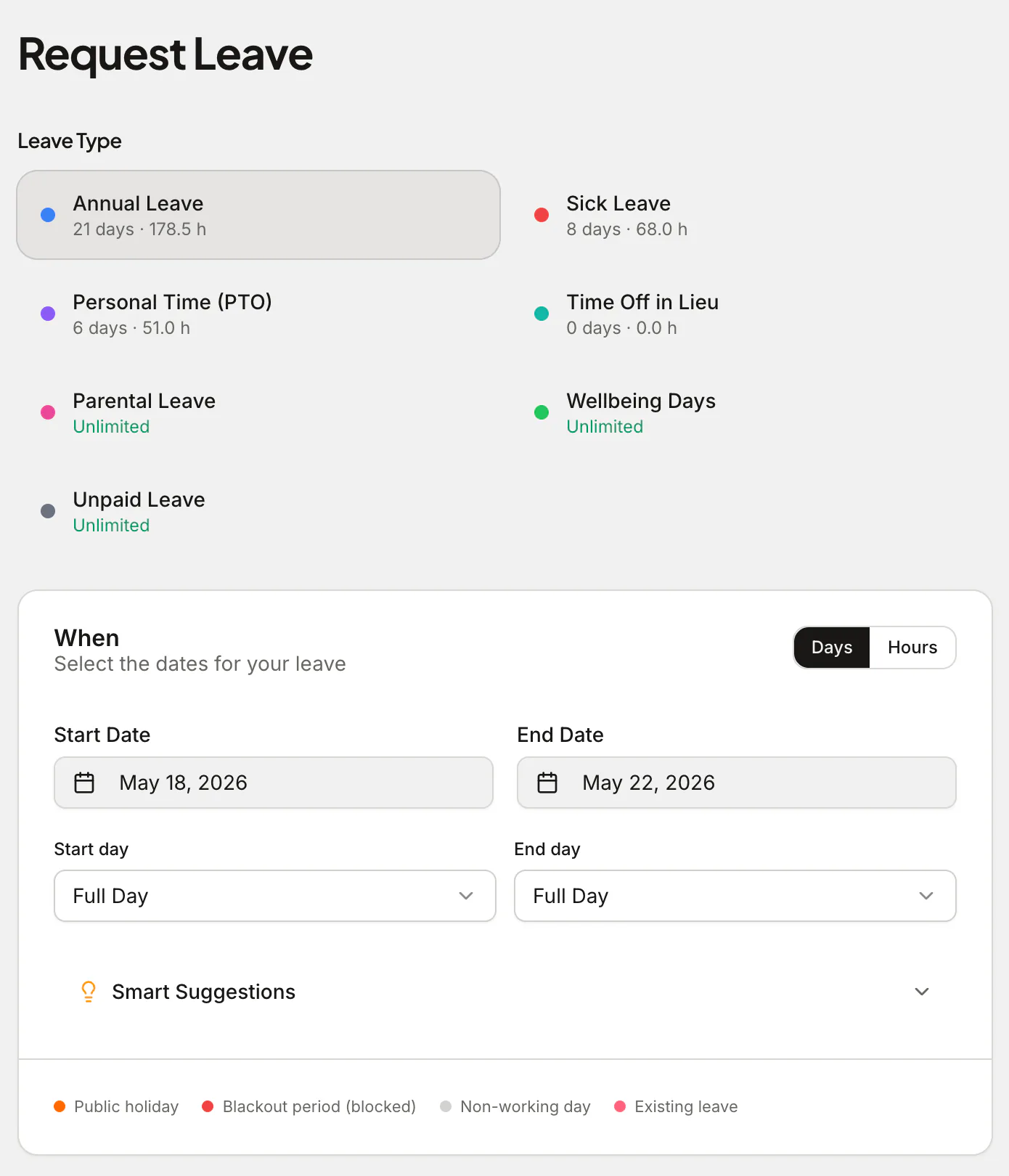
In Absenca you can create a dedicated leave type with a neutral name and its own allowance, so these days sit apart from general sick leave, which is what Acas recommends. Leave can be taken in days, half-days (AM/PM) or hours, which fits symptoms that come and go. The Free plan includes 2 leave types for up to 10 people; Pro allows 20. See the absence tracker for how it works.
FAQ
Is menstrual leave a legal right in Spain? Yes, for women whose painful periods come from a previously diagnosed condition. It works as a special sick leave with a medical note, paid by Social Security from the first day, with no minimum contribution period.
Is menopause leave a legal right in the UK? No. There is no statutory menopause leave as of 2026. Employers must still avoid discrimination under the Equality Act 2010 and make reasonable adjustments where symptoms amount to a disability.
Do UK employers need a menopause policy? It isn't a legal requirement. From spring 2027, subject to legislation, employers with 250 or more staff will have to publish an action plan that includes at least one menopause support action. A policy is the simplest way to show what support exists.
Should menopause absence count towards sickness triggers? Acas advises recording it separately, because counting it in someone's overall attendance record could be unfair or discriminatory.
Who pays for menstrual leave in Spain, the employer or the state? Social Security pays the benefit from the day the leave starts. Contributions continue during the leave.
Rules change and vary by country; check the official source (BOE, GOV.UK, Acas, EHRC) before you finalise your policy.