
Pet Bereavement Leave Policy: Template and How to Run It (UK and Ireland)
There is no statutory right to pet bereavement leave in the UK or Ireland, so it is up to the employer. A simple policy gives one paid day, allows annual or unpaid leave for extra time, and asks for no evidence; a copy-ready template is below.
There is no statutory right to pet bereavement leave in the UK or Ireland as of 2026, so whether staff get time off when a pet dies is entirely the employer's choice. A simple, fair approach is one paid day, annual or unpaid leave for extra time, no evidence required, all written into a short policy like the template below.
Is there a legal right to time off when your pet dies?
No. In the UK, Acas states plainly that outside the specific statutory cases "there's no legal right to time off" for a bereavement, and "there is no legal right to paid time off for bereavement" unless someone qualifies for parental bereavement pay. The statutory rights that do exist are about people:
| Right | Who it covers | Covers a pet? |
|---|---|---|
| Time off for dependants (UK) | "a spouse, partner, child, grandchild, parent, or someone who depends on you for care" | No |
| Parental Bereavement Leave (UK) | Parents whose child dies before 18, or a stillbirth after 24 weeks; 2 weeks' leave | No |
| Force majeure leave (Ireland) | Sick or injured child, spouse or partner, sibling, parent or grandparent, or a person who relies on the employee as carer | No |
| Bereavement or compassionate leave (Ireland) | No statutory entitlement to paid bereavement leave | No |
Time off for dependants in the UK does not have to be paid either: gov.uk says "your employer may pay you for time off to look after dependants but they do not have to." In Ireland, force majeure leave is paid but capped at 3 days in any 12 consecutive months, or 5 days in any 36, and only when the employee's presence with the ill or injured person is "indispensable".
So "pawternity leave", or pet bereavement leave, is a voluntary benefit. Acas encourages employers to "be compassionate towards a person's individual situation" and notes that an employer "can choose to offer time off", often called compassionate or special leave.
Why do companies offer pet bereavement leave?
- People will be off anyway. Someone whose dog was put down last night is rarely productive the next morning. A day off that is written down beats a sick day nobody believes, or a day of presenteeism (see the cost of working while sick).
- It removes awkward conversations. Without a policy, every request becomes a manager's judgement call, and two managers will answer it differently.
- It costs very little. Pet deaths are rare per employee, so one day a year is cheap to budget.
- It signals culture. For pet-owning staff and candidates it is a visible, low-cost sign that the company treats them as people.
What are the options for a pet bereavement leave policy?
| Option | How it works | Good fit when |
|---|---|---|
| 1 day paid, dedicated leave type | A separate "pet bereavement" allowance, usually 1 day per year | You want a clear, generous benefit |
| Use compassionate leave | Pets are named inside your existing compassionate and bereavement leave policy | You already have discretionary compassionate leave |
| Use annual leave at short notice | No new allowance, but managers approve same-day holiday for a pet loss | Budget is tight but you still want flexibility |
| Unpaid leave | Time off guaranteed, without pay | You want to protect the time without the cost |
| Combination | 1 paid day, then annual or unpaid leave for extra time | A balanced default for a small company |
Whichever you choose, decide the cap up front. Someone who fosters animals may lose several in a year: is it one day per animal, or one day per year? Writing it down keeps the policy fair to everyone.
Who should be eligible?
Keep it simple:
- From day one. There is no statutory qualifying period to copy, and a probation-period exclusion feels harsh for a one-day benefit.
- All employees, pro rata for part-time staff if the leave is in hours. If it is "one working day", a part-timer simply takes one of their working days.
- Which animals. "A pet that lived with you" is enough. Avoid lists of species; a 15-year-old cat and a horse can both hurt.
- Euthanasia appointments. Let people take the day of the vet appointment, not only the day after.
What evidence should you ask for?
None. Asking for a vet's letter or a death certificate for a pet turns a kind gesture into an audit, and the risk of abuse for one day a year is tiny. The request itself is the evidence. If you see a pattern that worries you, handle it as a general attendance conversation, not through the pet policy.
Pet bereavement leave policy template
Copy this and adapt the bracketed parts.
Pet bereavement leave policy
1. Purpose. [Company] recognises that losing a pet can be as hard as losing a family member. This policy gives you time to grieve and make arrangements without using your holiday.
2. Entitlement. You can take up to [1] working day of paid pet bereavement leave in any [leave year]. It can be taken as a full day or two half-days, on the day of the pet's death or euthanasia appointment or within [2 weeks] of it.
3. Extra time. If you need more time, you can request annual leave at short notice or unpaid leave. Your manager will approve these wherever the team can cover you.
4. Eligibility. All employees, from their first day. A pet means an animal that lived with you as a companion.
5. How to request it. Tell your manager as soon as you reasonably can, by message or phone, and record the leave in [leave system] when you are back. You do not need to give details.
6. Evidence. No evidence is required.
7. Pay. Pet bereavement leave is paid at your normal rate and does not reduce your annual leave balance.
8. Support. If grief is affecting your health or work, speak to your manager or HR about further support, including sick leave where appropriate.
Put it next to your annual leave policy and your sick leave policy so people can find it in one place.
How should managers handle a request sensitively?
- Approve first, admin later. A quick "sorry, take the day, log it when you're back" is the whole job.
- Do not rank grief. Avoid "it was only a hamster" or comparisons with human loss.
- Keep it private. Leave reasons do not belong on the team calendar; show "out of office", not "pet died".
- Check in once. A short message on their return is enough.
- Be consistent. Apply the same rules to every team so the benefit does not depend on who the manager is.
Tracking pet bereavement leave in Absenca
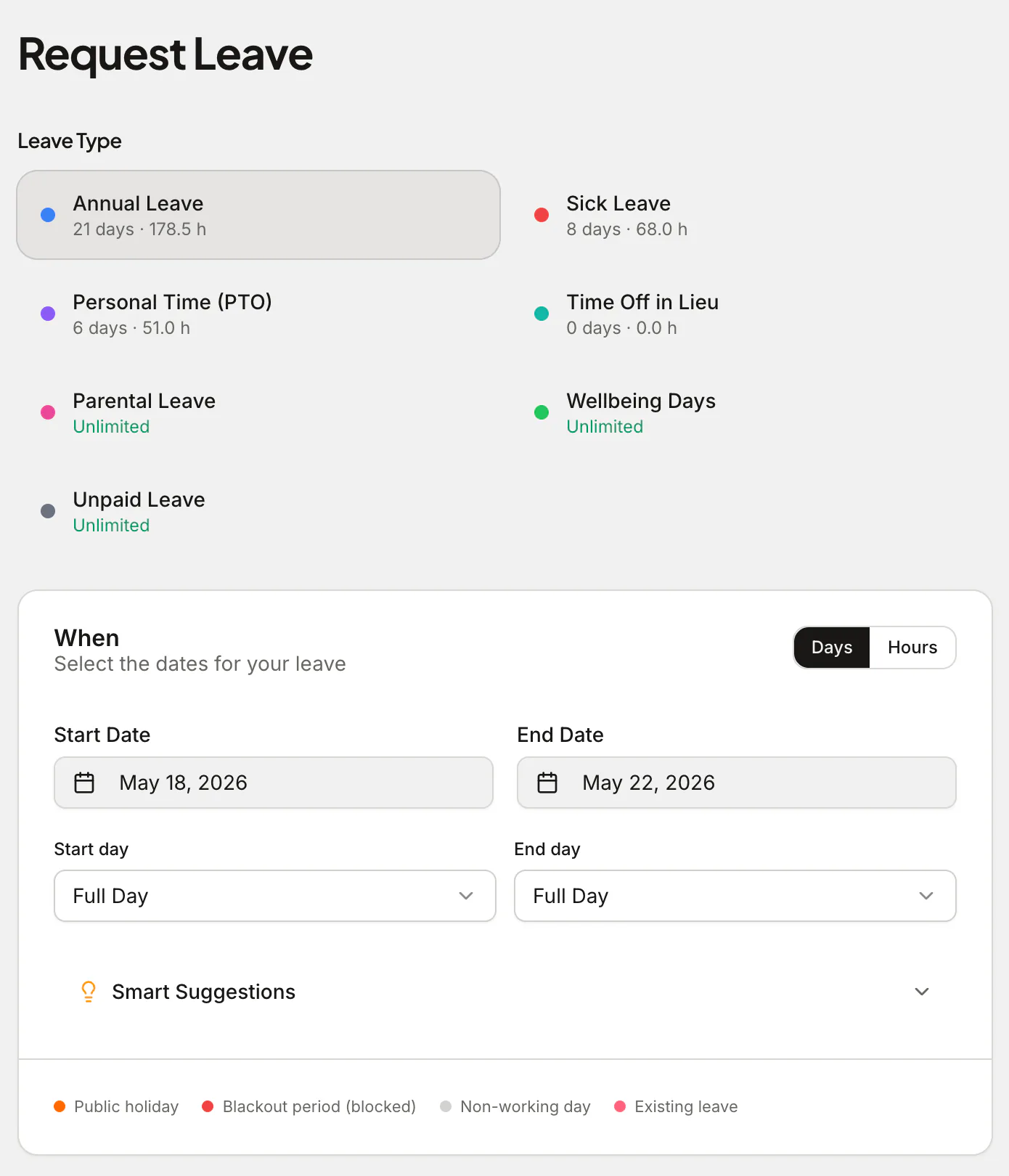
In Absenca you can add "Pet bereavement" as its own leave type with a one-day allowance, tracked in days or half-days, so it never eats into annual leave and requests go through the normal approval flow. The free plan includes 2 leave types for up to 10 people; Pro allows 20 leave types for up to 50 people. See pricing.
FAQ
Can I get time off work when my dog dies in the UK?
Not as a legal right. It depends on your employer's policy. If there is none, you can ask for compassionate leave, annual leave at short notice or unpaid leave, and Acas encourages employers to be compassionate.
Does compassionate leave cover pets?
Only if your employer's policy says so. The statutory rights in the UK and Ireland cover people, not animals, so check your handbook or ask HR.
Is pet bereavement leave paid?
Only if the employer chooses. A typical policy pays one day and treats extra time as annual or unpaid leave.
Can my employer refuse time off when my pet dies?
Yes, there is no statutory right to it in the UK or Ireland. You can still ask to use annual leave; see can my employer refuse my holiday request.
What is pawternity leave?
An informal name for pet-related leave. It sometimes means time off to settle a new pet and sometimes leave after a pet dies; your policy should say which.
Rules vary and can change; check the official guidance from Acas, gov.uk or the Workplace Relations Commission before relying on them.