
Ramadan and Eid at Work: How to Handle Eid Leave Requests Fairly (2027 Dates)
Handle Eid leave requests by publishing the expected dates early, letting people book a provisional window, and using caps, floating holidays and shift swaps. In 2027 Ramadan is expected from 8 February, Eid al-Fitr on 9 March and Eid al-Adha on 16 May, subject to moon sighting.
The fairest way to handle Eid leave requests is to know the expected dates early, ask people to book ahead, and treat Eid like any other popular period: first-come with a clear cap on how many can be off at once, plus shift swaps and flexible hours so nobody has to choose between their faith and their job. For 2027, Ramadan is expected to start on Monday 8 February, Eid al-Fitr on Tuesday 9 March and Eid al-Adha on Sunday 16 May, but every one of those dates can move by a day depending on the moon.
This guide is for managers of mixed teams who want a plan before the requests arrive, not after.
When are Ramadan and Eid in 2027?
The Islamic calendar is lunar, so Ramadan and both Eids move about 11 days earlier each year against the Gregorian calendar. The dates below are the expected ones for 1448 AH, based on the month starts published by the Fiqh Council of North America, which calculates its calendar in advance. The Saudi Umm al-Qura calendar gives the same month starts (moonsighting.com).
| Event (1448 AH) | Expected date in 2027 | Notes |
|---|---|---|
| Ramadan begins | Monday 8 February | First night prayers the evening before |
| Eid al-Fitr | Tuesday 9 March | Wednesday 10 March if Ramadan runs 30 days |
| Dhul-Hijjah begins | Friday 7 May | |
| Eid al-Adha | Sunday 16 May | The 10th of Dhul-Hijjah, counted from 7 May; the day before is the Day of Arafah |
Dates checked as of October 2026.
Why the exact day isn't fixed
Many mosques and communities start each month only when the new crescent moon is sighted, or follow a particular country's announcement. That means one employee may celebrate Eid on Tuesday and a colleague on Wednesday, and neither is wrong. The Fiqh Council itself says its Eid al-Adha follows the Day of Arafah as determined by Saudi Arabia's Supreme Court, which can differ from its own calculation.
For planning, the practical rule is simple: expect people to book a two-day window and confirm one of the days at short notice. Ramadan 1449 then starts around 28 January 2028, so the cycle repeats roughly 11 days earlier next year.
Can employees take leave for Eid?
Yes, usually as ordinary annual leave, and a reasonable employer tries hard to say yes. Whether they have a legal right to the day off depends on the country.
- UK. Acas, the official workplace advice service, says "there is no legal requirement for employers to allow time or facilities for religious reasons", but that "it could be discrimination if you unreasonably refuse." It advises employers to try to allow time off for festivals that matter to people, to ask staff to book well in advance, and to agree how to handle it if too many people want the same days off (Acas).
- US. Under Title VII, employers must reasonably accommodate religious practices unless that causes undue hardship. The EEOC names "flexible scheduling, voluntary shift substitutions or swaps" as common accommodations, and since the Supreme Court's 2023 Groff v. DeJoy decision, a cost that is merely "more than de minimis" no longer counts as undue hardship (EEOC).
Acas also makes a point worth keeping in your policy: religious festivals shouldn't automatically take priority over other reasons for wanting time off, because that could disadvantage people with no religion. Fair means the same rules for everyone, applied with some thought.
Rules vary by country and change over time; check the official source for where your team works.
Why do Eid requests all arrive at once?
If several people on your team celebrate Eid, they want the same one or two days, and they often can't book the exact date until a day or two before. On a small team that collides with your minimum cover. Three things make it worse:
- Late confirmation. The moon-sighting uncertainty means some people wait to book, then everyone books in the same 48 hours.
- Family travel. Eid is a family holiday, so people often add days either side, especially for Eid al-Adha.
- No precedent. If last year was handled ad hoc, nobody knows what's expected.
The fix is to move the decision earlier, not to squeeze it.
What are fair ways to handle Eid leave?
| Approach | How it works | Best for |
|---|---|---|
| Early, provisional booking | Publish the expected dates months ahead; people book a window and confirm the exact day later at no penalty | Every team |
| Floating holidays | Give everyone one or two days to use on any day that matters to them: Eid, Diwali, Yom Kippur, a birthday | Teams with many cultures |
| Shift swaps | Colleagues who don't celebrate cover Eid; the favour is returned at Christmas or another holiday | Rota and support teams |
| Capped first-come booking | A clear limit on how many can be out per team, applied the same way all year | Small teams with minimum cover |
| Flexible hours during Ramadan | Earlier start and finish, shorter lunch, breaks at sunset, without cutting total hours | Office and remote teams |
Floating holidays
A floating holiday is the most even-handed option for a multicultural team: everyone gets the same number of days, and each person picks the one that matters to them. Nobody's festival is privileged over anyone else's, which is exactly the balance Acas describes. If you run one, set it up as its own leave type so it doesn't eat into the annual allowance; the annual leave policy template has a section you can adapt.
Shift swaps and cover
Swaps work well because they're voluntary and they spread the load. Keep a simple record so the favour is returned: whoever covers Eid gets first pick at the next holiday they care about.
How should you handle Ramadan itself?
Ramadan is a month of daytime fasting, not a holiday, and most people keep working normally through it. A few small adjustments make a large difference:
- Shift the working day where the role allows: an earlier start and finish, or a shorter lunch in exchange for a break at sunset. Acas notes that time for prayer is not "time off"; total hours stay the same.
- Move heavy work and social events away from late afternoon. Avoid scheduling the team lunch in Ramadan.
- Expect more leave requests in the last ten days, which many people treat as especially important, and right before Eid.
- Don't assume. Not every Muslim colleague fasts, and some can't for health reasons. Ask what would help, privately, and leave it there.
What should managers avoid?
- Blanket blackouts over Eid. Blocking leave on a date only one group needs is hard to defend. If you need a blackout, base it on genuine business peaks; blackout periods explained covers how to set one fairly.
- Penalising late confirmation. Rejecting a request because it was "only confirmed yesterday" punishes people for how the calendar works.
- Favouring one faith's holidays. Approving every Christmas request and none at Eid, or the reverse, is the pattern that leads to complaints.
- Asking people to justify their beliefs. You need dates, not explanations.
- Deciding case by case without written rules. Use the same criteria you would for any request; how to approve leave requests fairly has a checklist.
How can a leave tool help?
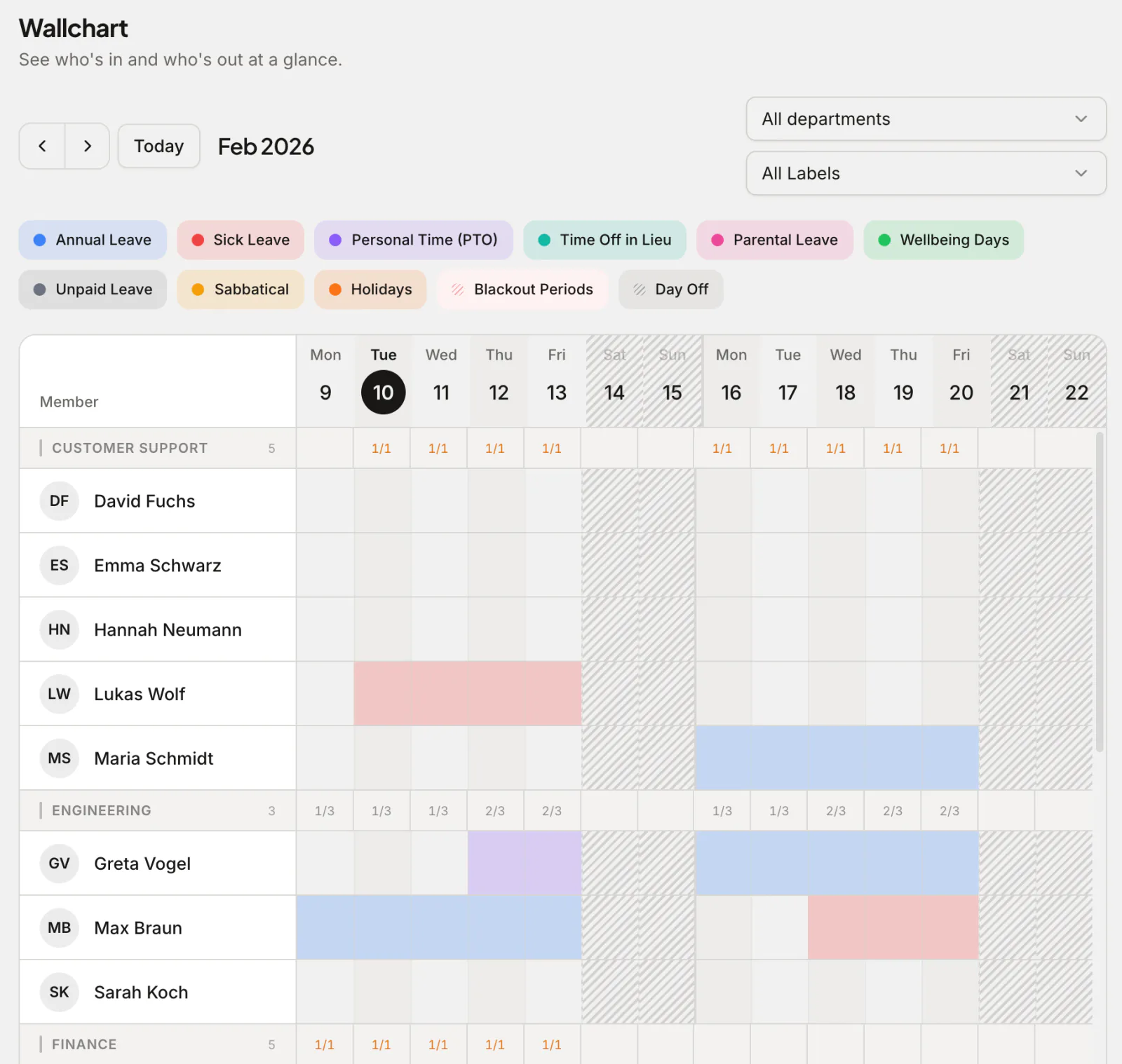
The hard part of Eid is seeing the clash before it happens. In Absenca, the team wallchart shows who's already booked around the expected dates, and you can set a maximum number of people per department who can be off at the same time, which is checked every time someone submits a request. The Free plan covers teams of up to 10 people.
FAQ
Is Eid a public holiday?
It depends on the country. Eid al-Fitr and Eid al-Adha are public holidays in many Muslim-majority countries, but not in the UK or US, where employees normally use annual leave. Check the public holiday calendars for the countries your team works in.
Can I refuse an Eid leave request?
You can refuse for a genuine business reason, the same way you would refuse any other request, but in the UK an unreasonable refusal could be discrimination, and in the US you need to show undue hardship. Offer an alternative first: a swap, a half day or a different shift.
How many days off do people need for Eid?
Most people ask for the day of Eid itself, often with a day either side because the exact date is uncertain. Some take longer, especially for Eid al-Adha when families travel.
Should Ramadan affect working hours?
It can, if the role allows. Temporary changes to start and finish times are a common, low-cost accommodation, as long as they don't disadvantage colleagues who don't fast.
What date is Eid al-Adha in 2027?
Eid al-Adha 2027 is expected on Sunday 16 May 2027, with the Day of Arafah on Saturday 15 May. The final date depends on the moon and on which authority a community follows.