
Time off for dependants UK: emergency leave rules and how long you can take
UK employees can take a reasonable amount of unpaid time off to handle an emergency involving a dependant, under section 57A of the Employment Rights Act 1996. There's no fixed number of days, and you can't be dismissed or treated unfairly for taking it.
In the UK, employees have a legal right to a "reasonable" amount of time off to deal with an emergency involving a dependant, such as a sick child, a carer who doesn't turn up or a parent taken to hospital. The law doesn't require this time to be paid and sets no fixed number of days. It covers what's needed to handle the emergency and put care in place, and you can't be dismissed or treated unfairly for taking it.
The right is in section 57A of the Employment Rights Act 1996. That section applies in England, Wales and Scotland. Below, as of 2026: what counts as an emergency, who counts as a dependant, how long is reasonable, what notice you must give, and how it differs from carer's leave and compassionate leave.
What is time off for dependants?
Section 57A gives an employee the right to take "a reasonable amount of time off during the employee's working hours" to take necessary action in five situations:
| Situation (s.57A(1)) | Everyday example |
|---|---|
| A dependant falls ill, gives birth, or is injured or assaulted | A dependant goes into labour unexpectedly and relies on you to take them to hospital |
| Arranging care for a dependant who is ill or injured | Arranging longer-term care |
| After a dependant dies | Making arrangements after the death |
| Care arrangements are unexpectedly disrupted or end | "a child minder or carer does not turn up", or "a nursery closes unexpectedly" |
| An unexpected incident involving your child at school | Your child is "involved in a fight", "injured on a school trip" or "suspended from school" |
The statute says illness or injury includes mental illness or injury. GOV.UK adds that the illness "does not have to be life-threatening or need full-time care". It can be an existing condition that has got worse. If a dependant is mugged without being hurt, you can take time off to comfort or help them.
The key word is unexpected. GOV.UK says: "You cannot have time off if you knew about a situation beforehand." A hospital appointment booked weeks ago doesn't qualify, though parental leave might cover it.
Who counts as a dependant?
Under s.57A(3), a dependant is your:
- spouse or civil partner
- child
- parent
- someone who lives in your household. Tenants, lodgers, boarders and employees don't count.
For illness, injury, assault and arranging care, it also covers anyone who "reasonably relies on the employee" for help. For broken-down care arrangements, it covers anyone who reasonably depends on you to arrange their care. GOV.UK sums it up: "A dependant could be a spouse, partner, child, grandchild, parent, or someone who depends on you for care."
How long can you take off for a family emergency?
The law gives no number. Acas puts it plainly: "The law does not say how much time an employee can take off, or how many occasions. It just says the amount should be 'reasonable'."
What's reasonable depends on what has happened. The time is for dealing with the emergency itself and making arrangements, not for providing the care yourself over a longer period. GOV.UK's example: if your child falls ill, you can take time to see a doctor and arrange care. If they need you at home for longer, your employer may ask you to use annual leave or parental leave instead.
There's also no limit on how often you use it. GOV.UK says: "There are no limits on how many times you can take time off for dependants." If the absences start to affect your work, your employer may want to talk with you about it.
Is emergency leave paid in the UK?
Not by law. GOV.UK says: "Your employer may pay you for time off to look after dependants but they do not have to." Check your contract, staff handbook or intranet. Some employers pay for it, and some pay for compassionate leave but not for dependants leave.
Do you have to give notice?
Not in advance. Section 57A(2) only requires you to:
- tell your employer the reason for your absence "as soon as reasonably practicable", and
- say how long you expect to be away, unless you can only do that once you're back at work.
If the emergency happens while you're at work, you may not be able to tell anyone before you leave. Tell them as soon as you can. GOV.UK says you don't have to give notice in writing or provide written proof.
For managers, this means you can't refuse the time because nobody was warned. Ask what happened and roughly how long it will take, then record it.
Can my employer refuse or dismiss me for it?
Your employer must not:
- refuse you reasonable time off
- treat you unfairly for taking it, for example "refusing you training or promotion"
- dismiss you or choose you for redundancy because you asked for or took the time.
Acas says it is "automatically unfair to be dismissed or selected for redundancy for taking or asking to take time off for dependants", and "you do not need to have a minimum length of service to make a claim."
If your employer unreasonably refuses the time, you can complain to an employment tribunal under s.57B. Since 1 October 2026, the time limit is six months from the date of the refusal. The Employment Rights Act 2025 made that change. A tribunal can award the compensation it considers "just and equitable". Before that, Acas and your union or staff representative can advise.
How is it different from carer's leave and compassionate leave?
| Time off for dependants | Carer's leave | Compassionate leave | |
|---|---|---|---|
| Source | ERA 1996 s.57A | Carer's Leave Act 2023 (from 6 April 2024) | Employer policy |
| For | Unexpected emergencies | Planned care for a dependant with a long-term care need | Usually a bereavement or serious family situation |
| How much | A reasonable amount, no set number of days | Up to one week every 12 months | Whatever the policy says |
| Notice | As soon as reasonably practicable | At least 3 days for half a day or a day; at least twice the leave length for longer | Whatever the policy says |
| Pay | Not required by law | Not required by law | Paid or unpaid, depending on the employer |
Carer's leave covers someone who has an illness or injury expected to need care for more than three months, a disability under the Equality Act 2010, or care needs because of old age. The person doesn't have to be family. You can take it in half days, full days or a whole week. Acas suggests compassionate leave can help when the dependants right doesn't apply, or when it's better because the employer pays for it.
For policy wording, see our compassionate and bereavement leave policy and the guide to maternity, paternity and parental leave. For planned time off, see can my employer refuse my holiday request.
Recording dependants leave without a spreadsheet
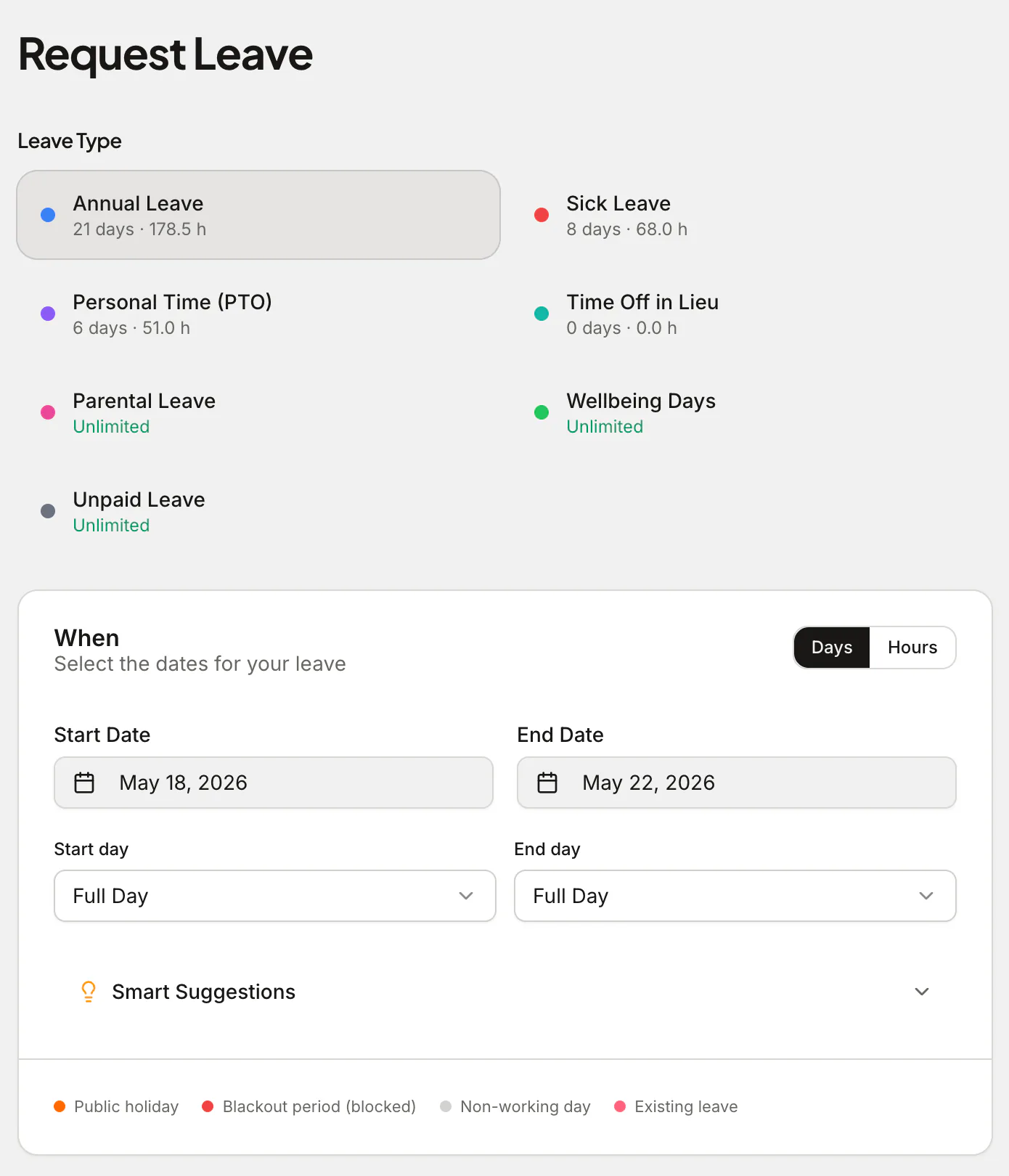
Managers need a record of emergency absences to spot patterns fairly and to show that nobody was penalised. In Absenca you can set up "Time off for dependants" as its own leave type, separate from annual leave, so it doesn't come out of the holiday balance. Leave can be recorded in days, half-days or hours, which suits the afternoon someone leaves to collect a sick child. The Free plan covers up to 10 people and 2 leave types, enough for annual leave plus dependants leave.
FAQ
How many days emergency leave can I take in the UK?
There's no fixed number. You get a reasonable amount of time to deal with the emergency and arrange care. If you need longer, your employer may ask you to use annual leave or parental leave.
Is time off for dependants paid?
Not by law. Your employer may choose to pay it, so check your contract or handbook.
Can I take emergency leave if my childminder cancels?
Yes. GOV.UK gives a childminder or carer not turning up, or a nursery closing unexpectedly, as examples of an emergency.
Do I need to have worked somewhere a certain time to qualify?
No. Acas says you don't need a minimum length of service to claim if you're dismissed for taking or asking for this time off.
Does a planned hospital appointment count?
No. You can't use it for something you knew about beforehand. Parental leave or carer's leave may fit instead.
Rules can change and apply differently in Northern Ireland. Check GOV.UK and Acas for the current position.