
Volunteering Leave Policy Template: How Many Paid Volunteer Days and What Counts (UK)
A volunteering leave policy gives employees one to three paid days a year to volunteer for charities, schools or community groups, approved in advance. In the UK it is a voluntary benefit, separate from statutory time off for public duties under section 50 of the Employment Rights Act 1996.
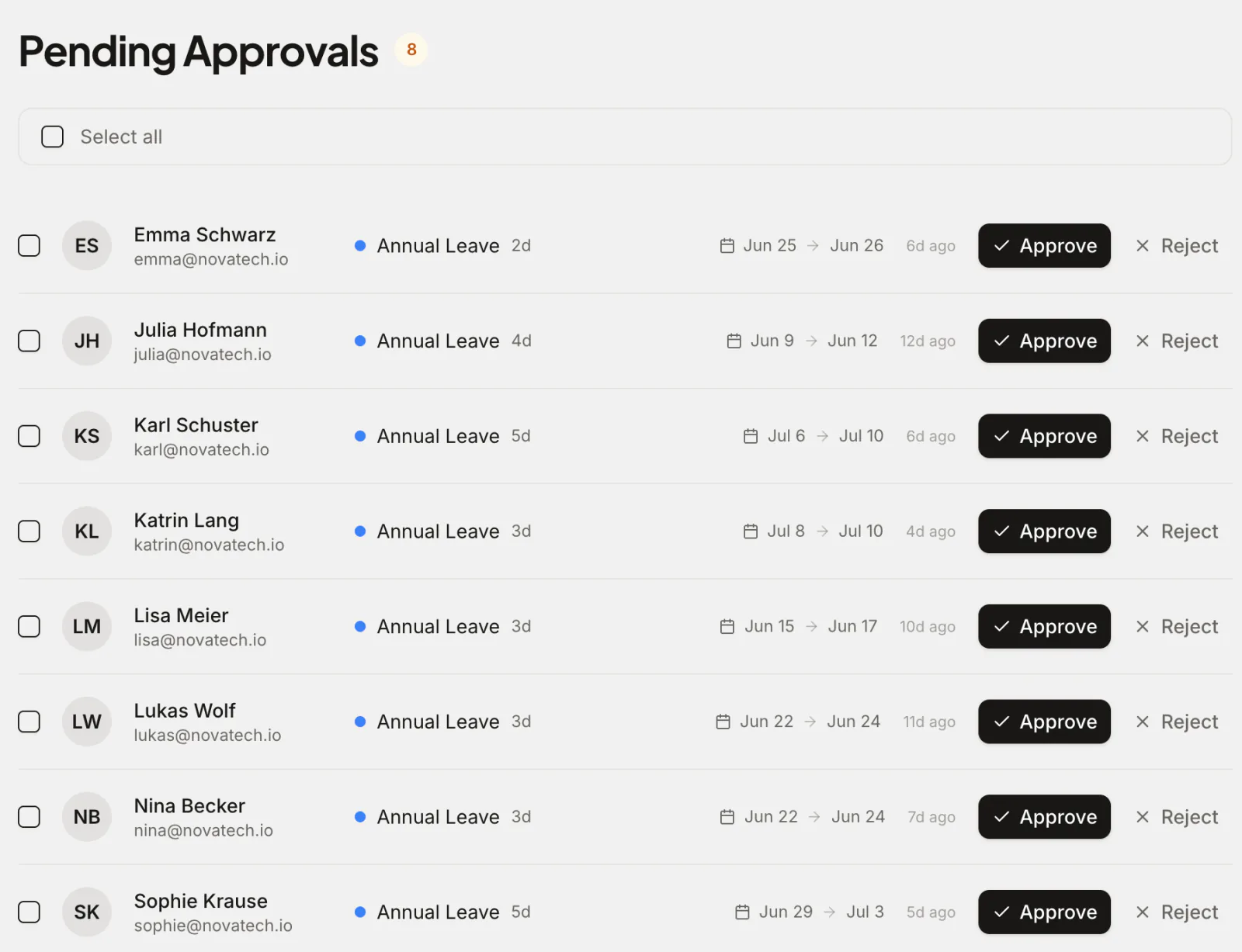
A volunteering leave policy gives employees a set amount of paid time, usually one to three working days a year, to volunteer for registered charities, schools or community groups, approved in advance like any other leave. In the UK it is a voluntary benefit: no law requires paid volunteering days, but public duties such as serving as a magistrate or councillor are a separate statutory right under section 50 of the Employment Rights Act 1996 and should sit in a different part of your policy.
This guide covers how many days to offer, what should count, how approval works, where the legal line falls in the UK, and a template you can copy.
How many volunteer days should employees get?
There is no statutory number, so the figure is a business decision. Most policies pick one of three designs:
| Design | Allowance | Works well when |
|---|---|---|
| Starter | 1 paid day (or 7–8 hours) a year | You are piloting the benefit or have tight cover |
| Standard | 2 paid days a year | You want room for one team event plus one personal choice |
| Generous | 3 paid days a year | Volunteering is a visible part of your CSR or ESG story |
Lattice's sample policy, for example, leaves the figure blank with the suggestion "8 hours or 1 workday" per year. Whichever you choose, decide three details up front:
- Part-timers. Pro-rate the allowance by contracted hours, the same way you would annual leave. Our guide to pro-rata holiday entitlement shows the arithmetic.
- Units. Allowing half-days or hours makes it easier to say yes to a two-hour school reading slot or a morning at a food bank.
- Carry-over. Templates commonly say unused days lapse at the end of the leave year and are not paid out. Lattice's sample states: "Unused VTO does not roll over or get paid out at year-end or upon separation."
What volunteering activities count?
Write the eligible list as categories, then name a few exclusions. That keeps decisions consistent without needing a rule for every request.
Usually eligible
- Registered charities and not-for-profit organisations
- Schools, colleges and youth groups (reading programmes, mentoring, careers talks)
- Community projects: food banks, litter picks, conservation days, shelters
- Skills-based volunteering: giving a charity a day of finance, design or IT help
- Company-organised team volunteering days
Usually excluded
- Political campaigning or party activity
- Activity that promotes a religion (as distinct from community work run by a faith group)
- Volunteering for a business, or for an organisation the employee is paid by
- Fundraising events where the employee is the main beneficiary
- Public duties covered by statute (handled separately, see below)
Ask the employee to name the organisation and the activity on the request. You do not need proof of registration for every small community group; a manager's judgement is enough for most cases.
How should approval and notice work?
Treat volunteering leave like any other planned absence: request, approval, record. Lattice's template puts it plainly: "VTO must be pre-approved by your manager and logged with HR or in the time tracking system."
A workable process:
- Notice. Two weeks for a single day; four weeks for team events that take several people out at once.
- Approval criteria. The activity is eligible, the employee has allowance left, and the team still has cover. Use the same cover rules you apply to holiday, and the same fair approval process.
- Refusals. Offer an alternative date rather than a flat no. A volunteering day refused twice in a row quietly kills the benefit.
- Blackout periods. If you already block annual leave during peak weeks, say whether those blocks apply to volunteering too.
Is volunteer leave a legal right in the UK?
No. Paid volunteering days are a contractual benefit you choose to offer. What the law does cover, as of 2026, is time off for public duties, and HR should keep the two apart.
Section 50 of the Employment Rights Act 1996, which applies in England, Wales and Scotland, requires employers to permit time off during working hours for employees who are, among others:
- a justice of the peace (magistrate)
- a member of a local authority (councillor)
- a member of a statutory tribunal
- a member of an independent monitoring board for a prison
- a member of a relevant health body or a relevant education body (for example the governing body of a local-authority-maintained school or a further education college)
- a member of the Environment Agency, SEPA or Scottish Water
The amount of time must be "reasonable in all the circumstances", taking into account how much time the duty needs, time off already given, and "the circumstances of the employer's business and the effect of the employee's absence". GOV.UK adds that the time off "should be agreed between the employee and employer beforehand" and that "Employers can choose to pay staff for time taken off, but they do not have to."
Jury service is stricter: employers "cannot refuse their staff time off to do jury service." Reservists called up for service have their own protections.
| Volunteering leave | Public duties (ERA 1996 s.50) | Jury service | |
|---|---|---|---|
| Legal right? | No, contractual | Yes, a reasonable amount | Yes |
| Can you refuse? | Yes, per policy | Yes, if the request is unreasonable | No |
| Must you pay? | Per your policy | No, unless your policy says so | Not covered here; check GOV.UK |
| Comes out of volunteer allowance? | Yes | Should not | Should not |
The practical rule: never make a magistrate or school governor spend their volunteering days on statutory duties. Give public duties their own clause and their own leave type.
Volunteering leave policy template
Copy this and replace the bracketed items.
Volunteering Leave Policy
1. Purpose. [Company] supports employees who give their time to their communities. This policy gives eligible employees paid time off to volunteer.
2. Who it covers. All employees on permanent or fixed-term contracts [after completing probation]. Part-time employees receive a pro-rata allowance based on contracted hours.
3. Allowance. Full-time employees receive [2] paid volunteering days per leave year, which may be taken as full days, half-days or hours. Unused volunteering leave does not carry over and is not paid out when employment ends.
4. Eligible activities. Volunteering for registered charities, not-for-profit organisations, schools, youth groups and community projects, including skills-based volunteering and company-organised team days. Political activity, activity promoting a religion, and work for a profit-making business are not eligible.
5. How to request. Submit a volunteering leave request at least [2 weeks] before the date ([4 weeks] for team events), naming the organisation and the activity. Your manager will approve or suggest another date, taking team cover into account.
6. Pay. Approved volunteering leave is paid at your normal basic rate.
7. Public duties and jury service. Time off for public duties (for example magistrate, councillor, school governor) and for jury service is handled under [Public Duties clause / policy] and does not reduce your volunteering allowance.
8. Conduct and safety. While volunteering you represent [Company]. Follow the host organisation's health and safety rules and tell your manager about any incident.
9. Records. Volunteering leave is recorded as its own leave type so balances and totals can be reported.
10. Review. This policy is reviewed every [12 months].
If you are updating your wider leave documents at the same time, the annual leave policy template and study leave policy template follow the same structure.
How do you track volunteering leave?
Track it as its own leave type, never as annual leave with a note. A separate type gives each employee a visible balance, stops volunteering eating into holiday, and lets you report total hours volunteered for your CSR or impact report.
In Absenca you can add a "Volunteering" leave type with its own allowance, track it in days, half-days or hours, and approve requests from the same queue as holiday. The free plan includes 2 leave types for up to 10 people; Pro allows 20 leave types, so public duties can get a type of its own too. Reports export to CSV.
FAQ
Do employers have to give paid volunteering days in the UK? No. Volunteering days are a voluntary benefit. Public duties (under ERA 1996 s.50) and jury service are different: they carry statutory time-off rights, and even public duties time off does not have to be paid.
Is 3 volunteer days a year a lot? It sits at the generous end of common designs. One or two days is a typical starting point; you can raise it once you see uptake and its effect on cover.
Can I refuse a volunteering leave request? Yes, under your own policy, for reasons like cover or eligibility. Suggest another date so the benefit stays usable.
Is school governor time volunteering leave? GOV.UK lists school governors among the public duties covered by section 50, so it should be handled separately and not deducted from the volunteering allowance.
Should part-time staff get volunteering leave? Yes, pro-rated by contracted hours, in the same way as annual leave.
Rules vary and can change; check the official source (legislation.gov.uk and GOV.UK) before finalising your policy.