
Holiday booking for UK teams
A staff holiday booking system for UK employers
Staff book holiday in a few taps, managers approve with the team's cover in view, and every request, decision and balance is kept on record, under UK holiday law.
Free for up to 10 people · 11 to 50 people: $37.50 a month on Pro
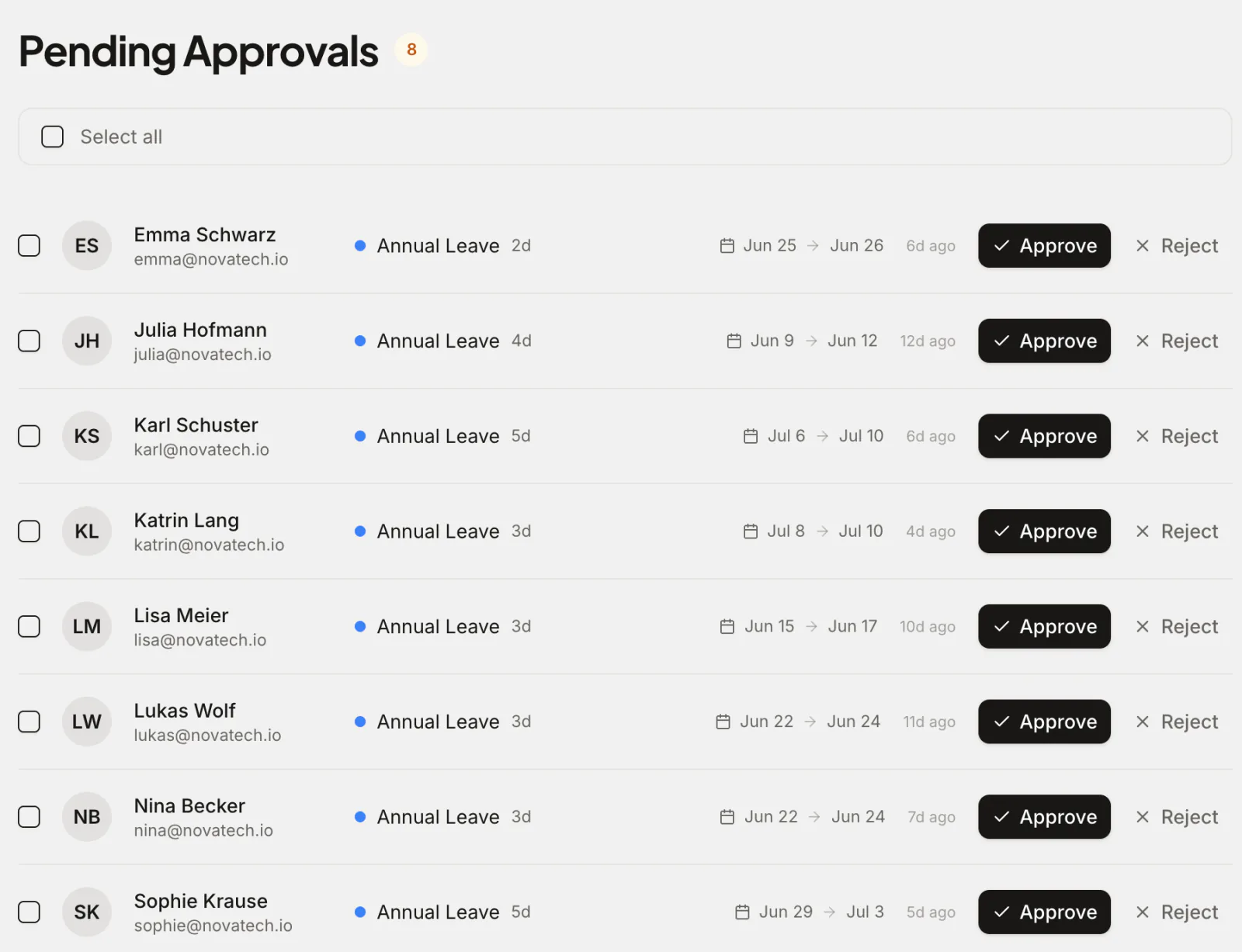
A staff holiday booking system replaces the email, the paper form and the shared spreadsheet with one place to ask for time off, approve it and see who's away. Absenca does that for UK employers: each person sees their remaining allowance before they book, the request goes to their manager, and the decision lands on the team calendar the moment it's made.
UK holiday has rules a booking system has to respect: 5.6 weeks of statutory leave, a 12.07% accrual for irregular-hours and part-year workers, notice periods set by the Working Time Regulations, bank holidays that differ by nation and, since April 2026, a duty to keep holiday records for six years. This page covers each one and what Absenca does about it. It describes the law as written; it is not legal advice, and your contracts and policy decide the details.
What you get
Requests and approvals
Staff book days, half days or hours. Requests go to their manager, or to an admin when they have none, with a backup approver per department.
Bank holidays per office
Load the UK's shared bank holidays, keep the ones your office closes for and add your nation's own, so no one loses a day of allowance to one.
Your leave year
Start each office's leave year in any month, or on each person's start date, with carry-over limits and expiry applied at year end.
A record of every decision
Every request and decision is stored with who made it and when, and balances can be exported to CSV for your own holiday records.
5.6 weeks, capped at 28 days
A worker in Great Britain gets 4 weeks of leave under regulation 13 of the Working Time Regulations 1998 and 1.6 weeks more under regulation 13A: 5.6 weeks in all, with a ceiling of 28 days. Someone on a five-day week gets 28 days; someone on six days a week works out at 33.6, which the cap brings back to 28. Bank holidays can count towards the 5.6 weeks; your contracts say whether they do.
In Absenca you give each leave type its entitlement, for example 28 days of annual leave including bank holidays, or 20 days on top of them. Someone who joins mid-year gets a pro-rata share from their start date. For a part-timer you set their own allowance, and the balance they see is what they have left to book.
12.07% for irregular-hours and part-year workers
For leave years beginning on or after 1 April 2024, workers whose paid hours are wholly or mostly variable, and those who work only part of the year with unpaid weeks off, build up holiday at 12.07% of the hours they work in each pay period (regulation 15B, with the definitions in regulation 15F). Each period's figure is rounded to the hour: under half an hour counts as nothing. GOV.UK's own example: 68 hours worked in June earn 8 hours of holiday (8.2076, rounded down). The rule covers England, Wales and Scotland only; Northern Ireland has its own working time regulations.
Our 12.07% holiday accrual calculator runs the sum pay period by pay period and checks first whether the method applies. Absenca doesn't record hours worked, so it doesn't accrue the 12.07% for you: you add the hours earned to the person's balance, and they book leave in hours, down to 15 minutes, against it.
Notice to book, and notice to refuse
Unless a contract or agreement sets other terms, regulation 15 asks a worker to give notice of at least twice as many days as the leave they want, and lets the employer refuse with notice of at least as many days as the leave. Both notices have to arrive before that date, so GOV.UK counts one day more: a week of 5 days needs 11 days' notice, and a refusal of it needs 6. An employer can also require leave on set days, such as a Christmas closure, with notice of twice the length.
Each leave type in Absenca can carry a minimum notice in days, and a request with less is refused when it's submitted. It's one fixed number per leave type rather than twice the request's length, so set it to what your policy asks. For teams still on paper, our holiday request form template works through the notice rule with an example.
Sick days count from day one
Since 6 April 2026 Statutory Sick Pay is payable from the first full day of sickness absence, with the three waiting days gone, and every eligible employee gets it whatever they earn, as the lower earnings limit has been removed. It is 80% of average weekly earnings or the flat rate of £123.25 a week, whichever is lower (GOV.UK). Payroll pays it; what changed for absence records is that a single day off sick now matters to pay.
Absenca records sick leave as its own leave type, kept apart from holiday so it never comes off anyone's allowance. Your payroll reads the days from the calendar or a CSV export. Bradford Factor scores for frequent short absences are on Pro and the Custom Pack, not on the free Starter plan. See our guide to the day-one SSP rules.
Bank holidays by nation
England and Wales share 8 bank holidays a year. Scotland has its own list, with 2 January and St Andrew's Day but no Easter Monday, and a summer bank holiday at the start of August instead of the end. Northern Ireland adds St Patrick's Day and the Battle of the Boyne to the England and Wales list.
Each office in Absenca has its own holiday calendar. Choose the United Kingdom and Absenca lists the UK's shared bank holidays; you keep the days your office closes for and add your nation's own by hand, once a year per office. A bank holiday on an office's calendar is never deducted from anyone there. The staff holiday planner lists every nation's 2026 dates and the days each office adds.
Holiday records you have to keep
Since 6 April 2026, regulation 16B requires employers in Great Britain to keep records that show they gave the statutory holiday entitlement and paid for it correctly, and to keep them for six years. The format is the employer's choice. The Fair Work Agency, set up in April 2026, is due to start enforcing statutory holiday pay no earlier than April 2027.
A booking system covers the leave half of that record: who asked for which days, who approved them, when, and what each person's balance was. Absenca keeps each request with its decision and the person who made it, and exports leave and balances to CSV, on every plan, so you can file them with your payroll records. Holiday pay itself is your payroll's job; Absenca doesn't calculate it.
A booking, start to finish
Greta Vogel works on NovaTech's support desk in Manchester, on a five-day week with 25 days of annual leave plus bank holidays. She asks for Monday 13 to Friday 17 July 2026 on 26 June, 17 days ahead, which clears the 14-day minimum notice NovaTech set on annual leave. The request shows her 25 days, 6 already taken and 5 more asked for.
Her manager is away the week she asks, so the request goes to the department's backup approver, who sees on the team calendar that one colleague is already off that week and the department allows two at once. One click approves it. Greta's balance drops to 14, the week appears on the calendar for everyone, and the request, the approver and the time are on record.
What it costs
Absenca is free for up to 10 people, on 1 office with 2 leave types. From 11 people Pro is $37.50 a month for up to 50, billed in US dollars, with 2 offices and 20 leave types; the Slack bot is on Pro and the Custom Pack, not on the free Starter plan. A team of 15 pays $37.50 a month on Pro, which is $2.50 a person. Every limit is on the pricing page, and the leave management software page covers the rest of the product.
Last reviewed: · Absenca Team
Why teams choose Absenca
- Requests, approvals and a backup approver per department
- Leave booked in days, half days or hours
- Bank holidays per office, for each UK nation
- A minimum notice per leave type, checked when staff book
- Free for up to 10 people; Pro is $37.50 a month for up to 50 people
Frequently asked questions
- What is a staff holiday booking system?
- Software where staff ask for time off, managers approve or decline it, and everyone sees who's away and how much leave is left, in place of email, paper forms or a spreadsheet.
- Does Absenca work out 12.07% holiday for irregular-hours workers?
- Not automatically, because it doesn't record hours worked. Our free 12.07% calculator works out each pay period's holiday; you add it to the person's balance, and they book leave in hours against it.
- How much notice must staff give to book holiday in the UK?
- Unless a contract says otherwise, at least twice as many days as the leave, given before that date; GOV.UK counts it as twice the leave plus one day. Absenca lets you set a minimum notice per leave type.
- Does it handle bank holidays in Scotland and Northern Ireland?
- Yes. Each office has its own calendar: load the UK's shared bank holidays, keep the ones your office closes for and add your nation's own. A bank holiday on the calendar is never deducted from anyone's allowance.
- How much does it cost?
- Absenca is free for up to 10 people. Pro is $37.50 a month for up to 50 people, billed in US dollars.