
Annual Leave in Finland: Vuosiloma Days, Summer Holiday and Lomaraha Holiday Bonus
Finnish employees earn 2 days of annual leave per full month (2.5 after a year by 31 March), up to 24 or 30 days with Saturdays counted. 24 days are summer holiday between 2 May and 30 September. Lomaraha, usually 50% of holiday pay, comes from collective agreements, not the law.
Under Finland's Annual Holidays Act (vuosilomalaki, 162/2005), employees earn 2 weekdays of annual leave for each full holiday credit month, or 2.5 weekdays once the job has lasted a year by 31 March. A full year therefore gives 24 or 30 days, Saturdays included. 24 of those days are summer holiday, taken between 2 May and 30 September, and the rest is winter holiday. The holiday bonus (lomaraha) is not in the Act. It comes from collective agreements and is usually 50% of holiday pay.
The rules below are as of 2026. The statutory ones come from the Act itself, and the holiday bonus rules come from collective agreement practice. They include a change to saving leave that starts on 1 January 2027.
How many days of vuosiloma do you get in Finland?
Leave builds up month by month over the holiday credit year (lomanmääräytymisvuosi), which runs from 1 April to 31 March. Section 5 of the Act sets two rates:
| Length of employment on 31 March | Days per full holiday credit month | Full holiday credit year (12 months) |
|---|---|---|
| Less than one year, without a break | 2 weekdays | 24 weekdays |
| One year or more, without a break | 2.5 weekdays | 30 weekdays |
Fractions are rounded up to a full day. Seven months at 2.5 days is 17.5, so the employee gets 18 days.
Why Saturdays count as holiday days
The Act counts holiday in weekdays (arkipäivä). That means every day except Sundays, church festivals, Independence Day, Christmas Eve, Midsummer Eve, Easter Saturday and 1 May. Saturdays are weekdays, so a normal week of leave uses six days. That is why 30 days comes to five weeks and 24 days to four. If you track leave in working days, Monday to Friday, convert the figures: 30 Finnish weekdays is about 25 working days.
What is a full holiday credit month: the 14-day and 35-hour rules
A month only earns leave if it is a full holiday credit month (täysi lomanmääräytymiskuukausi). Section 6 sets two tests:
- The 14-day rule: the employee has at least 14 days at work in the calendar month. It counts days, not hours.
- The 35-hour rule: this applies to someone whose contract gives so few working days that they never reach 14 in a month, or reach it only in some months. For them, a month counts if it has at least 35 hours at work.
Some absences count as days at work. Examples are sick leave up to 75 working days in a holiday credit year, and up to 156 days of parental leave for each birth or adoption.
Some employees work less than 14 days or 35 hours in every month. They don't earn holiday in the usual way. Instead, section 8 entitles them to two weekdays of leave for each month of employment if they ask for it. They are paid holiday compensation of 9% of their pay, or 11.5% once the job has lasted a year (section 16).
When is the summer holiday and when is the winter holiday?
The holiday season (lomakausi) runs from 2 May to 30 September. Section 20 splits the year's leave in two:
| Part | Days | When it must be taken |
|---|---|---|
| Summer holiday (kesäloma) | 24 weekdays | During the holiday season, 2 May to 30 September |
| Winter holiday (talviloma) | The rest, up to 6 weekdays at 30 days a year | Before the next holiday season starts |
Each part should be taken in one block. The employer can split the summer holiday above 12 weekdays only if that is essential to keep work going. Employer and employee can also agree to take the part above 12 weekdays in shorter periods.
Who decides the dates? The employer, unless the two sides agree otherwise. Before deciding, the employer must explain its general principles for holiday, let employees give their views and treat them fairly. It must announce the dates at least one month before the holiday starts. If that isn't possible, the minimum is two weeks before. For how to settle clashes, see our guide to approving leave requests fairly.
Can you save annual leave in Finland (säästövapaa)?
Yes. Section 27 of the Act calls it carried-over holiday (säästövapaa, often called saving leave):
- Employer and employee can agree to carry over the part of the holiday above 18 days.
- The employee has a right to carry over the part above 24 days, unless that would seriously harm the workplace's operations.
- Saved days are taken in the calendar year or years the employee chooses. If the two sides can't agree on dates, the employee must give four months' notice.
This changes on 1 January 2027. Parliament has passed an amendment so the employee can no longer set the dates for saved leave alone. The two sides must first try to agree. If they don't, the employee asks at least four months in advance and the employer gives a reasoned answer within a month. The employer can refuse if the dates would cause harm that normal work arrangements can't avoid, or would stop holidays and saved leave being shared out fairly. Our explainer on carry-over and accrual covers how saved balances build up in general.
What is lomaraha, the Finnish holiday bonus?
The Annual Holidays Act has no rules on the holiday bonus. The law guarantees holiday pay: at least the employee's regular or average pay for the holiday. That pay is due before the holiday starts, or on the normal payday for a holiday of six days or fewer.
Lomaraha (also called lomaltapaluuraha, "return-from-holiday pay") is extra money on top of that. It is owed only if a collective agreement, the employment contract or established workplace practice provides for it. Where it applies:
- It is typically 50% of the holiday pay.
- It usually depends on returning to work after the holiday.
- It is often paid in instalments before and after the holiday. Some agreements let you swap it for time off if the employer agrees.
If no binding sector agreement covers the job and paying it is not established practice, the employer doesn't have to pay it. Expats should check which collective agreement (työehtosopimus) applies to them. Collective agreements can also change the holiday season, holiday pay calculations and carried-over holiday, but the length of holiday has to stay the same as under the Act.
What happens to unused leave when the job ends?
Holiday earned but not taken is paid out as holiday compensation (lomakorvaus) when the employment ends (section 17). For monthly-paid staff, pay per holiday day is the monthly salary divided by 25. Compare Sweden and Denmark, or see the paid leave by country overview.
Tracking Finnish leave without a spreadsheet
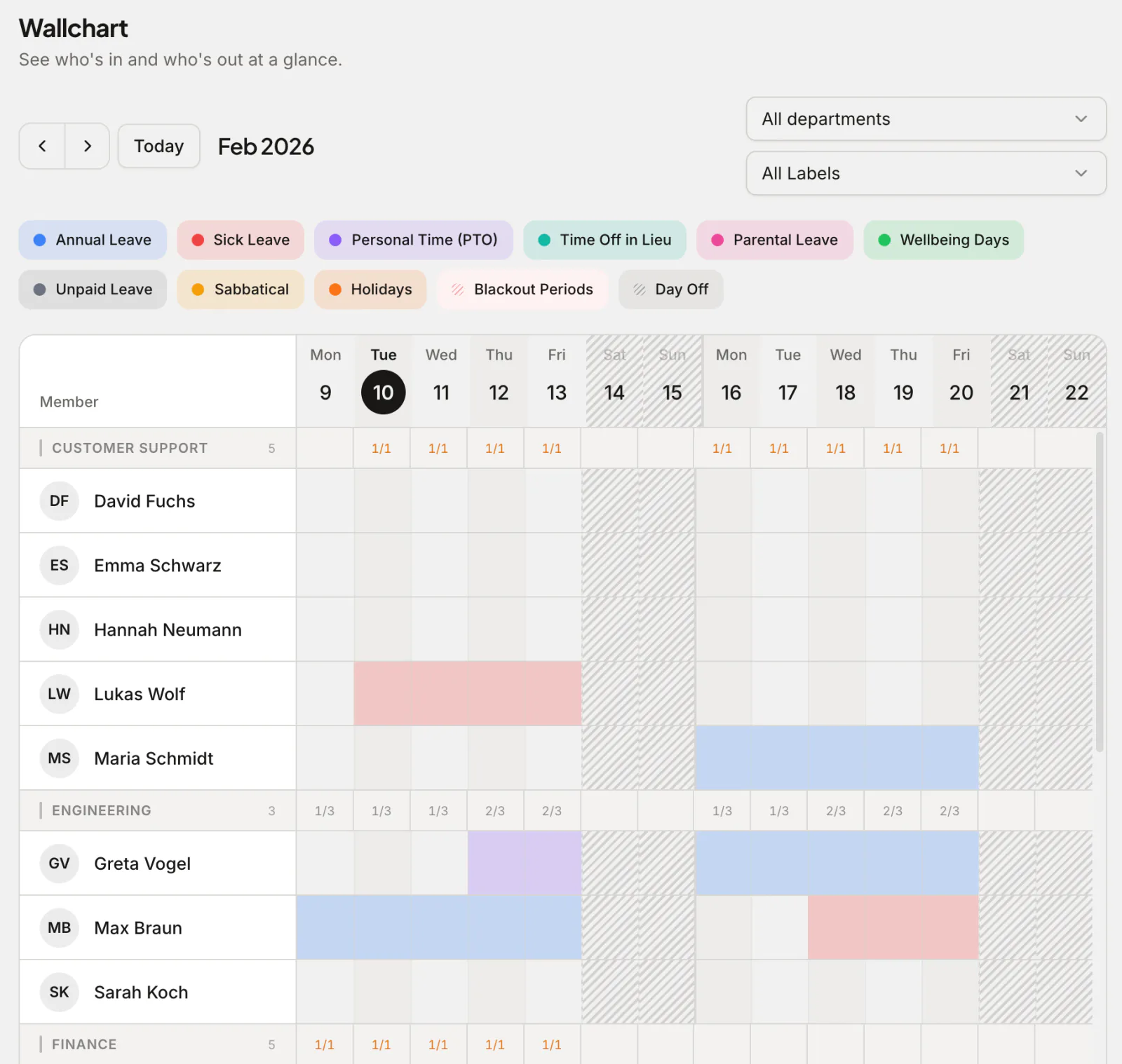
Finnish leave is counted from April, on a six-day week, with summer and winter parts. In Absenca, each office has its own leave year, so it can start in April, plus its own work week, public holidays and leave types. Accrual and carry-over run on top of that. The Free plan covers up to 10 people. See PTO accrual for how monthly accrual works.
FAQ
Is it 24 or 30 days of annual leave in Finland?
It depends on length of service on 31 March. Under a year, you earn 2 days a month, which is 24 days for a full year. After a year, you earn 2.5 days a month, which is 30 days. Both figures count Saturdays, so they mean four and five weeks.
Do I get summer holiday in my first year in Finland?
You get whatever you earned by 31 March. If you started in October, that is six full months at 2 days, or 12 days. One exception: if the job started on 1 April or the first working day in April, the holiday credit year ends with a full year of service, so the 2.5-day rate already applies.
Is lomaraha mandatory in Finland?
Not under the Annual Holidays Act. It becomes mandatory when your collective agreement, contract or workplace practice includes it. It is usually 50% of holiday pay and usually requires you to come back to work after the holiday.
Can my employer choose when I take my summer holiday?
Yes. The employer sets the dates within 2 May to 30 September after hearing employees' views, and must tell you at least a month ahead (at least two weeks if that isn't possible).
What counts as a full month for holiday?
A calendar month with at least 14 days at work. If your contract gives so few days that you don't reach 14 in a month, or reach it only in some months, a month with at least 35 hours counts instead.
Rules can change and collective agreements often add to them, so check the official text of the Annual Holidays Act on finlex.fi and guidance on tyosuojelu.fi.