
Annual Leave in Italy: Ferie, the 4-Week Minimum and the 18-Month Rule (2026)
Employees in Italy get at least 4 weeks of paid annual leave (ferie) a year: 2 weeks must be taken in the year they accrue and the other 2 within 18 months after it ends. The minimum can only be paid out when employment ends.
Every employee in Italy is entitled to at least four weeks of paid annual leave (ferie) a year, and at least two of those weeks must be taken during the year the leave is earned. The other two weeks can be taken within 18 months after that year ends, and the four-week minimum can't be paid out in cash unless employment ends (art. 10 of Legislative Decree 66/2003, as of 2026).
Most Italian employees end up with more than that. Their national collective agreement (CCNL) usually adds paid hours off known as ROL and ex festività. These come from the contract, not from statute, so the figures vary from one sector to the next.
How many days of annual leave do you get in Italy?
The law counts leave in weeks. Article 10(1) of D.Lgs. 66/2003 says the worker "ha diritto ad un periodo annuale di ferie retribuite non inferiore a quattro settimane", meaning a paid annual leave period of not less than four weeks. Italy's Ministry of Labour gives the same minimum: employees get "paid leave each year for a minimum period of four weeks."
Converting weeks into days is simple arithmetic based on the working week:
| Working pattern | Statutory minimum |
|---|---|
| 5 days a week (Mon–Fri) | 4 weeks = 20 working days |
| 6 days a week (Mon–Sat) | 4 weeks = 24 working days |
That is only the legal floor. Your CCNL may give more, and payroll often records leave in hours rather than days, so check the leave clause in the agreement that applies to your job.
The right itself goes deeper than the decree. Article 36 of the Italian Constitution says the worker "ha diritto al riposo settimanale e a ferie annuali retribuite, e non può rinunziarvi". In other words, a worker can't give up paid annual leave even by agreement. Article 2109 of the Civil Code adds two practical rules: the employer decides when leave is taken, weighing business needs against the worker's interests, and must tell the worker the dates in advance.
What is the 2 weeks in the year rule?
This rule is what sets Italy apart. Article 10(1) splits the four weeks into two blocks:
- At least two weeks "nel corso dell'anno di maturazione", during the year the leave accrues. If the employee asks, these two weeks must be consecutive.
- The remaining two weeks "nei 18 mesi successivi al termine dell'anno di maturazione", within the 18 months after the accrual year ends.
The decree lets collective bargaining set different arrangements ("salvo quanto previsto dalla contrattazione collettiva"), so a CCNL can adjust this timing.
An example, assuming the accrual year runs January to December:
| Leave earned in 2026 | Deadline |
|---|---|
| First 2 weeks | Taken by 31 December 2026 (consecutive if the employee asks) |
| Remaining 2 weeks | Taken by 30 June 2028 (18 months after 31 December 2026) |
That is why Italian businesses tend to empty the office for two weeks in summer, often around Ferragosto on 15 August. A long block in August satisfies the "two weeks in the year" rule for most of the staff at once.
Do vacation days expire in Italy?
The 18-month window is a deadline for taking the leave, and it is mainly the employer's problem. Article 2109 of the Civil Code makes the employer responsible for scheduling leave, and article 10(2) says the four-week minimum "non può essere sostituito dalla relativa indennità per ferie non godute", so it can't be swapped for money. A business can't let the leave run out and then pay it off.
In practice, an employer who lets the deadline pass is out of compliance. The fix is to plan ahead, not to pay out at the end of the year. If you are an employee with leave left near the deadline, raise it in writing and ask for dates.
Can unused ferie be paid out?
Only when the job ends. Article 10(2) makes one exception to the payout ban: "il caso di risoluzione del rapporto di lavoro", the termination of the employment relationship. When someone leaves, statutory leave they've accrued but not taken is paid as an indemnity.
While the job continues, the four statutory weeks must be taken as time off. Any extra leave a CCNL grants on top of the four weeks follows that agreement's rules.
One more Civil Code rule matters when someone leaves. Article 2109 says the notice period (preavviso) "non può essere computato nelle ferie", so the notice period can't be counted as leave.
What are ROL and ex festività?
These are paid hours off that sit on top of ferie. They don't come from D.Lgs. 66/2003. They come from collective agreements, so the exact number of hours depends on the CCNL that covers you.
- Ex festività replace public holidays that Law 54/1977 abolished. That law stopped treating several days as public holidays for civil purposes, including St Joseph, the Ascension, Corpus Domini and Saints Peter and Paul. Collective agreements give paid hours to make up for them.
- ROL (riduzione orario di lavoro) are paid hours that reduce the working time agreed in the contract. There is no statutory minimum. They exist only where a CCNL provides them.
Two common examples, both reported from the agreement texts:
| CCNL | Ex festività | ROL |
|---|---|---|
| Commercio (Confcommercio, art. 158) | 32 hours a year | 56 hours (up to 15 employees) or 72 hours (more than 15) |
| Metalmeccanici (industry) | 32 hours a year | 72 hours, giving 104 hours of PAR in total |
Under the metalworkers' agreement, full-time staff get "13 permessi annui retribuiti (PAR) di 8 ore pari a complessive 104 ore": thirteen paid days off of 8 hours, on top of ferie. Counted in days, a metalworker on a five-day week gets the 20 statutory days plus 13 days of PAR. Accrual, notice and what happens to unused hours are all set by each contract, so read the specific CCNL rather than assuming.
Tracking ferie, ROL and permits in one place
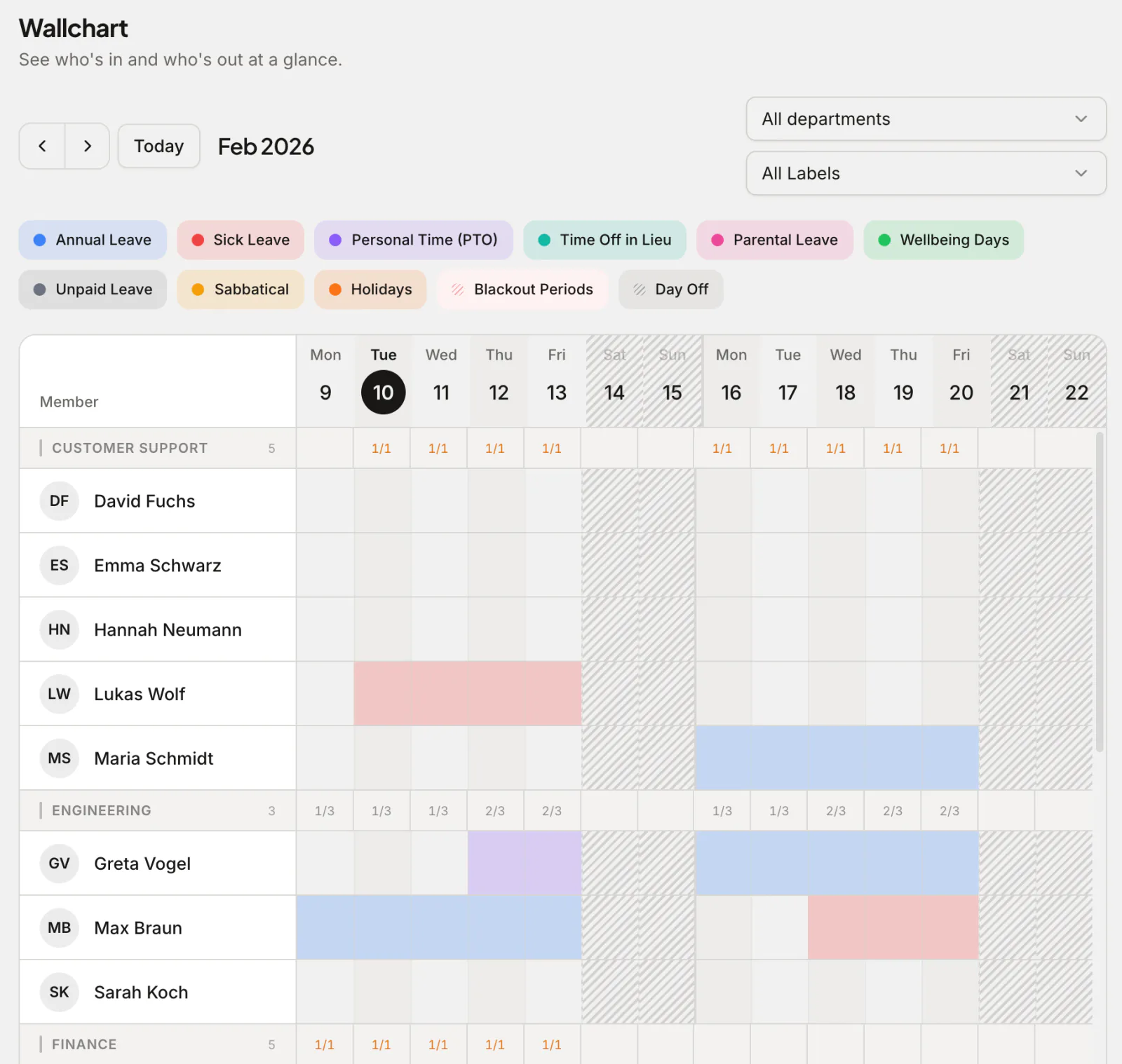
Because Italian leave mixes a statutory allowance in weeks with contractual permits in hours, a spreadsheet can make it hard to see whether everyone has taken their two weeks this year. In Absenca, each office has its own work week, public holidays and leave year. You can set up separate leave types such as Ferie and ROL, track leave in days, half-days or hours (in 15, 30 or 60-minute steps) and see balances and carry-over at a glance. The free plan covers up to 10 people. Absenca doesn't calculate pay, so indemnities for unused leave stay with payroll. See how carry-over and accrual work, browse paid leave by country, or check public holidays on the holidays page.
FAQ
How many days of holiday do you get in Italy?
By law, at least four weeks a year, which is 20 working days on a Monday-to-Friday schedule or 24 on a six-day week. Most collective agreements add paid hours on top, such as ROL and ex festività.
Do I have to take two weeks of holiday in the same year in Italy?
Yes. At least two of the four statutory weeks must be taken in the year they accrue, and they must be consecutive if you ask. The other two weeks can be taken within 18 months after the year ends, unless your CCNL says otherwise.
Can my employer pay me instead of giving me ferie?
Not for the four-week minimum while you are still employed. Article 10(2) of D.Lgs. 66/2003 only allows payment in lieu when the employment ends.
Are ROL and ex festività required by law?
No. They come from collective agreements, and the number of hours depends on your CCNL. Ex festività compensate for public holidays that Law 54/1977 abolished.
Who decides when I take my ferie?
Under article 2109 of the Civil Code, the employer sets the timing, taking account of business needs and the worker's interests, and must tell you the dates in advance.
Rules can change and CCNLs vary. Check the current text of D.Lgs. 66/2003 on Normattiva and the Ministry of Labour's guidance.