
Annual Leave in Spain: 30 Calendar Days and How Vacation Works (Art. 38 ET)
Workers in Spain get at least 30 calendar days of paid annual leave a year under article 38 of the Estatuto de los Trabajadores. Dates are agreed with the employer and known two months ahead, and leave cannot be paid out except when the job ends.
Annual leave in Spain is at least 30 calendar days (días naturales) of paid holiday a year, under article 38 of the Workers' Statute (Estatuto de los Trabajadores, ET). Employer and employee agree the dates, the employee must know them at least two months before the leave starts, and the leave cannot be swapped for money while the job continues.
That is the short answer. The rest of this guide covers how the 30 days are counted, who sets the vacation calendar, what happens when sick leave or birth leave overlaps with holiday, when unused days are paid out, and how Spain's up to 14 public holidays a year fit on top. Everything below reflects the consolidated ET on boe.es as of October 2026.
How many vacation days do you get in Spain?
Article 38.1 ET says the paid annual leave period "será el pactado en convenio colectivo o contrato individual. En ningún caso la duración será inferior a treinta días naturales." In plain English: your collective agreement (convenio colectivo) or employment contract sets the number, and it can never be less than 30 calendar days.
Because the law counts calendar days, the weekends inside a holiday block are part of the 30. A worked example, for an employee on a Monday-to-Friday week:
| Holiday block | Calendar days used | Working days off (Mon–Fri week) |
|---|---|---|
| One week, Monday to Sunday | 7 | 5 |
| Two weeks, Monday to Sunday | 14 | 10 |
| 30 days in one block, starting on a Monday | 30 | 22 |
Many collective agreements and company policies express the same entitlement in working days (días laborables) instead. Check which unit your convenio uses before you count, and remember that the agreement can improve the minimum but never go below it.
Who decides when you take your vacation in Spain?
Article 38.2 ET says the period or periods of leave are fixed "de común acuerdo entre el empresario y el trabajador", in line with whatever the collective agreement says about annual vacation planning. Neither side can impose the dates alone.
If they cannot agree, the employee can take the dispute to the social courts (jurisdicción social). The court fixes the date, the procedure is summary and given priority, and its decision cannot be appealed.
Does Spain require two months' notice of vacation dates?
Yes. Article 38.3 ET says each company sets a vacation calendar (calendario de vacaciones) and that "el trabajador conocerá las fechas que le correspondan dos meses antes, al menos, del comienzo del disfrute." So if an employee's summer holiday starts on 2 August, they should know those dates by 2 June at the latest.
For employers, the practical step is to collect requests early in the year, settle overlaps, and publish the calendar well ahead of the busy summer weeks. Our guide on how to approve leave requests fairly covers ways to settle competing requests.
Can vacation days be paid out instead of taken?
Not while the employment continues. Article 38.1 ET describes the leave as "no sustituible por compensación económica", so an employer cannot buy back the 30 days, even if the employee agrees.
The exception is when the job ends. EU Working Time Directive 2003/88/EC, as summarised by the Court of Justice of the EU, says the minimum leave "no podrá ser sustituido por una compensación financiera, salvo en caso de conclusión de la relación laboral." So days earned and not taken by the termination date are paid in the final settlement (finiquito). The Court has held that this right does not disappear even when the employment ends because the worker dies (case C-118/13, Bollacke). For how this works in other countries, see getting paid for unused holiday when you leave a job.
What happens if you are sick or on maternity leave during your vacation?
Article 38.3 ET has two rules, depending on why the employee is off.
| Situation overlapping the scheduled vacation | What the ET allows |
|---|---|
| Temporary incapacity (incapacidad temporal) caused by pregnancy, childbirth or breastfeeding | Take the vacation on other dates, after the leave ends, even if the calendar year has finished |
| Birth leave (art. 48.4), adoption, foster care or guardianship for adoption (art. 48.5), or risk during pregnancy or breastfeeding (art. 48.7) | Same rule: take the vacation after the suspension ends, even in the next year |
| Temporary incapacity for any other reason that stops the employee taking all or part of the vacation in the year | Take it once the incapacity ends, as long as no more than 18 months have passed since the end of the year the leave was earned |
Birth leave itself is long: article 48.4 ET suspends the contract of the biological mother and of the other parent for nineteen weeks. If the vacation calendar puts someone's summer holiday inside that time, the holiday moves rather than disappearing. Our guides on sickness during annual leave and maternity, paternity and parental leave cover these overlaps more generally.
How many public holidays are there in Spain?
Public holidays (fiestas laborales) are separate from the 30 days of annual leave. Article 37.2 ET says they are paid, do not have to be made up, and "no podrán exceder de catorce al año, de las cuales dos serán locales." Three layers make up that total:
| Layer | Who sets it | Notes |
|---|---|---|
| National | State | Christmas Day, New Year's Day, 1 May and 12 October must always be kept |
| Regional | Each autonomous community | Can replace some national days with its own traditional holidays |
| Local | Each municipality | Up to two days a year, published in the regional or provincial bulletin |
The 2027 list was published in the BOE on 13 October 2026 (Resolution of 8 October 2026, BOE-A-2026-21254). It lists 1 January, 26 March (Good Friday), 1 May, 12 October, 1 November, 6 December, 8 December and 25 December as national holidays that no region has replaced. Days such as 6 January, Maundy Thursday and 19 March (San José) depend on the region. For example, the communities of Andalucía, Aragón, Asturias, Canarias, Castilla y León and Madrid give the Monday 16 August off because 15 August falls on a Sunday. Check the regional and municipal bulletins for your office's two local days.
When a public holiday falls on a Sunday, article 37.2 ET moves the rest day to the following Monday. Our paid leave by country page compares Spain with other countries.
Tracking Spanish vacation in a leave tool
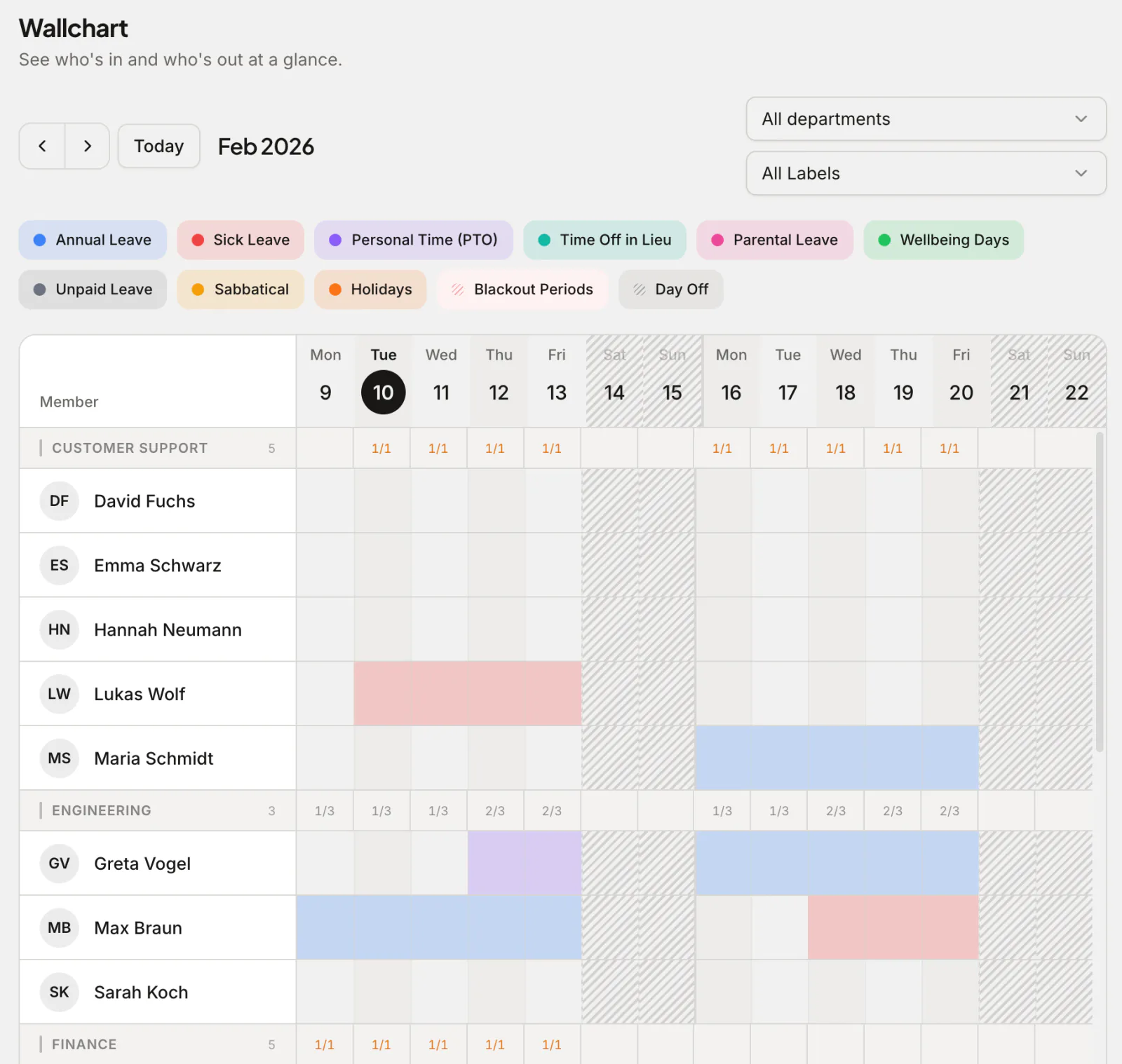
If you run a team in Spain, the hard part is usually the calendar: who is off in August, who still has days left, and which regional and local holidays apply to each office. In Absenca each office has its own work week, time zone, public holidays, leave year and leave types, so a Madrid office and a Barcelona office can each follow their own holidays. Employees request leave, managers approve it, and balances update in a shared team calendar. The Free plan covers up to 10 people in one office, with no end date. Absenca does not calculate pay, so the finiquito stays with your payroll.
FAQ
Is it 30 calendar days or 22 working days of vacation in Spain?
The law says at least 30 calendar days (art. 38.1 ET). Many collective agreements and contracts express it in working days instead. If you take 30 calendar days in one block starting on a Monday and work Monday to Friday, you are off for 22 working days.
Can my employer in Spain choose my vacation dates?
Not alone. The dates are agreed between employer and employee under article 38.2 ET, following any rules in your collective agreement. If you disagree, the social courts can fix the date.
How far in advance must I know my vacation dates in Spain?
At least two months before the vacation starts (art. 38.3 ET).
Do I lose my vacation if I am on sick leave in Spain?
No. If sick leave stops you taking it in the year, you can take it after you recover, up to 18 months after the end of the year in which it was earned. If the overlap is with pregnancy-related incapacity or birth leave, you can take it after that leave ends, even in a later year.
Are public holidays included in my 30 days of annual leave?
They are a separate entitlement: up to 14 paid public holidays a year, two of them local (art. 37.2 ET). You can calculate days off for a given period with our working days calculator.
Rules can change and collective agreements often improve on them; check the current text of the Estatuto de los Trabajadores on boe.es and your convenio colectivo.