
Can My Employer Make Me Take Holiday? Shutdowns and Enforced Leave in the UK and Ireland (2026)
Usually, yes. In the UK your employer can make you take holiday, for example during a Christmas shutdown, if it gives notice of at least twice the length of the leave or your contract says so; in Ireland the employer sets leave dates but must consult you at least a month ahead.
Yes. In the UK your employer can make you take holiday on dates it chooses, such as a Christmas shutdown, as long as it gives you notice of at least twice as many days as the leave (5 days' enforced holiday needs at least 10 days' notice) or your contract sets other rules. In Ireland the employer decides when annual leave is taken anyway, but it must consult you at least a month before and take your family responsibilities and need for rest into account.
So if your manager has announced that the office closes between Christmas and New Year and the days will come out of your allowance, that is usually lawful. What matters is how much notice you got, what your contract says, and whether you're left able to actually rest. This guide covers the rules as of October 2026.
Can my employer force me to take holiday in the UK?
Yes. Regulation 15(2) of the Working Time Regulations 1998 lets an employer give notice "requiring the worker to take leave" on particular days. Acas says an employer can make workers take holiday "when it suits the employer", for example if the organisation shuts down over Christmas, and adds that this is the case "even if in previous years the business was open over Christmas".
GOV.UK lists the same examples: an employer can tell staff to take leave for bank holidays or Christmas, or restrict leave during busy periods.
In Northern Ireland, nidirect says the same thing in plain terms: your employer "may require the whole company to take holiday during a Christmas shutdown", and has to give the same amount of notice as you do.
How much notice does my employer have to give?
At least twice as many days as the holiday it wants you to take, under regulation 15(4)(a). The notice has to state the days and reach you before that deadline.
| Enforced holiday | Minimum notice |
|---|---|
| 1 day | 2 days |
| 3 days | 6 days |
| 4 days | 8 days |
| 5 days | 10 days |
| 10 days | 20 days |
These are calendar days. GOV.UK says the worker must be told before the notice period starts, so counting one extra day is the safe reading.
A worked example: Christmas 2026
In England and Wales the bank holidays are Christmas Day (Friday 25 December), Boxing Day (substitute day Monday 28 December) and New Year's Day (Friday 1 January 2027). If your office closes from Thursday 24 December to Friday 1 January, a Monday-to-Friday worker uses 4 days of annual leave (24, 29, 30 and 31 December) on top of the 3 bank holidays, which for many workers come out of the same 5.6-week allowance. The legal minimum notice for the 4 days is 8 days, so to be safe you should be told by Tuesday 15 December. Scotland adds 2 January as a bank holiday, observed on Monday 4 January 2027.
Does my contract change the rules?
It can. Regulation 15(5) says any right or obligation in the notice rules "may be varied or excluded by a relevant agreement", which includes your contract or a collective agreement. Acas notes such an agreement "might say their employer needs to give more or less notice."
Many contracts contain a shutdown clause ("the office closes between Christmas and New Year and you must reserve 3 days of your holiday for this"). If yours does, the clause applies rather than the twice-the-length rule. Check three places:
- Your written contract or statement of terms.
- The staff handbook or holiday policy it refers to.
- Long-standing practice. nidirect points out the requirement "may be in your contract of employment, or it may be normal practice built up over time".
Can my employer make me use holiday for bank holidays?
Yes, if the bank holiday is a normal working day for you and the workplace is shut. Acas says the employer must either make this clear in the contract or give notice.
Part-time workers get one important protection: if a bank holiday falls on a day you don't normally work, Acas says "the employer cannot make them use that day as part of their holiday entitlement." For working out what you're owed in the first place, see how to calculate pro-rata holiday entitlement.
What are the limits in the UK?
Enforced holiday is still holiday, so a few things stay the same:
- It must be paid at your normal holiday rate. Acas says unpaid leave can only be imposed "if it's agreed in the contract".
- It has to give you real rest. GOV.UK says "an employer cannot force a sick worker to take leave". If you're ill during a shutdown, report it in the usual way; our guide to being sick during annual leave explains what happens to the days.
- It can't block your entitlement. Your employer can choose some dates, but GOV.UK is clear it cannot stop workers taking leave at all.
Can my employer tell me when to take annual leave in Ireland?
Yes, and more broadly than in the UK. Section 20(1) of the Organisation of Working Time Act 1997 says the times of annual leave "shall be determined by his or her employer having regard to work requirements". That's the default, not an exception, so a Christmas closure that uses annual leave is generally lawful. Three conditions apply:
- Your circumstances. The employer must take into account your need to reconcile work and family responsibilities, and your opportunities for rest and recreation (s.20(1)(a)).
- Consultation a month ahead. You, or your trade union, must be consulted "not later than 1 month" before the leave starts (s.20(1)(b)). For a closure from 24 December 2026, that means by 24 November.
- Inside the leave year. The leave must be granted within the leave year it belongs to, or with your consent within the 6 months after (s.20(1)(c)).
Two more points matter for shutdowns. If you work 8 or more months in a leave year, your leave should include an unbroken period of 2 weeks, unless an agreement says otherwise (s.19(3)). And Christmas Day, St Stephen's Day and 1 January are public holidays under the Act's Second Schedule, so they're handled separately from your annual leave. Our Ireland annual leave guide covers the entitlement itself.
UK and Ireland side by side
| Great Britain and Northern Ireland | Ireland | |
|---|---|---|
| Who picks the dates by default | You, by giving notice | Your employer |
| Can the employer impose a shutdown? | Yes | Yes |
| Notice / consultation | At least twice the length of the leave | Consultation at least 1 month before |
| Can a contract change it? | Yes, a relevant agreement can vary or exclude the notice rules | Arrangements more favourable to you are allowed (s.20(3)) |
| Main source | Working Time Regulations 1998, reg 15 | Organisation of Working Time Act 1997, s.20 |
What can I do if I disagree with enforced holiday?
Start with the facts, then talk:
- Check the notice. Count the days between being told and the first day of leave. Less than twice the length (UK) or no consultation a month ahead (Ireland), and no contract clause covering it, is a real point to raise.
- Read your contract and handbook for a shutdown or "reserved holiday" clause.
- Check your balance. If you'd already booked and used your days, ask how the shutdown will be handled before assuming the worst.
- Ask in writing for the dates, the reason and how many days will come from your allowance. If you have a booked trip at another time, say so now.
- Raise a grievance if it still looks wrong. Our post on whether your employer can refuse your holiday request sets out the escalation steps in both countries.
For managers: how do you run a shutdown fairly?
- Announce it early. The legal minimum is short, but people plan Christmas months ahead. Put shutdown days in the holiday policy, or announce them at the start of the leave year.
- Say how many days come from the allowance, and remind staff to keep those days free.
- Plan for part-timers and new starters, who may have fewer days than the shutdown needs.
- Irish employers: consult a month before each closure, and record that you did.
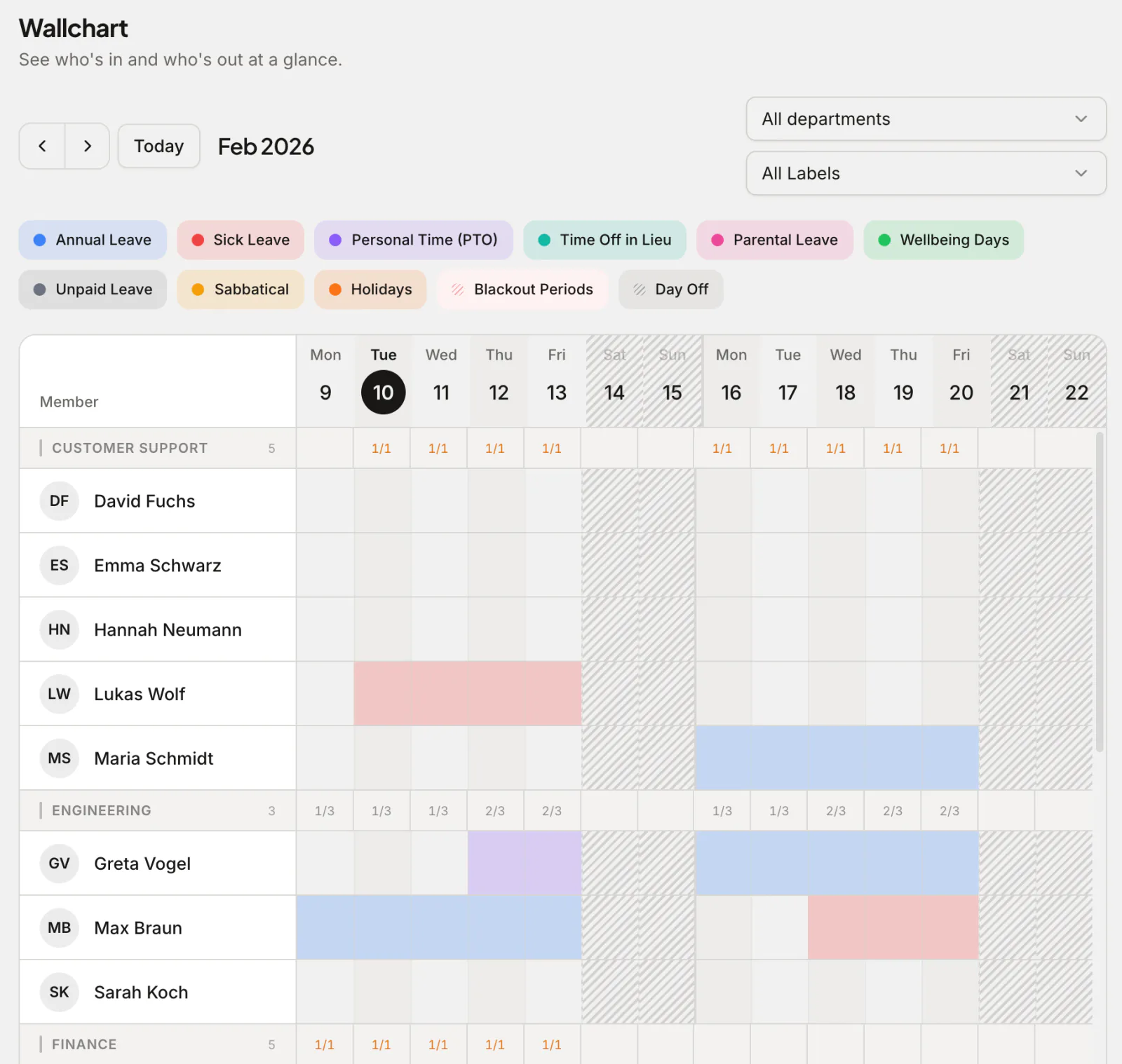
If you track leave in Absenca, the wallchart shows the whole team's leave in one view, and each person's profile shows their remaining balance, so you can spot who is short of days before the closure. The Free plan covers teams of up to 10 people.
Frequently asked questions
Can my employer make me take holiday at Christmas if we've never closed before? Yes. Acas says an employer can decide to shut over Christmas and tell workers to use holiday "even if in previous years the business was open over Christmas", as long as it gives enough notice.
Can my employer change my booked holiday to the shutdown instead? In the UK it can cancel booked leave with notice at least as long as the leave (GOV.UK advises one extra day), and require leave on other days with notice of twice the length, unless your contract says otherwise. In Ireland the employer sets the dates but must consult you a month ahead.
What if I don't have enough holiday left for the shutdown? Ask your employer how it will be handled. Unpaid leave can only be imposed if your contract allows it, according to Acas.
Can my employer make me take holiday on a day I don't work? No. If a bank holiday falls on your non-working day, Acas says your employer cannot make you use it as holiday.
This is general guidance as of October 2026. Rules vary by contract and jurisdiction, so check GOV.UK, nidirect or the Irish Statute Book for your situation.