
Paternity leave UK 2026: how many weeks, when to take it and statutory paternity pay
UK employees can take up to 2 weeks' paternity leave, as one block or two separate weeks, within 52 weeks of the birth. As of 2026 the leave is a day-one right, and statutory paternity pay is £194.32 a week or 90% of average earnings if lower, after 26 weeks' service.
In the UK, an eligible employee gets up to 2 weeks' Paternity Leave, taken as one 2-week block or as two separate 1-week blocks at any point from the birth until 52 weeks after it. As of 2026 the leave is a day-one right, while Statutory Paternity Pay (SPP) is £194.32 a week or 90% of average weekly earnings, whichever is lower, and still needs 26 weeks' service.
This guide covers the rules for England, Scotland and Wales. Northern Ireland has its own rules.
How many weeks of paternity leave do you get in the UK?
You can take up to 2 weeks. The total stays the same for twins or other multiple births. A "week" means your usual number of working days in a week, so someone who works 2 days a week gets 2 days per week of leave.
| Rule | As of 2026 |
|---|---|
| Length | Up to 2 weeks (same for multiple births) |
| How to take it | One week, two weeks together, or two separate weeks |
| Earliest start | The day of the birth (not before) |
| Latest end | 52 weeks after the birth (or the due date if the baby is early) |
| Leave eligibility | From the first day of employment |
| Pay | £194.32 a week or 90% of average weekly earnings, whichever is lower |
| Pay eligibility | 26 weeks' continuous service by the qualifying week, and average earnings of at least £129 a week |
Can paternity leave be split?
Yes. The Paternity Leave (Amendment) Regulations 2024 let employees take "two non-consecutive weeks' paternity leave", or a single period of one or two weeks. The same regulations moved the deadline from 56 days after the birth to 52 weeks after it. These changes apply where the expected week of birth begins after 6 April 2024, so they cover every birth in 2026.
So a parent could take the first week when the baby arrives and save the second for later, for example when a partner goes back to work or during a busy family stretch. Both weeks have to be used within the 52-week window, and neither can start before the birth.
Is paternity leave a day-one right now?
Yes, for the leave itself. Under the Employment Rights Act 2025, Acas says that from 6 April 2026 "paternity leave became a 'day one right', allowing someone to give notice of leave from the first day of employment."
Two other changes came in at the same time:
- Ordinary (unpaid) parental leave is now a day-one right too.
- Acas says "the restriction on taking paternity leave after shared parental leave was removed", so you can take the two in either order.
Pay hasn't changed. To get SPP you still need 26 weeks' continuous employment with your employer by the end of the qualifying week, which is the 15th week before the due date. If you joined recently, you can take the 2 weeks off, but your employer doesn't have to pay SPP for them. Check your contract, because an employer's own paternity scheme can pay more than the statutory amount, though never less.
What notice do you have to give for paternity leave?
GOV.UK sets out two notices:
- Due date, at least 15 weeks before the baby is due. You can use the online form that used to be called SC3, or your employer's own form if it has one. You don't need to give proof of the pregnancy or birth.
- Leave dates, at least 28 days before you want the leave to start. Say when it should start and whether you want 1 or 2 weeks.
You don't have to give a fixed calendar date. You can say "the day of the birth" or "one week after the birth" instead. If you want to change the start date, give 28 days' notice.
There's a temporary exception for the new day-one right. If your baby is due before 25 July 2026 and you'll have been employed for less than 26 weeks by the qualifying week, you don't need to give the 15-week notice. You still need the 28-day notice. If your baby is due on or after 26 July 2026, both notices apply as normal.
How much is statutory paternity pay in 2026?
GOV.UK says: "The statutory weekly rate of Paternity Pay is £194.32, or 90% of your average weekly earnings (whichever is lower)." It's usually paid while you're on leave, and your employer confirms the start and end dates when you claim.
Two quick examples:
- Average weekly earnings of £650: 90% is £585, which is more than £194.32, so SPP is £194.32 a week.
- Average weekly earnings of £200: 90% is £180, which is less than £194.32, so SPP is £180 a week.
To qualify for pay you must also:
- earn an average of at least £129 a week before tax
- still be employed by the same employer on the date of the birth
- give the correct notice
If your employer decides you don't qualify, it has to tell you why within 28 days, using form SPP1.
Who is eligible for paternity leave?
You must be an employee taking time off to care for the child. You also need to be one of these:
- the biological father
- the mother's or adopter's husband or partner, including a same-sex partner
- an adopter
- an intended parent in a surrogacy arrangement
Before the birth, you can also take unpaid time off to go with your partner (or the surrogate) to 2 antenatal appointments, up to 6.5 hours each. During leave your employment rights are protected, including pay rises, holiday building up and your right to return to work.
How does paternity leave fit with shared parental leave?
Shared Parental Leave (SPL) is a separate entitlement. Through SPL, parents can share up to 50 weeks of leave and up to 37 weeks of pay in the first year. As of April 2026, you can take paternity leave before or after SPL. For the full picture, see our maternity, paternity and parental leave guide. You can also read about holiday that builds up during maternity leave and the other April 2026 day-one change, statutory sick pay.
Tracking paternity leave as an employer
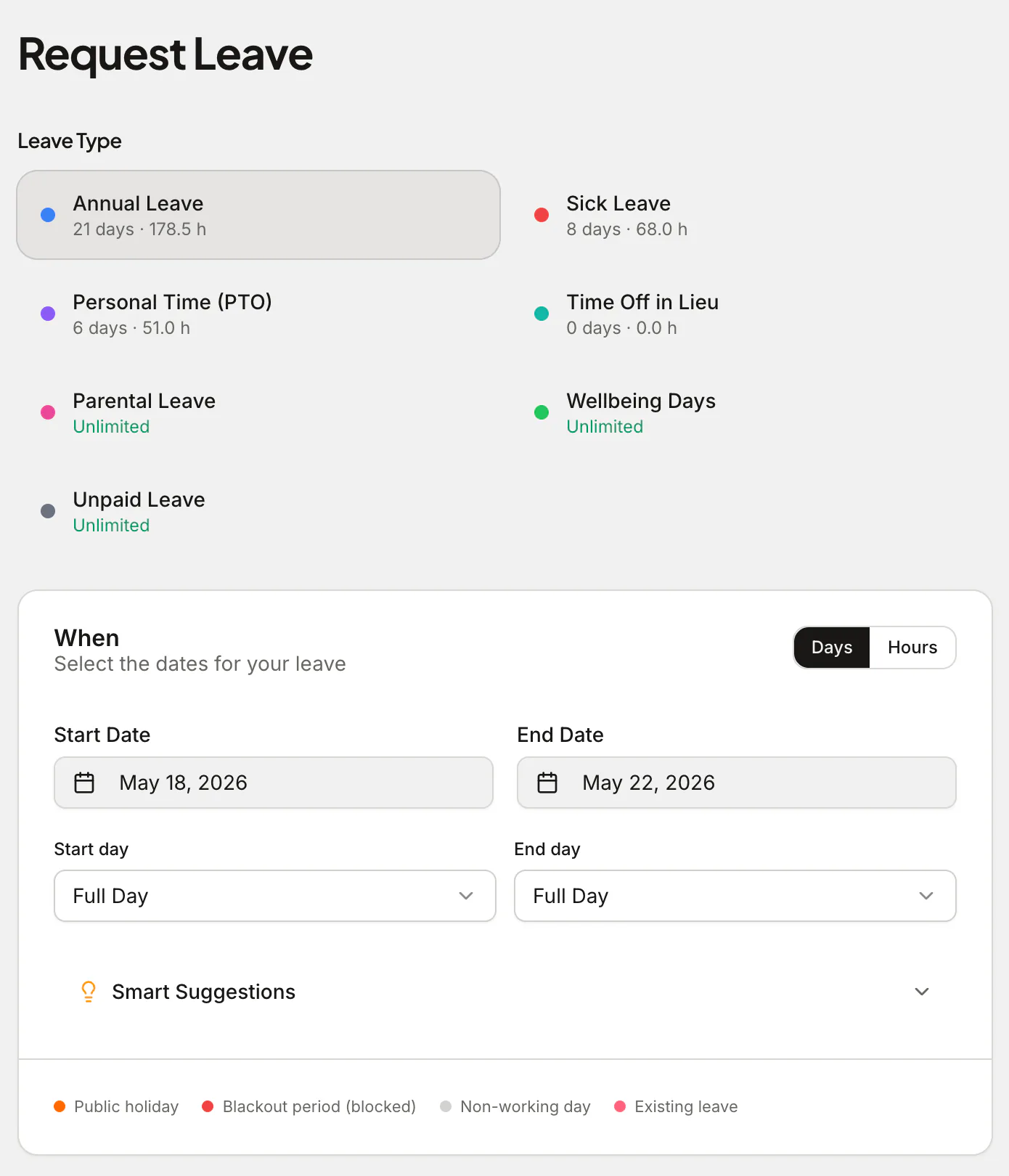
Two separate weeks are easy to lose track of, especially when the second week falls months after the birth. In Absenca, paternity leave can be its own leave type next to annual leave. Each week is a request your manager approves, and the team calendar shows who is off. Absenca doesn't calculate pay, so SPP still goes through payroll.
FAQ
Can I take paternity leave before the baby is born?
No. Paternity leave can't start before the birth. It can start on the day of the birth, or on any later date that lets you finish within 52 weeks.
I started my job last month. Can I take paternity leave?
Yes. As of 6 April 2026, paternity leave is a day-one right. Statutory Paternity Pay still needs 26 weeks' continuous service by the 15th week before the due date, so the leave may be unpaid unless your employer pays more than the statutory minimum.
Can I take the two weeks months apart?
Yes, as long as both weeks are used within 52 weeks of the birth. Give your employer at least 28 days' notice before each week starts.
Do I get more paternity leave for twins?
No. You get up to 2 weeks whether one baby or more is born.
Rules vary by circumstance and can change. Check the official source at GOV.UK before you act.