
Annual Leave in the Czech Republic: 4 Weeks (Dovolená) Counted in Hours Since 2021
Czech employees get at least 4 weeks of annual leave a year (5 in the public sector), counted in hours since 2021: 160 hours on a 40-hour week after 52 weeks worked, earned at 1/52 per week.
Annual leave in the Czech Republic (dovolená) is at least 4 weeks a year, or 5 weeks if you work for the state, a municipality or another public-sector employer. Since 1 January 2021 it is counted in hours, not days. A full-time employee on a 40-hour week who works all 52 weeks of the calendar year is entitled to 160 hours, and each full week worked earns 1/52 of the yearly total.
The rules sit in Part Nine of the Labour Code (zákoník práce, Act No. 262/2006 Coll.), §§ 211–223. The hours-based system came in with amendment No. 285/2020 Coll. Below is how it works for employers and for expats working in Czechia, as of 2026.
How many weeks of annual leave do you get in the Czech Republic?
§ 212 sets the yearly entitlement (výměra dovolené) in weeks:
| Who | Minimum annual leave | Hours on a 40-hour week |
|---|---|---|
| Private-sector employees | 4 weeks | 160 hours |
| Employees of the state, regions and municipalities, state funds and other employers listed in § 109(3) | 5 weeks | 200 hours |
| Teachers (pedagogičtí pracovníci) and university academics | 8 weeks | 320 hours |
Four weeks is a floor. A private employer can offer more, such as 5 weeks, in the contract, a collective agreement or an internal rule.
Some people get additional leave (dodatková dovolená) on top under § 215: one extra week for underground mining and tunnelling and for work the law classes as "particularly difficult".
Why is Czech holiday counted in hours?
Since 2021, leave follows the hours you actually work, not the number of shifts. Under § 213(1), an employee who has worked 52 weeks of their set weekly hours (stanovená týdenní pracovní doba) in the calendar year gets annual leave equal to weekly hours × weeks of entitlement.
The standard full-time week is 40 hours (§ 79). It is 37.5 hours for multi-shift and continuous operations and 38.75 hours for two-shift work. The formula covers all of them:
| Weekly hours | 4-week entitlement | 5-week entitlement |
|---|---|---|
| 40 | 160 hours | 200 hours |
| 38.75 | 155 hours | 193.75 → 194 hours |
| 37.5 | 150 hours | 187.5 → 188 hours |
| 20 (part-time) | 80 hours | 100 hours |
The leave earned in a year is always rounded up to whole hours (§ 216(5)). Leave is then taken by the hour, against the length of the shift you would have worked. A 12-hour shift uses 12 hours of leave; an 8-hour shift uses 8.
How do you calculate proportional leave if you joined mid-year?
If you didn't work the full 52 weeks, you get a proportional part (poměrná část dovolené). You only need at least 4 weeks of work with the same employer in the calendar year (§ 213(3)). For each full working week completed, you earn 1/52 of weekly hours × weeks of entitlement (§ 213(4)).
Example: someone on 40 hours a week and 4 weeks' leave starts on 1 July and works 26 full weeks by year end. 26 / 52 × 40 × 4 = 80 hours.
If someone works more than 52 weeks' worth of hours under their shift schedule, their leave grows by a further 1/52 for each extra week (§ 213(5)).
Does sick leave reduce annual leave?
Only beyond a cap. For leave purposes, time off sick in the same year counts as time worked, up to 20 times the weekly hours (800 hours on a 40-hour week). This only applies if the employee also worked at least 12 weeks' worth of hours outside those absences (§ 216(2)–(3)). Sickness caused by a work injury or occupational disease always counts in full.
Who decides when you take your holiday?
The employer decides when leave is taken (§ 217(1)). It must weigh its operational needs against the employee's legitimate interests. The key rules:
- 14 days' written notice. The employer must tell the employee in writing at least 14 days in advance, unless they agree on a shorter period.
- One 2-week block. If leave is split, at least one part must be 2 weeks in a row, unless the two sides agree otherwise.
- Minimum chunk. Leave is normally taken in whole shifts. With the employee's consent, the employer can exceptionally allow half a shift (§ 218(6)).
- Company-wide shutdowns. Collective leave (hromadné čerpání dovolené) needs agreement with the trade union and works council consent. It can last no more than 2 weeks, or 4 weeks for performing-arts ensembles (§ 220).
- Not during sickness or parental leave. The employer cannot schedule leave while the employee is off sick, on maternity, paternity or parental leave, or on military exercises (§ 217(4)).
Can you carry over unused leave to next year?
The default is that leave is taken in the year it is earned. The employer must schedule it that way unless obstacles on the employee's side or urgent operational reasons stop it (§ 218(1)). After that:
- Leave above 4 weeks (above 6 weeks for teachers and academics) can be carried into the next year at the employee's written request (§ 218(2)).
- Any leave carried over or left untaken must be scheduled so it is used by the end of the following calendar year (§ 218(3)).
- If the employer hasn't scheduled it by 30 June of the following year, the employee may set the dates themselves, with at least 14 days' written notice (§ 218(4)).
- If sickness, maternity or parental leave stops it being used even then, the employer must schedule it once that absence ends (§ 218(5)).
Unused leave cannot be paid out while the job continues. Pay in lieu is due only when employment ends, at average earnings (§ 222(2)–(3)). For how carry-over works in other countries, see holiday carry-over and leave accrual explained.
Do public holidays count as annual leave in Czechia?
No. If a public holiday (svátek) falls during your leave on a day you would normally work, it is not deducted from your leave (§ 219(2)). Czechia has 13 public holidays under Act No. 245/2000 Coll.:
| Date | Holiday |
|---|---|
| 1 January | Restoration Day of the Independent Czech State / New Year's Day |
| Movable | Good Friday |
| Movable | Easter Monday |
| 1 May | Labour Day |
| 8 May | Victory Day |
| 5 July | Saints Cyril and Methodius Day |
| 6 July | Jan Hus Day |
| 28 September | Czech Statehood Day |
| 28 October | Independent Czechoslovak State Day |
| 17 November | Struggle for Freedom and Democracy Day |
| 24 December | Christmas Eve |
| 25 December | Christmas Day |
| 26 December | St Stephen's Day (2nd Christmas Day) |
Falling ill on holiday also interrupts the leave (§ 219(1)), so those hours aren't used up.
Can an employer cut your leave?
Only for unexcused absence, and only by the number of hours missed (§ 223(1)). Shorter unexcused absences can be added together. An employee whose employment lasted the whole calendar year must still get at least 2 weeks of leave (§ 223(3)).
Tracking Czech leave in hours
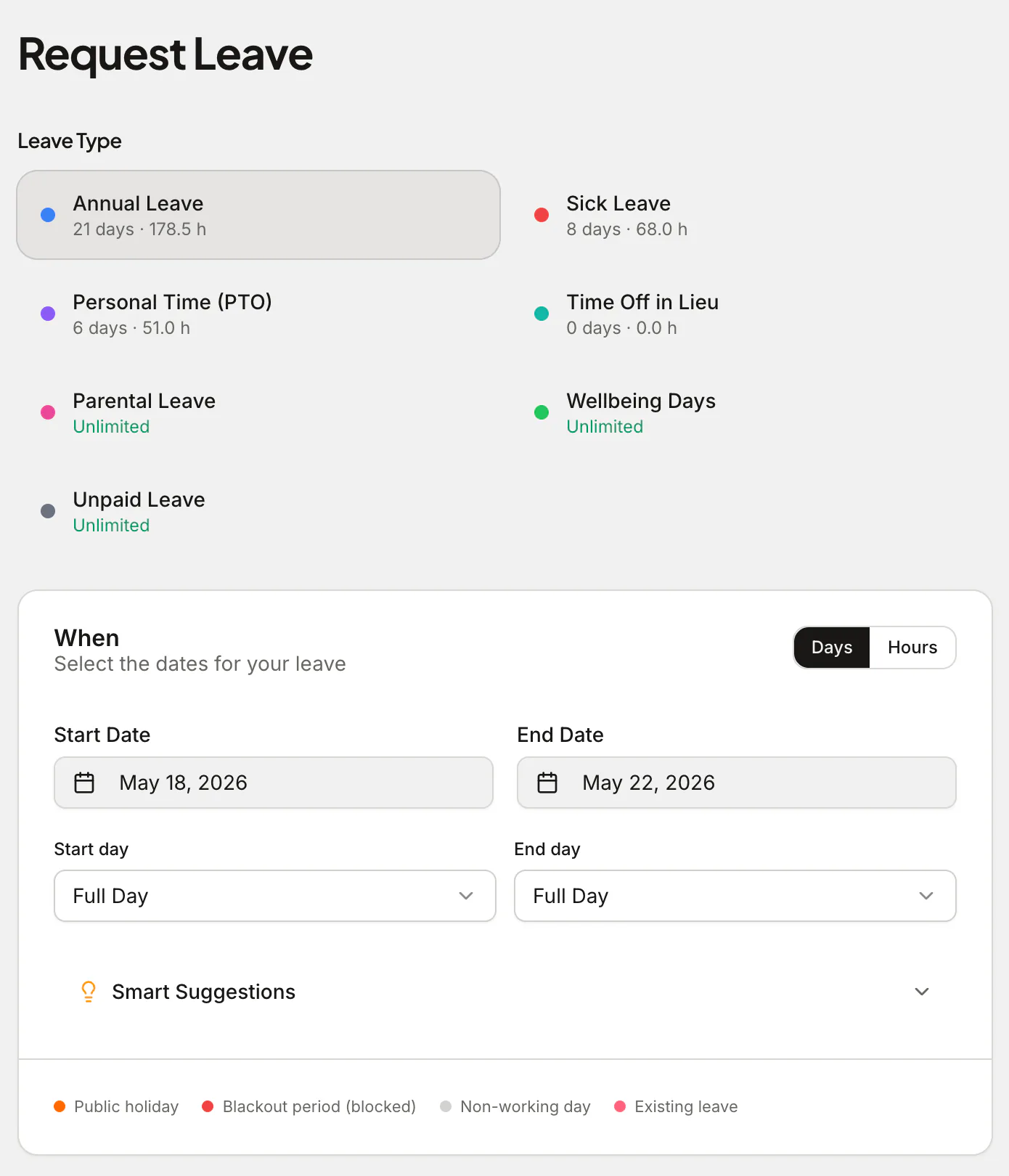
A spreadsheet that counts days doesn't fit a law that counts hours. In Absenca, leave can be tracked in hours (in 15, 30 or 60-minute steps), half-days or days. Each office gets its own work week, time zone, public holidays and leave year, so a Prague office can run on Czech rules next to teams in other countries. The free plan covers up to 10 people.
FAQ
Is annual leave in the Czech Republic 20 or 25 days? The legal minimum is 4 weeks, which is 20 working days on a five-day week or 160 hours on a 40-hour week. Public-sector employees get 5 weeks (200 hours). A private employer can agree to more by contract or collective agreement.
Can my Czech employer pay me for holiday instead of letting me take it? No. Pay in lieu of unused leave is only allowed when employment ends.
Does my employer have to give me 14 days' notice of my holiday? Yes. The employer must notify the dates in writing at least 14 days in advance, unless you agree on a shorter period.
What happens to holiday I didn't use by 31 December? It must normally be used by the end of the next calendar year. If the employer hasn't scheduled it by 30 June, you can set the dates yourself with 14 days' written notice.
For other countries, see paid leave by country or our guide to annual leave in Poland.
Rules can change and individual contracts or collective agreements may give more. Check the current Labour Code text on zakonyprolidi.cz or the Ministry of Labour and Social Affairs (MPSV).