
Employee Not Taking Holiday? What a Manager Should Do (and Why It's a Risk)
If an employee won't take their holiday, put their balance and the year-end deadline in writing, encourage them to book dates, and set dates if needed. In the UK and EU, unused leave only lapses if you can show you gave a real chance to take it.
If an employee never takes their holiday, don't just let it slide: put their remaining days and the year-end deadline in writing, ask them to book dates, and if they still don't, use your right to set some dates for them. In the UK and across the EU, unused leave only lapses if you can show you gave the person a real chance to take it, so doing nothing is both a wellbeing risk and a financial one.
Why do some employees never take their holiday?
It's rarely because they love their desk. The usual reasons:
| Reason | What it sounds like | What usually fixes it |
|---|---|---|
| No cover | "If I'm off, nobody can do payroll" | Cross-train a backup and document the work |
| Workload | "I'll go once this project ships" (it never ships) | Re-plan the deadline around the leave, not the other way round |
| Culture | "The founder never takes a day off" | Leaders taking visible leave themselves |
| Fear | "I don't want to look less committed" | Saying out loud that leave is expected, not tolerated |
| Saving it up | "I'll get paid for it when I leave" | Clear rules on what lapses and what doesn't |
| Not knowing | "I didn't realise I had 14 days left" | Regular, written balance reminders |
Ask which one applies first: a nudge fixes "not knowing", not "no cover".
Can unused holiday be lost under "use it or lose it"?
Yes, but only if the employer has done its part. In the UK, regulation 13(9) of the Working Time Regulations 1998 says the basic four weeks of leave may only be taken in the leave year it's due and can't be swapped for pay except when employment ends.
Since 1 January 2024, regulation 13(16) and 13(17) add a condition. If, in a leave year, the employer fails to:
- recognise the worker's right to annual leave and to holiday pay,
- give the worker a reasonable opportunity to take the leave, or encourage them to do so, or
- tell the worker that leave not taken by the end of the leave year, which can't be carried forward, will be lost,
then the worker can carry that untaken leave forward. Under regulation 13(18), it can keep rolling until the end of the first full leave year in which the employer does meet those duties.
For leave years starting on or after 1 April 2024, irregular-hours and part-year workers fall under separate rules (regulation 15B onwards), so check those if your team includes them.
The extra 1.6 weeks under regulation 13A (bringing the total to 5.6 weeks, capped at 28 days) works differently: it can be carried into the next year if a "relevant agreement", such as the contract, allows it.
What does EU law say about an employee who won't take leave?
The EU rule comes from the Court of Justice's November 2018 judgments in Kreuziger (C-619/16) and Max-Planck (C-684/16), interpreting Directive 2003/88/EC. According to the Court's press release:
- A worker can't automatically lose paid annual leave just because they didn't apply for it.
- The leave may lapse only if the employer actually gave the worker the opportunity to take it in good time, "in particular through the provision of adequate information", and the employer must prove it did.
- If the employer can prove the worker "deliberately and knowingly refrained" from taking leave after having that chance, EU law doesn't stop the leave, or the payment in lieu at the end of employment, being lost.
The Court also said the point of paid leave is actual rest, to protect workers' health and safety. That's why letting someone bank leave to cash it out later isn't what the law intends.
| UK | EU | |
|---|---|---|
| Source | Working Time Regulations 1998, reg. 13, 13A, 15 | Directive 2003/88/EC, art. 7, plus CJEU case law |
| Leave lapses at year end if… | You gave a reasonable opportunity, encouraged it, and warned it would be lost | You gave a real opportunity in good time, with adequate information, and can prove it |
| If you didn't | The four weeks carry forward | The leave doesn't lapse, and is paid out on leaving |
| Who has to prove it | Keep records: you'll need them | The employer, explicitly |
What are the risks of employees not taking leave?
Burnout and mistakes. Rest is the whole purpose of the right. Someone who hasn't had a real break in a year is more likely to make errors, get ill, or quietly start job-hunting. We cover the early warning signs in spotting burnout early from leave data.
A single point of failure. If one person "can't" be away, the business can't survive them being off sick either. Holiday is the safest possible test of your cover.
Hidden problems. In roles that handle money or approvals, someone who never steps away also means nobody else ever looks at their work. A week of cover is a routine, blame-free second pair of eyes.
A growing liability. If you can't show you encouraged leave and warned it would be lost, days can carry forward and end up being paid out when the person leaves. See being paid for unused holiday when leaving a job for how that works.
What should a manager do? A practical playbook
- Find out who it is, early. Look at balances by mid-year, not in the last month. Anyone with most of their allowance left after six months gets a conversation.
- Have a private chat. Ask what's stopping them. Listen for the real reason from the table above.
- Fix the blocker. Arrange cover, move a deadline, or split the leave into shorter breaks if a full fortnight feels impossible.
- Put it in writing. Send a short note: how many days are left, the date the leave year ends, that leave not taken (and not eligible for carry-over) will be lost, and that you'll help them plan it. Repeat it before the last quarter.
- Set dates if you need to. In the UK, you can tell staff to take leave on particular days. GOV.UK says the notice must be at least twice as long as the leave, so four days' leave needs at least eight days' notice. Check the contract first, as it may set its own rules.
- Keep records. Save the reminders, the conversation notes and the dates offered. If carry-over is ever disputed, that's your evidence.
- Lead by example. Book your own holiday and switch off. Teams copy what managers do, not what the handbook says.
Your annual leave policy is the place to write down how reminders, carry-over and employer-set dates work, so nobody is surprised.
How can leave data help you spot it?
You don't need to wait for someone to burn out. Three simple signals:
- Balance left vs. time elapsed in the leave year. Half the year gone, 90% of the allowance unused is a flag.
- Days since the last break of a week or more. Single days off don't give the same rest.
- Patterns by team. If a whole department is low on leave taken, it's a staffing or culture issue, not an individual one.
A shared calendar also helps: when people can see colleagues taking time off, it feels normal. More on that in why every team needs a shared leave calendar.
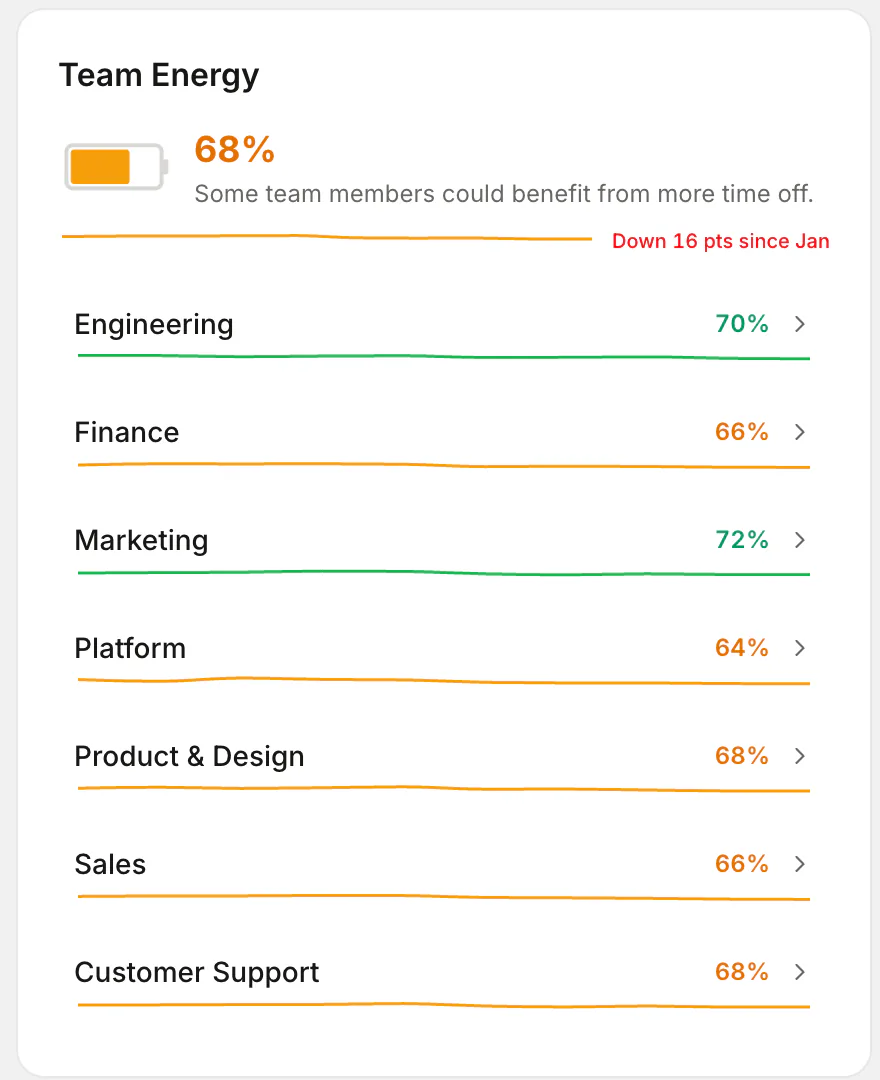
In Absenca, every balance is visible per person, and the team energy score reads work and leave patterns to show who hasn't had a break, by person and by department, so you can start that conversation in month five rather than month twelve. The month-by-month energy trend is part of the Pro plan.
FAQ
Can I force an employee to take their holiday?
In the UK, yes, within limits. You can tell a worker to take leave on set days, as long as you give notice at least twice as long as the leave. You can't force a worker who is off sick to take holiday instead.
Do I have to pay an employee for holiday they didn't take?
Not during employment: the basic four weeks can't be replaced by pay unless employment ends. But if you didn't give them the chance, encourage them and warn them it would be lost, the leave can carry forward and be paid out when they leave.
What if the employee simply refuses to take leave after I've done everything?
Under the EU case law, if you can prove the person deliberately and knowingly chose not to take leave after having a real opportunity, it can be lost. In the UK, the carry-over rule only applies when the employer failed in its duties. Your written reminders are what show you did your part.
How often should I remind staff to use their leave?
There's no fixed number in the regulations. A practical rhythm is a mid-year check and a written reminder at the start of the final quarter, plus a last one a month before the leave year ends.
Can staff carry over leave instead?
The extra 1.6 weeks in the UK can be carried over if the contract or another agreement allows it. Carrying over the basic four weeks is limited to specific cases, such as the employer not meeting its duties. See holiday carry-over and accrual explained.
This is general guidance as of 2026. Rules vary by country and contract, so check the official source (legislation.gov.uk, GOV.UK or your country's labour authority) before acting.