
Annual Leave in Switzerland: 4 or 5 Weeks, Holiday Pay and Public Holidays by Canton
Swiss law gives every employee at least 4 weeks of paid holiday a year (5 weeks under age 20), with at least 2 weeks taken together and no cash payout while employed. Only 1 August is a federal public holiday; cantons add up to 8 more.
Under Swiss law every employee gets at least four weeks of paid holiday per year of service, and employees under 20 get at least five weeks (Art. 329a of the Code of Obligations, OR/CO). At least two of those weeks must be taken together, holidays cannot be swapped for money while the job lasts, and the only public holiday set at federal level is 1 August. Each canton adds its own.
This guide covers the rules for expat employees and for foreign companies with staff in Switzerland, as of 2026. The German and French versions are written for local readers: Ferienanspruch Schweiz and Vacances en Suisse : combien de semaines ?.
How many weeks of annual leave do you get in Switzerland?
Swiss holiday law sits in Articles 329a to 329d of the Code of Obligations. The minimums are:
| Who | Minimum holiday per year of service | On a 5-day week |
|---|---|---|
| Employees aged 20 and over | 4 weeks | 20 working days |
| Employees under 20 | 5 weeks | 25 working days |
| Incomplete year of service | Pro rata to the time employed | e.g. 6 months = 2 weeks |
These are floors. Your contract, a staff handbook or a collective labour agreement (GAV/CCT) can give more, and many employers do. If you started mid-year, the entitlement is proportional to how long you were employed that year (Art. 329a para. 3). To turn a number of weeks into days for your own schedule, use the annual leave calculator.
Who decides when you take your holiday?
The employer does. Under Art. 329c para. 2, the employer sets the timing but must take the employee's wishes into account as far as that is compatible with the interests of the business. The State Secretariat for Economic Affairs (SECO) says holidays should as a rule be fixed at least three months in advance, and that employees only have to accept a short-notice move of agreed holidays in emergencies.
Two further rules from Art. 329c para. 1:
- Holidays should normally be granted during the year of service they belong to.
- At least two weeks must be taken consecutively. The rest can be split into shorter blocks.
Can your employer reduce your holiday because you were absent?
Sometimes. Art. 329b sets out when:
- Absence that is your own fault: if it adds up to more than one month in a year of service, the employer may cut holiday by one-twelfth for each full month of absence.
- Absence that is not your fault (illness, accident, legal obligations, public duties, youth leave): if the total stays within one month in the year of service, the employer may not reduce holiday at all.
- Never reduced for: pregnancy-related inability to work of up to two months, maternity leave, the other parent's leave, leave after the mother's death, carer's leave and adoption leave.
A collective or standard employment contract can set different rules only if they are, overall, at least as favourable to the employee (Art. 329b para. 4).
If you fall ill during your holiday, SECO says the days can be taken again insofar as the illness or accident defeats the purpose of rest.
Can my employer pay out vacation in Switzerland?
Not while you are employed. Art. 329d para. 2 says holidays may not be replaced by money or other benefits for the duration of the employment relationship. SECO explains why: the purpose of holidays is rest, so they have to be taken as actual time off.
Payment instead of time off is possible in certain cases only when the employment ends. Unused holiday does not vanish quickly either: SECO states that the entitlement becomes time-barred after five years, counted from the end of the year in which the holiday should have been granted.
What is holiday pay, and what is the 8.33% rule?
During holidays the employer owes the full salary attributable to that time, plus fair compensation for any lost benefits in kind (Art. 329d para. 1). On a monthly salary that simply means your pay continues.
For hourly-paid staff, Swiss payroll often adds a holiday supplement instead. The percentages come from the ratio of holiday weeks to working weeks:
| Holiday entitlement | Supplement on the hourly wage | Calculation |
|---|---|---|
| 4 weeks | 8.33% | 4 ÷ 48 |
| 5 weeks | 10.64% | 5 ÷ 47 |
Case law only tolerates this for part-time staff with irregular hours, and only when the holiday supplement is shown separately in the written contract and on every payslip, as a percentage or a franc amount. SECO is explicit that writing "holiday included in the hourly wage" is not enough, and an employer that leaves it out risks paying the holiday twice.
For full-time employees on hourly or piece-rate pay, the Federal Supreme Court ruled in 4A_357/2022 (30 January 2023) that the supplement is no longer allowed: holidays must be granted as paid days off. An employer can still calculate and show the holiday share each pay period, but pay it out only when the holiday is taken.
Which public holidays are paid in Switzerland?
Switzerland has one federal public holiday: 1 August, National Day. The Federal Constitution (Art. 110 para. 3) treats it like a Sunday for employment purposes and makes it paid. SECO notes that it is the only holiday that must be paid by law even to hourly-paid staff.
Everything else is cantonal. Under Art. 20a of the Labour Act, each canton may treat at most eight further public holidays as equal to Sundays, so the list differs between, say, Zurich, Geneva and Ticino. On those days:
| Pay type | Paid for a cantonal public holiday? |
|---|---|
| Monthly salary | Yes, pay continues for the hours lost to the holiday |
| Hourly wage | Only if the individual contract or collective agreement says so |
| Any pay type, 1 August on a working day | Yes |
There is no right to a day in lieu when a public holiday falls on a day you would not have worked anyway. Our public holidays pages list the dates by country.
Tracking Swiss leave across cantons
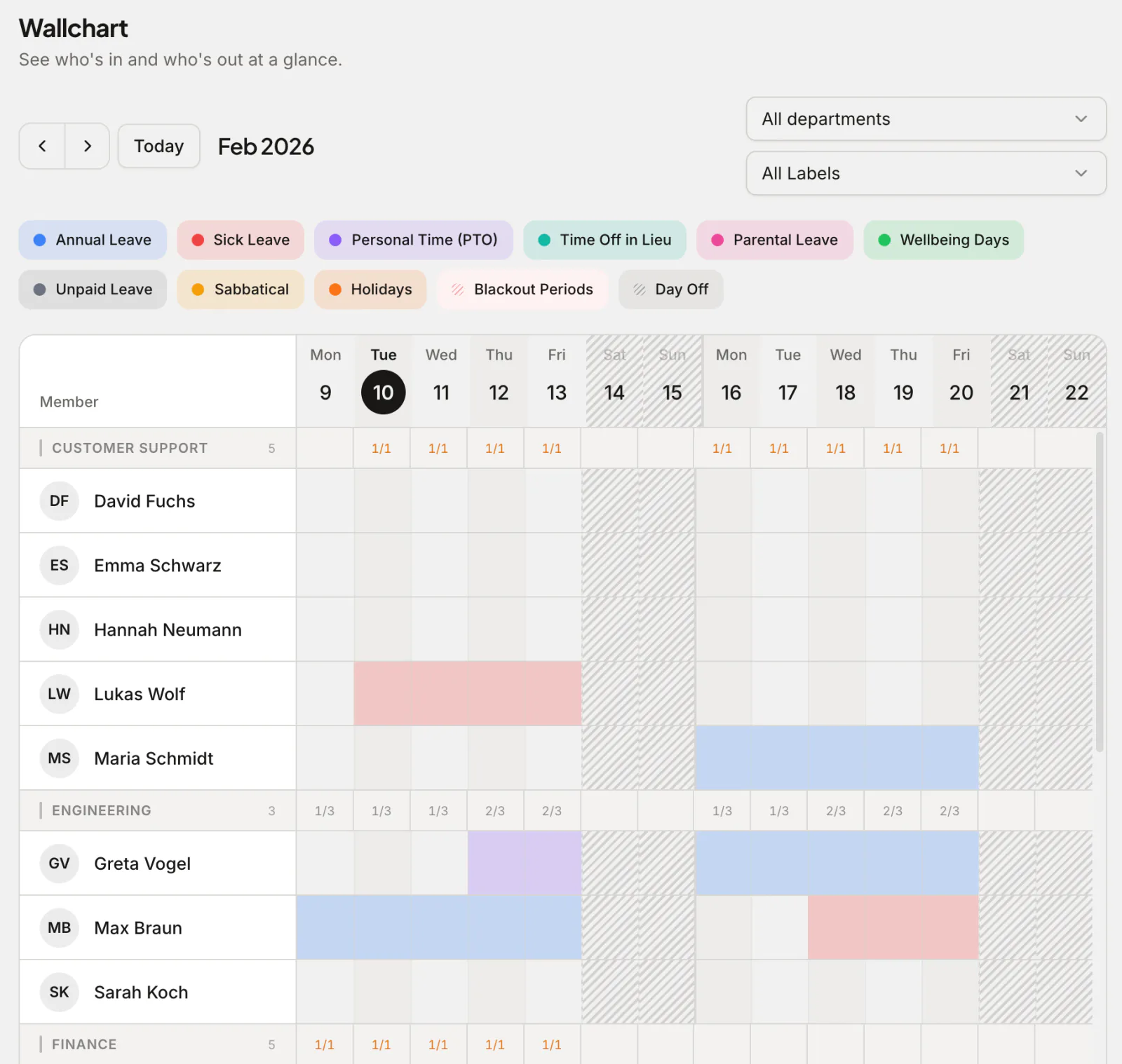
If your team spans Swiss cantons or Switzerland and another country, the hard part is keeping each group on its own holiday calendar and leave year. In Absenca, each office has its own work week, time zone, public holidays, leave year and leave types, and leave can be tracked in days, half-days or hours. The free plan covers up to 10 people in one office; Absenca does not calculate pay, so the 8.33% supplement stays in your payroll.
FAQ
Is annual leave in Switzerland 4 or 5 weeks?
The legal minimum is 4 weeks a year, and 5 weeks for employees under 20. Many contracts and collective agreements give 5 weeks or more to everyone, but the law does not require it.
Do part-time workers in Switzerland get 4 weeks of holiday?
Yes. The minimum is expressed in weeks, so a part-timer gets four weeks off from their own schedule, paid at their normal rate. Someone working three days a week gets 12 days off for four weeks.
Can I ask my employer to pay me instead of taking holiday?
No. Swiss law forbids replacing holidays with money during the employment. Only when the job ends can unused holiday be paid out in certain cases.
Do Swiss public holidays count as holiday days?
No. Public holidays are separate from the four-week minimum. Only 1 August is set nationally; the other holidays depend on the canton, and whether hourly staff are paid for them depends on the contract.
Can my employer refuse the dates I ask for?
Yes. The employer sets the timing, but has to consider your wishes as far as the business allows, and at least two weeks must be consecutive. See also can my employer refuse my holiday request, written mainly for UK readers.
Rules can change and collective agreements often go further; check the official text of the Code of Obligations on fedlex.admin.ch and SECO's guidance for your situation.