
Annual Leave in France Explained in English: Congés Payés, 2.5 Days a Month and Summer Leave
Employees in France earn 2.5 working days of paid leave (congés payés) per month, or 30 jours ouvrables (five weeks, 25 Monday-to-Friday days) a year, and must take at least 12 consecutive days between 1 May and 31 October.
Employees in France earn 2.5 working days of paid annual leave (congés payés) for every month worked, which adds up to 30 "jours ouvrables", or five weeks, over a full year. Counted the Monday-to-Friday way ("jours ouvrés"), the same five weeks come to 25 days, and at least 12 of them have to be taken as one continuous block between 1 May and 31 October.
That is the short answer. The rest of this guide explains the French terms you will meet on a payslip or in a contract, as of 2026, for expat employees and for foreign employers with staff in France.
How many days of annual leave do you get in France?
Article L3141-3 of the Code du travail sets the rule: "Le salarié a droit à un congé de deux jours et demi ouvrables par mois de travail effectif chez le même employeur", capped at 30 jours ouvrables. The official government guide puts it plainly: that "correspond à 30 jours ouvrables (5 semaines) pour une année complète de travail."
Two things often surprise people from other countries:
- There is no qualifying period. Leave starts building "dès son embauche dans l'entreprise, quelle que soit son ancienneté" (from hiring, whatever your length of service).
- Fractions are rounded up. Five months of work gives 2.5 × 5 = 12.5 days, which is rounded up to 13 jours ouvrables.
| Months worked in the reference period | Leave earned (jours ouvrables) |
|---|---|
| 1 | 2.5 |
| 5 | 13 (12.5 rounded up) |
| 12 | 30 (the cap, five weeks) |
Collective agreements (conventions collectives) or your contract can give more. They cannot give less.
Jours ouvrables vs jours ouvrés: why 30 days and 25 days are the same thing
This is the main source of confusion for anyone reading French HR documents in English.
- Jour ouvrable: every day of the week that can legally be worked, which excludes the weekly rest day (usually Sunday) and public holidays not normally worked. "On en compte 6 par semaine", so Monday to Saturday.
- Jour ouvré: the days actually worked in the company, usually Monday to Friday. "On en compte 5 par semaine."
The law counts leave in jours ouvrables, so five weeks is 5 × 6 = 30 days. Many employers count in jours ouvrés instead, so five weeks is 5 × 5 = 25 days. The employer may do this, but the method must give the employee at least as much leave as the jours ouvrables count would.
In practice, under the jours ouvrables method a week off "costs" six days because Saturday is deducted too. Service-Public gives this example for July 2026: a week off from Monday 13 to Saturday 18 July, with 14 July (a Tuesday, a public holiday the company normally takes off) not counted, uses 5 jours ouvrables. The same week counted in jours ouvrés uses 4 days. For a deeper walk-through in French, see jours ouvrables ou ouvrés: comment calculer.
What is the reference period for paid leave in France?
Leave is earned over a "période de référence". By default it runs from 1 June of the previous year to 31 May of the current year, although a collective agreement can set different dates.
If you join a French company mid-year or employ your first French hire, check which period the applicable agreement uses before setting up balances.
When do you have to take your summer leave (congé principal)?
French leave is built around the summer. Under the default rules in article L3141-23, the continuous block of at least 12 jours ouvrables is taken "pendant la période du 1er mai au 31 octobre". The government guide says the employee must take at least 12 jours ouvrables (two weeks) in that window, and "Ce congé doit être pris en continu."
There is also a ceiling: "Le salarié ne peut pas poser plus de 24 jours ouvrables de congés consécutifs (soit 4 semaines)." Article L3141-17 allows individual exceptions for employees with particular geographic constraints or who live with a disabled child or adult, or an elderly person losing autonomy. So the fifth week is normally taken separately.
The employer sets the order of departures. Each employee must be told the order and their departure date "au moins 1 mois à l'avance". More on this in French: ordre des départs en congés: qui décide.
What are fractionnement days?
If part of the main leave (the first 24 days) is taken outside 1 May to 31 October, the employee can earn extra days under the default rules:
| Main-leave days taken between 1 November and 30 April | Extra days (jours de fractionnement) |
|---|---|
| 3 to 5 | 1 jour ouvrable |
| 6 or more | 2 jours ouvrables |
The fifth week does not count: days beyond 24 jours ouvrables are excluded from the calculation. Article L3141-23 also says the default rules can be set aside with the employee's individual agreement, and a company or branch agreement can set its own rules. Full details in French: fractionnement des congés payés.
Do you earn annual leave while off sick in France?
Yes, since 2024. Law no. 2024-364 of 22 April 2024 added article L3141-5-1 to the Code du travail. During sick leave for a non-work-related illness, an employee earns paid leave "dans la limite de 2 jours ouvrables par mois (soit 24 jours ouvrables par an)". That is four weeks a year rather than the five earned while working.
The rule also applied back to 1 December 2009 for past periods, within the same 24-day cap per reference period, and claims for those past days had to be made within two years of the law taking effect. Read the French guide: arrêt maladie et congés payés: la loi d'avril 2024.
Are RTT days the same as annual leave?
No. RTT (réduction du temps de travail) days are a separate scheme that gives "journées ou des demi-journées de repos" to employees whose working week is above 35 hours. They are not a legal right on their own: "Le bénéfice des jours de RTT est fixé par une convention collective ou par un accord d'entreprise." An employee working 35 hours a week gets no RTT. Someone actually working 39 hours gets 4 hours of RTT a week, half a day. See RTT: c'est quoi for the French explanation.
Tracking French leave alongside other countries
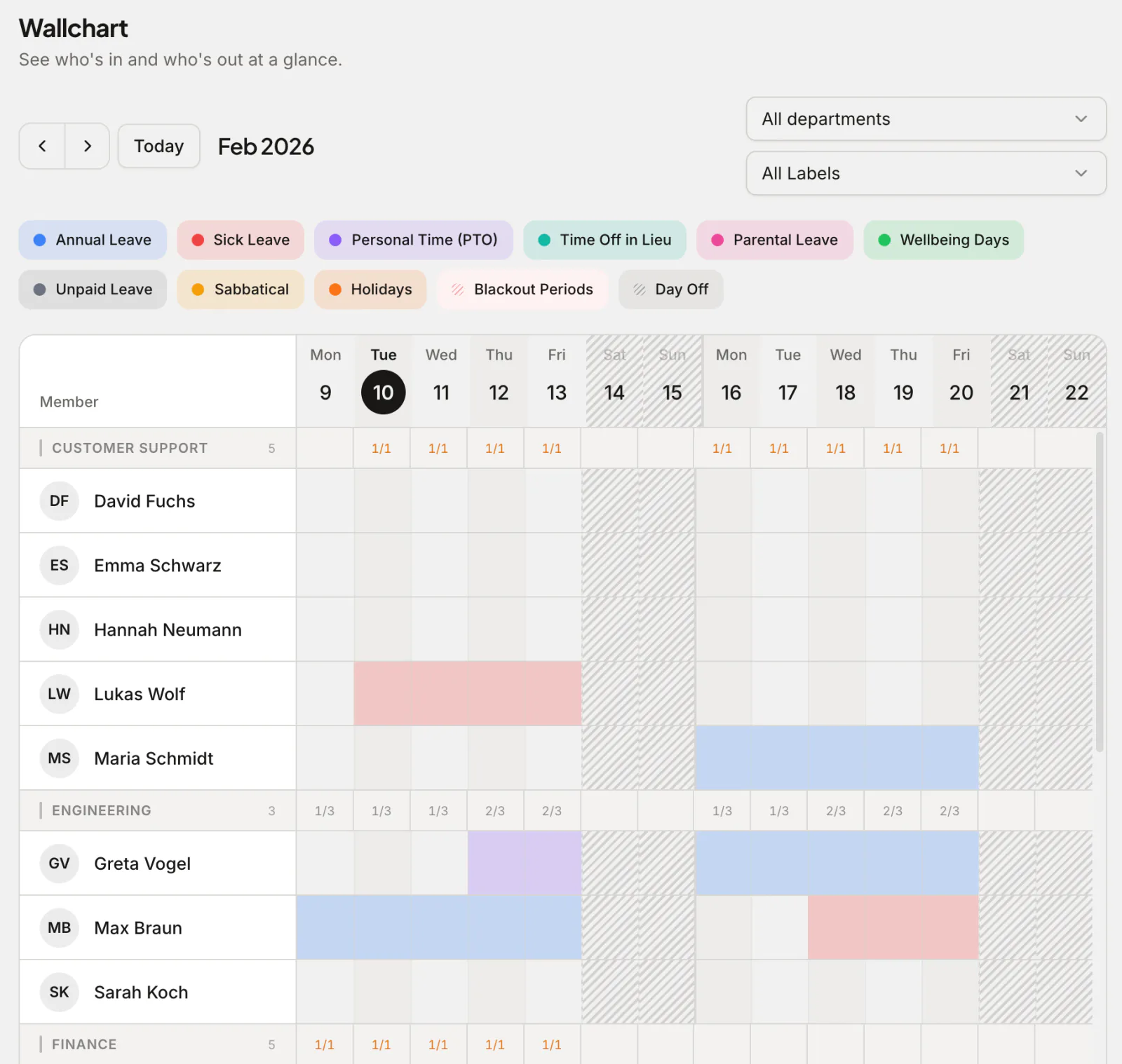
If your French staff sit next to colleagues in the UK, US or elsewhere, the hard part is keeping different rules apart. In Absenca, each office has its own work week, public holidays, leave year and leave types, so a Paris office can run a June-to-May leave year while another office uses January. Leave can be tracked in days or half-days. The free plan covers up to 10 people. Absenca tracks balances and approvals; it does not calculate pay.
For other countries, see our overview of paid leave by country.
FAQ
Is it 25 or 30 days of annual leave in France?
Both. The law says 30 jours ouvrables (Monday to Saturday). Counted in jours ouvrés (Monday to Friday), that is 25 days. Either way it is five weeks.
Do I get paid leave in my first year in France?
Yes. You earn 2.5 jours ouvrables for each month worked from your first day, with no minimum length of service.
Can I take all five weeks in one go in summer?
Not by default. You cannot take more than 24 jours ouvrables (four weeks) in a row, unless an individual exception for geographic constraints or caring for a disabled or dependent relative applies.
Do I lose holiday days if I am sick in France?
You keep accruing, but at 2 jours ouvrables per month of non-work-related sick leave, up to 24 per year, rather than 2.5.
Does a public holiday count as a leave day in France?
A public holiday the company normally takes off is not deducted from your leave. Details in French: jour férié pendant les congés payés.
Rules can change and collective agreements often give more; check the official source (Service-Public.gouv.fr or the Code du travail) for your situation.